


JEE Mains · Physics · STD 11 - Gravitation
- JEE Mains 2026
- Medium
- MCQ
A planet \((P_1)\) is moving around the star of mass \(2M\) in the orbit of radius \(R\). Another planet \((P_2)\) is moving around another star of mass \(4M\) in a orbit of radius \(2R\). Ratio of time periods of revolution of \(P_2\) and \(P_1\) is _______.
Pick an option to check your answer.
Answer & Solution
Correct Answer
(B) \(2\)
Step-by-step Solution
Detailed explanation
Using Kepler's third law, the time period of revolution of a planet is given by \(T = 2\pi \sqrt{\dfrac{r^3}{GM_s}}\).
For planet \(P_1\), the orbital radius is \(r = R\) and the mass of the star is \(M_s = 2M\):
\(T_1 = 2\pi \sqrt{\dfrac{R^3}{G(2M)}}\)
For planet \(P_2\), the orbital radius is \(r = 2R\) and the mass of the star is \(M_s = 4M\):
\(T_2 = 2\pi \sqrt{\dfrac{(2R)^3}{G(4M)}} = 2\pi \sqrt{\dfrac{8R^3}{4GM}} = 2\pi \sqrt{\dfrac{2R^3}{GM}}\)
Taking the ratio of \(T_2\) and \(T_1\):
\(\dfrac{T_2}{T_1} = \dfrac{\sqrt{\dfrac{2R^3}{GM}}}{\sqrt{\dfrac{R^3}{2GM}}} = \sqrt{2 \times 2} = 2\)
Answer: \(2\)
More questions from Physics
- A new unit \((\alpha)\) of length is chosen such that it is equal to the speed of light in vacuum. What is the distance between Venus and Earth in terms of \(\alpha\) units if light takes \(6\) min. \(40\) s to cover this distance?JEE Mains 2026 Easy
- A regular hexagon is formed by six wires each of resistance \(r \Omega\) and the corners are joined to centre by wires of same resistance. If the current enters at one corner and leaves at the opposite corner, the equivalent resistance of the hexagon between the two opposite corners will beJEE Mains 2026 Easy
- A force \(\mathrm{F}=\alpha+\beta \mathrm{x}^2\) acts on an object in the x -direction. The work done by the force is 5 J when the object is displaced by 1 m . If the constant \(\alpha=1 \mathrm{~N}\) then \(\beta\) will be ________.JEE Mains 2025 Easy
- A \(2\, W\) carbon resistor is color coded with green, black, red and brown respectively. The maximum current which can be passed through this resistor is .............. \(mA\)JEE Mains 2019 Medium
- A slab of dielectric constant \(K\) has the same crosssectional area as the plates of a parallel plate capacitor and thickness \(\frac{3}{4}\,d\), where \(d\) is the separation of the plates. The capacitance of the capacitor when the slab is inserted between the plates will be.(Given \(C _{0}=\) capacitance of capacitor with air as medium between plates.)JEE Mains 2022 Hard
- Two cars \(P\) and \(Q\) are moving on a road in the same direction. Acceleration of car \(P\) increases linearly with time whereas car \(Q\) moves with a constant acceleration. Both cars cross each other at time \(t=0\), for the first time. The maximum possible number of crossing(s) (including the crossing at \(t=0)\) is ________.JEE Mains 2025 Medium
More PYQs from JEE Mains
- At a certain place the angle of dip is \(30^{\circ}\) and the horizontal component of earth's magnetic field is \(0.5 G\). The earth's total magnetic field (in \(G\) ), at that certain place, is ................JEE Mains 2022 Easy
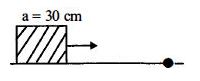
- A cubical block of side \(30\,cm\) is moving with velocity \(2\,\,ms^{-1}\) on a smooth horizontal surface. The surface has a bump at a point \(O\) as shown in figure. The angular velocity (in rad/s) of the block immediately after it hits the bump, is
 JEE Mains 2016 Hard