


JEE Mains · Physics · STD 11 - 4.1 newtons laws of motion
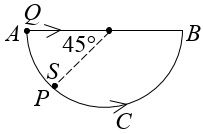
A bead \(P\) sliding on a frictionless semi-circular string \((A C B)\) and it is at point \(S\) at \(t =0\) and at this instant the horizontal component of its velocity is \(v\). Another bead \(Q\) of the same mass as \(P\) is ejected from point \(A\) at \(t =0\) along the horizontal string \(A B\), with the speed \(v\), friction between the beads and the respective strings may be neglected in both cases. Let \(t_p\) and \(t_Q\) be the respective times taken by beads \(P\) and \(Q\) to reach the point \(B\), then the relation between \(t_p\) and \(t_Q\) is
- A \(t_{P}>t_{Q}\)
- B \(t_{p} < t_{Q}\)
- C \(t_{p}>1.25t_{Q}\)
- D \(t_{p}=t_{Q}\)
Answer & Solution
Correct Answer
(B) \(t_{p} < t_{Q}\)
Step-by-step Solution
Detailed explanation
Horizontal displacement of Q is more than P. \(X_{Q}>X_{p}\) Horizontal component of velocity is same So \(t _{ p }=\frac{ x _{ p }}{ v }\) \(t_Q=\frac{x_Q}{v}\) \(t_{p} < t_{Q}\)
See the Complete Solution
Get step-by-step explanations for this and 2.5 Lakh+ more JEE, NEET & CET questions.
- Unlock all solutions
- Practice the full chapter
- Track accuracy across PYQs
4.8 rated on Google Play · 14,000+ reviews
More questions from Physics
- Number of molecules in a volume of \(4\, cm ^{3}\) of a perfect monoatomic gas at some temperature \(T\) and at a pressure of \(2\, cm\) of mercury is close to \(?\) (Given, mean kinetic energy of a molecule (at \(T\) ) is \(4 \times 10^{-14}\) erg, \(g=980\, cm / s ^{2}\), density of mercury \(=13.6\, g / cm ^{3}\))JEE Mains 2020 Medium
- In an experiment a convex lens of focal length \(15\, cm\) is placed coaxially on an optical bench in front of a convex mirror at a distance of \(5\,cm\) from it. It is found that an object and its image coincide, if the object is placed at a distance of \(20\,cm\) from the lens. The focal length of the convex mirror is.......\(cm\)JEE Mains 2017 Hard
- In Young's double slit experiment, light from two identical sources are superimposing on a screen. The path difference between the two lights reaching at a point on the screen is \(\frac{7 \lambda}{4}\). The ratio of intensity of fringe at this point with respect to the maximum intensity of the fringe is _______.JEE Mains 2024 Hard
-
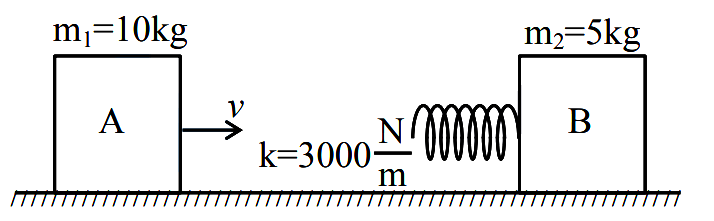
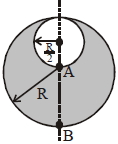
Consider two blocks A and B of masses \(m_1=10 \mathrm{~kg}\) and \(m_2=5 \mathrm{~kg}\) that are placed on a frictionless table. The block A moves with a constant speed \(v=3 \mathrm{~m} / \mathrm{s}\) towards the block B kept at rest. A spring with spring constant \(\mathrm{k}=3000 \mathrm{~N} / \mathrm{m}\) is attached with the block B as shown in the figure. After the collision, suppose that the blocks A and B, along with the spring in constant compression state, move together, then the compression in the spring is _______. (Neglect the mass of the spring)JEE Mains 2025 Medium - Consider a sphere of radius \(\mathrm{R}\) which carries a uniform charge density \(\rho .\) If a sphere of radius \(\frac{\mathrm{R}}{2}\) is carved out of it, as shown, the ratio \(\frac{\left|\overrightarrow{\mathrm{E}}_{\mathrm{A}}\right|}{\left|\overrightarrow{\mathrm{E}}_{\mathrm{B}}\right|}\) of magnitude of electric field \(\overrightarrow{\mathrm{E}}_{\mathrm{A}}\) and \(\overrightarrow{\mathrm{E}}_{\mathrm{B}}\) respectively, at points \(\mathrm{A}\) and \(\mathrm{B}\) due to the remaining portion is
 JEE Mains 2020 Hard
 - A telescope has an objective lens of focal length \(150\,\,cm\) and an eyepiece of focal length \(5 \,\,cm.\) If a \(50\,\,m\) tall tower at a distance of \(1\,\,km\) is observed through this telescope in normal setting, the angle formed by the image of the tower is \(\theta \), then \(\theta \) is close to.....\(^o\)JEE Mains 2015 Hard
More PYQs from JEE Mains
- A string is clamed at both the ends and it is vibrating in its \(4^{th}\) harmonic. The equation of the stationary wave is \(Y =0.3\,sin\,(0.157\,x) \,cos\,(200\pi t)\). The length of the string is ..... \(m\) (all quantities are in \(SI\) units)JEE Mains 2019 Easy
- The minimum value of \(f ( x )= a ^{ a ^{ x }}+ a ^{1- a ^{ x }},\) where \(a, x \in R\) and \(a > 0\), is equal to ..... .JEE Mains 2021 Medium
- Let \(\mathrm{A}=\{1,2,3,4\}\) and \(\mathrm{R}=\{(1,2),(2,3),(1,4)\}\) be a relation on \(\mathrm{A}\). Let \(\mathrm{S}\) be the equivalence relation on \(A\) such that \(\mathrm{R} \subset \mathrm{S}\) and the number of elements in \(\mathrm{S}\) is \(\mathrm{n}\). Then, the minimum value of \(\mathrm{n}\) is ...........JEE Mains 2024 Easy
- In a Vernier Calipers. \(10\) divisions of Vernier scale is equal to the \(9\) divisions of main scale. When both jaws of Vernier calipers touch each other, the zero of the Vernier scale is shifted to the left of \(zero\) of the main scale and \(4^{\text {th }}\) Vernier scale division exactly coincides with the main scale reading. One main scale division is equal to \(1\,mm\). While measuring diameter of a spherical body, the body is held between two jaws. It is now observed that zero of the Vernier scale lies between \(30\) and \(31\) divisions of main scale reading and \(6^{\text {th }}\) Vernier scale division exactly. coincides with the main scale reading. The diameter of the spherical body will be \(.......cm\)JEE Mains 2022 Hard
- Two cylindrical vessels of equal cross-sectional area \(16\,cm ^{2}\) contain water upto herghts \(100\,cm\) and \(150\,cm\) respectively. The vessels are interconnected so that the water levels in them become equal. The work done by the force of gravity during the process, is \(......J\) [Take density of water \(=10^{3}\,kg / m ^{3}\) and \(g =10\,ms ^{-2}\) ]JEE Mains 2022 Hard
-
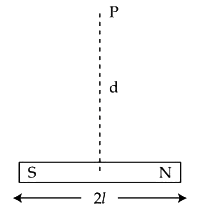
A bar magnet has total length \(2 l=20\) units and the field point \(P\) is at a distance \(\mathrm{d}=10\) units from the centre of the magnet. If the relative uncertainty of length measurement is \(1 \%\), then uncertainty of the magnetic field at point P is :JEE Mains 2025 Hard