


JEE Mains · Physics · STD 11 - Newtons laws of motion
- JEE Mains 2026
- Hard
- MCQ
Two blocks (\(P\) and \(Q\)) with respectively masses \(2\) kg and \(1.5\) kg are joined by a massless thread. These blocks are mounted on a frictionless pulley which is fixed on the edge of a cube (\(S\)), as shown in the figure below. Block \(P\) is positioned on the top surface which has no friction and block \(Q\) is in contact with side-surface, having coefficient friction \(\mu\). The cube (\(S\)) moves towards the right with acceleration of \(\dfrac{g}{2}\), where \(g\) is gravitational acceleration. During this movement the block \(P\) and \(Q\) remain stationary. The value of \(\mu\) is _______. (take \(g = 10\) m/s\(^2\))

Pick an option to check your answer.
Answer & Solution
Correct Answer
(B) \(0.67\)
Step-by-step Solution
Detailed explanation
Let us analyze the forces acting on blocks \(P\) and \(Q\) in the non-inertial frame of reference of the cube \(S\), which is moving to the right with an acceleration \(a = \dfrac{g}{2} = 5 \text{ m/s}^2\).
In this frame, a pseudo force acts on both blocks towards the left.
For block \(P\) (mass \(m_P = 2 \text{ kg}\)):
The forces in the horizontal direction are the tension \(T\) in the string (acting towards the right) and the pseudo force \(F_{pP}\) (acting towards the left). Since block \(P\) is stationary relative to the cube and there is no friction on the top surface:
\(T = m_P a = 2 \times 5 = 10 \text{ N}\)
For block \(Q\) (mass \(m_Q = 1.5 \text{ kg}\)):
The horizontal forces are the normal reaction \(N\) from the side surface of the cube (acting towards the right) and the pseudo force \(F_{pQ}\) (acting towards the left). Since block \(Q\) is stationary horizontally relative to the cube:
\(N = m_Q a = 1.5 \times 5 = 7.5 \text{ N}\)
The vertical forces acting on block \(Q\) are the downward gravitational force \(m_Q g\), the upward tension \(T\), and the frictional force \(f\).
The downward force is \(m_Q g = 1.5 \times 10 = 15 \text{ N}\).
Since \(m_Q g > T\) (\(15 \text{ N} > 10 \text{ N}\)), the block has a tendency to slide downwards, so the static friction \(f\) must act upwards.
For vertical equilibrium of block \(Q\):
\(T + f = m_Q g\)
\(10 + f = 15 \Rightarrow f = 5 \text{ N}\)
To keep the block stationary, the required friction must be less than or equal to the maximum static friction (\(f \le \mu N\)). Assuming the limiting case to find the value of \(\mu\):
\(\mu N = f\)
\(\mu (7.5) = 5\)
\(\mu = \dfrac{5}{7.5} = \dfrac{2}{3} \approx 0.67\)
Answer: \(0.67\)
More questions from Physics
- A ceiling fan having 3 blades of length \(80 \mathrm{~cm}\) each is rotating with an angular velocity of \(1200\ \mathrm{rpm}\). The magnetic field of earth in that region is \(0.5 \ \mathrm{G}\) and angle of dip is \(30^{\circ}\). The emf induced across the blades is \(N \pi \times 10^{-5} \mathrm{~V}\). The value of \(\mathrm{N}\) is _______.JEE Mains 2024 Hard
- With reference to the observations in photo-electric effect, identify the correct statements from below: \(A.\) The square of maximum velocity of photoelectrons varies linearly with frequency of incident light. \(B.\) The value of saturation current increases on moving the source of light away from the metal surface. \(C.\) The maximum kinetic energy of photo-electrons decreases on decreasing the power of LED (light emitting diode) source of light. \(D.\) The immediate emission of photo-electrons out of metal surface can not be explained by particle nature of light/electromagnetic waves. \(E.\) Existence of threshold wavelength can not be explained by wave nature of light/electromagnetic waves. Choose the correct answer from the options given below:JEE Mains 2022 Hard
- A block of mass \(40 \,kg\) slides over a surface, when a mass of \(4 \,kg\) is suspended through an inextensible massless string passing over frictionless pulley as shown below. The coefficient of kinetic friction between the surface and block is \(0.02\). The acceleration of block is ............ \(ms ^{-2}\) (Given \(g =10 \,ms ^{-2}\).)
 JEE Mains 2022 Medium
- A solid sphere and a hollow sphere of the same mass and of same radius are rolled on an inclined plane. Let the time taken to reach the bottom by the solid sphere and the hollow sphere be \(t_1\) and \(t_2\), respectively, then...JEE Mains 2025 Easy
- A satellite is launched into a circular orbit of radius ' R ' around the earth. A second satellite is launched into an orbit of radius 1.03 R . The time period of revolution of the second satellite is larger than the first one approximately byJEE Mains 2025 Medium
- A cylindrical vessel of \(40\) cm radius is completely filled with water and its capacity is \(528\) dm\(^3\) (dm : decimeter). The vessel is placed on a solid block of exactly same height as vessel. If a small hole is made at \(70\) cm below the top of water level, then horizontal range of water falling on the ground in the beginning is __________ cm.JEE Mains 2026 Hard
More PYQs from JEE Mains
- If the initial velocity in horizontal direction of a projectile is unit vector \(\hat{i}\) and the equation of trajectory is \(y =5 x (1- x )\). The \(y\) component vector of the initial velocity is. (Take \(g=10\,m / s ^{2}\) )JEE Mains 2022 Medium
- An atom absorbs a photon of wavelength \(500\,nm\) and emits another photon of wavelength \(600\,nm\). The net energy absorbed by the atom in this process is \(n \times 10^{-4}\,eV\). The value of \(n\) is ............ [Assume the atom to be stationary during the absorption and emission process] \(\left(\right.\)Take \(h =6.6 \times 10^{-34}\,Js\) and \(\left.c =3 \times 10^8\,m / s \right)\)JEE Mains 2023 Medium
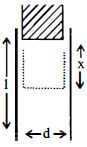
- A parallel plate capacitor is made of two plates of length \(l\), width \(w\) and separated by distance \(d\). A dielectric slab ( dielectric constant \(K\)) that fits exactly between the plates is held near the edge of the plates. It is pulled into the capacitor by a force \(F = -\frac{{\partial U}}{{\partial x}}\) where \(U\) is the energy of the capacitor when dielectric is inside the capacitor up to distance \(x\) (See figure). If the charge on the capacitor is \(Q\) then the force on the dielectric when it is near the edge is
 JEE Mains 2014 Hard
- The centre of mass of a solid hemisphere of radius \(8\, cm\) is \(X \,cm\) from the centre of the flat surface. Then value of \(x\) is\(......\)JEE Mains 2020 Medium
- A mercury drop of radius \(10^{-3}\,m\) is broken into \(125\) equal size droplets. Surface tension of mercury is \(0.45\,Nm ^{-1}\). The gain in surface energy is \(......\times 10^{-5}\,J\)JEE Mains 2023 Medium