


JEE Mains · Physics · STD 11 - Fluid mechanics
- JEE Mains 2026
- Hard
- MCQ
If an air bubble of diameter \(2\) mm rises steadily through a liquid of density \(2000\) kg/m\(^3\) at a rate of \(0.5\) cm/s, then the coefficient of viscosity of liquid is _______ Poise. (Take \(g = 10\) m/s\(^2\))
Pick an option to check your answer.
Answer & Solution
Correct Answer
(B) \(8.8\)
Step-by-step Solution
Detailed explanation
The terminal velocity of an air bubble rising in a liquid is given by Stokes' law:
\(v = \dfrac{2}{9} \dfrac{r^2 \rho g}{\eta}\)
Where:
\(r = \dfrac{D}{2} = 1 \text{ mm} = 10^{-3} \text{ m}\)
\(\rho = 2000 \text{ kg/m}^3\)
\(g = 10 \text{ m/s}^2\)
\(v = 0.5 \text{ cm/s} = 5 \times 10^{-3} \text{ m/s}\)
Rearranging the formula for the coefficient of viscosity \(\eta\):
\(\eta = \dfrac{2}{9} \dfrac{r^2 \rho g}{v}\)
Substituting the given values:
\(\eta = \dfrac{2}{9} \times \dfrac{(10^{-3})^2 \times 2000 \times 10}{5 \times 10^{-3}}\)
\(\eta = \dfrac{2}{9} \times \dfrac{10^{-6} \times 20000}{5 \times 10^{-3}}\)
\(\eta = \dfrac{2}{9} \times \dfrac{2 \times 10^{-2}}{5 \times 10^{-3}}\)
\(\eta = \dfrac{2}{9} \times 4 = \dfrac{8}{9} \text{ Pa}\cdot\text{s}\)
To convert the viscosity from SI units (Pa\(\cdot\)s) to CGS units (Poise), we multiply by \(10\):
\(\eta = \dfrac{8}{9} \times 10 = \dfrac{80}{9} \text{ Poise}\)
\(\eta \approx 8.88 \text{ Poise}\)
The closest given option is \(8.8\).
Answer: \(8.8\)
More questions from Physics
- A sample of a liquid is kept at 1 atm. It is compressed to 5 atm which leads to change of volume of \(0.8 \mathrm{~cm}^3\). If the bulk modulus of the liquid is 2 GPa , the initial volume of the liquid was _______ litre. \(\left(\right.\) Take \(\left.1 \mathrm{~atm}=10^5 \mathrm{~Pa}\right)\)JEE Mains 2025 Medium
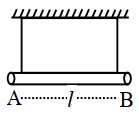
- A uniform rod of mass m and length \(l\) suspended by means of two identical inextensible light strings as shown in figure. Tension in one string immediately after the other string is cut, is _________.(g acceleration due to gravity)
 JEE Mains 2026 Easy
- An electromagnetic wave of frequency \(1\times10^{14}\, hertz\) is propagating along \(z-\) axis. The amplitude of electric field is \(4\, V/m\) . lf \({\varepsilon_0}=\, 8.8\times10^{-12}\, C^2/Nm^2\) , then average energy density of electric field will be:JEE Mains 2014 Medium
- Given below are two statements : Statement \(I:\) If the Brewster's angle for the light propagating from air to glass is \(\theta_{ B }\), then Brewster's angle for the light propagating from glass to air is \(\frac{\pi}{2}-\theta_B\). Statement \(II:\) The Brewster's angle for the light propagating from glass to air is \(\tan ^{-1}\left(\mu_{ g }\right)\) where \(\mu_{ g }\) is the refractive index of glass. In the light of the above statements, choose the correct answer from the options given below :JEE Mains 2023 Medium
- A sphere of capacitance \(100\) pF is charged to a potential of \(100\) V. Another identical uncharged metal sphere is brought in contact with the charged sphere, then the change in the total energy stored on these spheres, when they touch is \(\alpha \times 10^{-7}\) J. The value of \(\alpha\) is __________. (combined capacitance of spheres is \(200\) pF)JEE Mains 2026 Hard
- A rubber ball is released from a height of \(5\, m\) above the floor. It bounces back repeatedly, always rising to \(\frac{81}{100}\) of the height through which it falls. Find the average speed of the ball. (Take \(g =10 ms ^{-2}\) ) (in \(ms ^{-1}\))JEE Mains 2021 Hard
More PYQs from JEE Mains
- A screw gauge with a pitch of \(0.5 \ mm\) and a circular scale with \(50\) divisions is used to measure the thickness of a thin sheet of Aluminium. Before starting the measurement, it is found that wen the two jaws of the screw gauge are brought in contact, the \(45^{th} \)division coincides with the main scale line and the zero of the main scale is barely visible. What is the thickness of the sheet (in \(mm\)) if the main scale reading is \(0.5\ mm\) and the \(25^{th}\) division coincides with the main scale lineJEE Mains 2016 Medium
- A spaceship orbits around a planet at a height of \(20\,km\) from its surface. Assuming that only gravitational field of the plant acts on the spaceship. What will be the number of complete revolutions made by the spaceship in \(24\,hours\) around the plane? [Given: Mass of plane \(= 8 \times 10^{22}\,kg,\) Radius of planet \(= 2\times 10^6\,m,\) Gravitational constant \(G = 6.67\times 10^{-11}\,Mn^2/kg^2\) ]JEE Mains 2019 Hard
- Water from a tap emerges vertically downwards with an initial speed of \(1.0\,ms^{-1}.\) The cross-sectional area of the tap is \(10^{-4}\,m^2.\) Assume that the pressure is constant throughout the stream of water and that flow is streamlined. The cross-sectional area of the stream, \(0.15\,m\) below the tap would be: (take \(g = 10\,ms^{-2}\) )JEE Mains 2019 Medium