


JEE Mains · Physics · STD 12 -Alternating current
- JEE Mains 2026
- Easy
- Numerical
A series LCR circuit with \(R = 20\ \Omega\), \(L = 1.6\text{ H}\) and \(C = 40\ \mu\text{F}\) is connected to a variable frequency a.c. source. The inductive reactance at resonant frequency is _______ \(\Omega\).
Pick an option to check your answer.
Answer & Solution
Correct Answer
(D) 200
Step-by-step Solution
Detailed explanation
Given \(L = 1.6\text{ H}\) and \(C = 40\ \mu\text{F} = 40 \times 10^{-6}\text{ F}\).
At resonance, the angular frequency is \(\omega_r = \dfrac{1}{\sqrt{LC}}\).
The inductive reactance at resonance is \(X_L = \omega_r L = \dfrac{L}{\sqrt{LC}} = \sqrt{\dfrac{L}{C}}\).
Substituting the given values:
\(X_L = \sqrt{\dfrac{1.6}{40 \times 10^{-6}}}\)
\(X_L = \sqrt{\dfrac{1.6}{4 \times 10^{-5}}}\)
\(X_L = \sqrt{4 \times 10^4}\)
\(X_L = 200\ \Omega\)
Answer: \(200\)
More questions from Physics
- A projectile is given an initial velocity of \((\hat i + 2\hat j)\ ms^{-1}\), where \(\hat i\) is along the ground and \(\hat j\) is along the vertical. If \(g = 10\ m/s^2\) , the equation of its trajectory isJEE Mains 2013 Medium
- To increase the resonant frequency in series \(LCR\) circuit,JEE Mains 2022 Medium
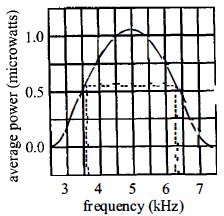
- The plot given below is of the average power delivered to an \(LRC\) circuit versus frequency. The quality factor of the circuit is
 JEE Mains 2013 Medium
- A parallel plate capacitor consisting of two circular plates of radius 10 cm is being charged by a constant current of 0.15 A . If the rate of change of potential difference between the plates is \(7 \times 10^8 \mathrm{~V} / \mathrm{s}\) then the integer value of the distance between the parallel plates is \(\left(\right.\) Take, \(\left.\epsilon_0=9 \times 10^{-12} \frac{\mathrm{~F}}{\mathrm{~m}}, \pi=\frac{22}{7}\right)\) ________ \(\mu \mathrm{m}\).JEE Mains 2025 Medium
- Equation of travelling wave on a stretched string of linear density \(5\,g/m\) is \(y = 0.03\,sin\,(450\,t -9x)\) where distance and time are measured in \(SI\) united. The tension in the string is ... \(N\)JEE Mains 2019 Medium
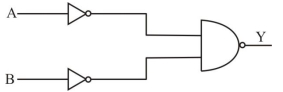
- Identify the logic operation performed by the given circuit.
 JEE Mains 2024 Hard
More PYQs from JEE Mains
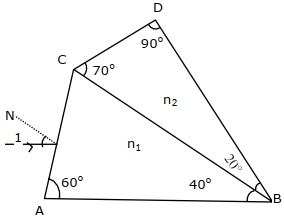
- A prism of refractive index \(n_{1}\) and another prism of refractive index \(n_{2}\) are stuck together (as shown in the figure). \(n_{1}\) and \(n_{2}\) depend on \(\lambda\), the wavelength of light, according to the relation \({n}_{1}=1.2+\frac{10.8 \times 10^{-14}}{\lambda^{2}} \text { and } {n}_{2}=1.45+\frac{1.8 \times 10^{-14}}{\lambda^{2}}\) The wavelength for which rays incident at any angle on the interface \(B C\) pass through without bending at that interface will be \(....\,nm.\)
 JEE Mains 2021 Hard
- The temperature dependence of resistances of \(Cu\) and undoped \(Si\) in the temperature range \(300-400\;K\), is best described byJEE Mains 2016 Easy
- \(200\,g\) water is heated from \(40\,^oC\) to \(60\,^oC.\) Ignoring the slight expansion of water, the change in its internal energy is close to ...... \(kJ\) (Given specific heat of water \(=4184\,J/kgK\) )JEE Mains 2016 Medium
- To find the focal length of a convex mirror, a student records the following data
The focal length of the convex lens is \(f_1\) and that of mirror is \(f_2\). Then taking index correction to be negligibly small, \(f_1\) and \(f_2\) are close toObject Pin Convex Lens Convex Mirror Image Pin \(22.2\,cm\) \(32.2\,cm\) \(45.8\,cm\) \(71.2\,cm\) JEE Mains 2016 Hard - A compressive force, \(F\) is applied at the two ends of a long thin steel rod. It is heated, simultaneously, such that its temperature increases by \(\Delta T\). The net change in its length is zero. Let \(l\) be the length of the rod, \(A\) its area of cross- section, \(Y\) its Young's modulus, and \(\alpha \) its coefficient of linear expansion. Then, \(F\) is equal toJEE Mains 2017 Medium