


JEE Mains · Physics · STD 11 - System of particles and rotational motion
- JEE Mains 2026
- Hard
- MCQ
A thin uniform rod \(( X )\) of mass M and length L is pivoted at a height \(\left(\frac{ L }{3}\right)\) as shown in the figure. The rod is allowed to fall from a vertical position and lie horizontally on the table. The angular velocity of this rod when it hits the table top, is _________ . (g = gravitational acceleration)

Pick an option to check your answer.
Answer & Solution
Correct Answer
(D) \(\sqrt{\frac{3g}{L}}\)
Step-by-step Solution
Detailed explanation
Explanation:
To find the correct angular velocity of the rod when it hits the table top, we apply the law of conservation of mechanical energy step-by-step:
1. Determine the Center of Mass (CM) Position:
The center of mass of a thin uniform rod of length \( L \) lies at its geometric center, which is at a distance of \( \frac{L}{2} \) from either end.
According to the figure, the pivot is located at a distance of \( \frac{L}{3} \) from the bottom end. Therefore, the distance (\( d \)) between the pivot and the center of mass is:
\( d = \frac{L}{2} - \frac{L}{3} = \frac{L}{6} \)
2. Calculate the Moment of Inertia (\( I \)) about the Pivot:
Using the parallel axis theorem (\( I = I_{\text{cm}} + Md^2 \)):
\( I = \frac{1}{12}ML^2 + M\left(\frac{L}{6}\right)^2 \)
\( I = \frac{1}{12}ML^2 + \frac{1}{36}ML^2 = \frac{3 + 1}{36}ML^2 = \frac{4}{36}ML^2 = \frac{1}{9}ML^2 \)
3. Calculate the Loss in Potential Energy (\( \Delta \text{PE} \)):
- In the initial vertical position, the center of mass is located at a height of \( \frac{L}{6} \) directly above the pivot point (table level).
- In the final horizontal position, the entire rod lies flat on the table, meaning its center of mass drops down to the exact level of the pivot.
Thus, the net vertical displacement of the center of mass is \( \Delta h = \frac{L}{6} \), giving a potential energy loss of:
\( \Delta \text{PE} = Mg\Delta h = Mg\left(\frac{L}{6}\right) \)
4. Apply Conservation of Energy:
The loss in potential energy is fully converted into rotational kinetic energy (\( \frac{1}{2}I\omega^2 \)):
\( \frac{1}{2}I\omega^2 = \Delta \text{PE} \)
\( \frac{1}{2}\left(\frac{1}{9}ML^2\right)\omega^2 = Mg\left(\frac{L}{6}\right) \)
\( \frac{1}{18}ML^2\omega^2 = \frac{1}{6}MgL \)
Simplifying the equation to solve for \( \omega \):
\( \omega^2 = \frac{18}{6}\frac{g}{L} = \frac{3g}{L} \)
\( \omega = \sqrt{\frac{3g}{L}} \)
The mathematical derivation confirms that the provided answer key is completely accurate.
Hence, Option D is the correct choice.
More questions from Physics
- A physical quantity \(Q\) is found to depend on quantities \(a, b, c\) by the relation \(Q=\frac{a^4 b^3}{c^2}\). The percentage error in \(a\), \(b\) and \(c\) are \(3 \%, 4 \%\) and \(5 \%\) respectively. Then, the percentage error in \(\mathrm{Q}\) is _______.JEE Mains 2024 Hard
- In materials like aluminium and copper, the correct order of magnitude of various elastic modulii isJEE Mains 2014 Medium
- In a Young's double slit experiment, the intensity at some point on the screen is found to be \(\dfrac{3}{4}\) times of the maximum of the interference pattern. The path difference between the interfering waves at this point is \(\dfrac{\lambda}{x}\) where \(\lambda\) is wavelength of the incident light. The value of \(x\) is _______.JEE Mains 2026 Medium
- The total current supplied to the circuit as shown in figure by the \(5 V\) battery is \(A\)
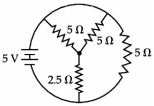 JEE Mains 2022 Medium
- Given figure shows few data points in a photo electric effect experiment for a certain metal. The minimum energy for ejection of electron from its surfface is\(.......eV\) (Plancks constant \(\left. h =6.62 \times 10^{-34}\, J . s \right)\)
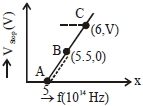 JEE Mains 2020 Medium
- The velocity of sound in a gas. in which two wavelengths \(4.08\,m\) and \(4.16\,m\) produce \(40\) beats in \(12\,s\), will be ..............\(ms ^{-1}\)JEE Mains 2022 Easy
More PYQs from JEE Mains
- A child stands on the edge of the cliff \(10\,m\) above the ground and throws a stone horizontally with an initial speed of \(5\,ms ^{-1}\). Neglecting the air resistance, the speed with which the stone hits the ground will be \(..........ms ^{-1}\) (given, \(g =10\,ms ^{-2}\))JEE Mains 2023 Medium
- An aluminium and steel rods having same lengths and cross-sections are joined to make total length of 120 cm at \(30^{\circ} C\). The coefficient of linear expansion of aluminium and steel are \(24 \times 10^{-6} /{ }^{\circ} C\) and \(1.2 \times 10^{-5} /{ }^{\circ} C\), respectively. The length of this composite rod when its temperature is raised to \(100^{\circ} C\), is _________ cm .JEE Mains 2026 Medium