


JEE Mains · Physics · STD 12 -Alternating current
- JEE Mains 2026
- Hard
- MCQ
The figure given below shows an \(LCR\) series circuit with two switches \(S_1\) and \(S_2\). When switch \(S_1\) is closed keeping \(S_2\) open, the phase difference \((\phi)\) between the current and source voltage is \(30°\) and phase difference is \(60°\) when \(S_2\) is closed keeping \(S_1\) open. The value of \((3L_1 - L_2)\) is _______ H.

Pick an option to check your answer.
Answer & Solution
Correct Answer
(B) \(\dfrac{2}{9}\)
Step-by-step Solution
Detailed explanation
From the source \(v = V_0 \sin(300t)\), the angular frequency is \(\omega = 300\text{ rad/s}\).
Capacitance \(C = 100\ \mu\text{F} = 10^{-4}\text{ F}\), so \(X_C = \dfrac{1}{\omega C}\).
Case 1 (\(S_1\) closed, \(S_2\) open):
Closing \(S_1\) short-circuits \(L_2\), leaving an LCR series circuit with \(C\), \(R\) and \(L_1\). With phase difference \(\phi_1 = 30^\circ\):
\(\tan 30^\circ = \dfrac{\omega L_1 - X_C}{R}\)
\(\dfrac{1}{\sqrt{3}} = \dfrac{\omega L_1 - X_C}{R} \Rightarrow R = \sqrt{3}\,(\omega L_1 - X_C)\) ... (1)
Case 2 (\(S_2\) closed, \(S_1\) open):
Closing \(S_2\) short-circuits \(L_1\), leaving an LCR series circuit with \(C\), \(R\) and \(L_2\). With phase difference \(\phi_2 = 60^\circ\):
\(\tan 60^\circ = \dfrac{\omega L_2 - X_C}{R}\)
\(\sqrt{3} = \dfrac{\omega L_2 - X_C}{R} \Rightarrow \omega L_2 - X_C = R\sqrt{3}\) ... (2)
Substituting \(R\) from (1) into (2):
\(\omega L_2 - X_C = \sqrt{3}\,(\omega L_1 - X_C) \cdot \sqrt{3}\)
\(\omega L_2 - X_C = 3\omega L_1 - 3X_C\)
\(2X_C = 3\omega L_1 - \omega L_2 = \omega(3L_1 - L_2)\)
Therefore:
\(3L_1 - L_2 = \dfrac{2X_C}{\omega} = \dfrac{2}{\omega^2 C}\)
Substituting \(\omega = 300\text{ rad/s}\) and \(C = 10^{-4}\text{ F}\):
\(\omega^2 C = (300)^2 \cdot 10^{-4} = 9 \times 10^4 \cdot 10^{-4} = 9\)
\(3L_1 - L_2 = \dfrac{2}{9}\text{ H}\)
Hence, the correct option is \((2)\ \dfrac{2}{9}\).
More questions from Physics
- A ceiling fan having 3 blades of length \(80 \mathrm{~cm}\) each is rotating with an angular velocity of \(1200\ \mathrm{rpm}\). The magnetic field of earth in that region is \(0.5 \ \mathrm{G}\) and angle of dip is \(30^{\circ}\). The emf induced across the blades is \(N \pi \times 10^{-5} \mathrm{~V}\). The value of \(\mathrm{N}\) is _______.JEE Mains 2024 Hard
- A \(0.5 \,kg\) block moving at a speed of \(12 \,ms ^{-1}\) compresses a spring through a distance \(30\, cm\) when its speed is halved. The spring constant of the spring will be \(Nm ^{-1}\).JEE Mains 2022 Medium
- Six point charges are kept \( 60^{\circ} \) apart from each other on the circumference of a circle of radius R as shown in figure. The net electric field at the centre of the circle is __________ .
(\( \epsilon \) is permittivity of free space)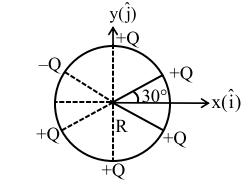 JEE Mains 2026 Hard
- A cubical block of side \(0.5\,m\) floats on water with \(30\%\) of its volume under water. ....... \(kg\) is the maximum weight that can be put on the block without fully submerging it under water ? [Take density of water \(= 10^3\,kg/m^3\) ]JEE Mains 2019 Hard
- A body is dropped on ground from a height \(h_1\) and after hitting the ground, it rebounds to a height \(h _2\) If the ratio of velocities of the body just before and after hitting ground is \(4\), then percentage loss in kinetic energy of the body is \(\frac{x}{4}\). The value of \(x\) is \(.......\)JEE Mains 2023 Hard
- Find out the surface charge density at the intersection of point \(x =3\, m\) plane and \(x\) -axis, in the region of uniform line charge of \(8\, nC / m\) lying along the \(z\) -axis in free space.JEE Mains 2021 Hard
More PYQs from JEE Mains
- Two radioactive elements \(A\) and \(B\) initially have same number of atoms. The half life of \(A\) is same as the average life of \(B\). If \(\lambda_A\) and \(\lambda_B\) are decay constants of \(A\) and \(B\) respectively, then choose the correct relation from the given options.JEE Mains 2023 Easy
- Given below are two statements : one is labelled as Assertion \(A\) and the other is labelled as Reason \(R\). Assertion \(A\): A bar magnet dropped through a metallic cylindrical pipe takes more time to come down compared to a non-magnetic bar with same geometry and mass. Reason \(R\): For the magnetic bar, Eddy currents are produced in the metallic pipe which oppose the motion of the magnetic bar. In the light of the above statements, choose the correct answer from the options given belowJEE Mains 2023 Medium
- The typical output characteristics curve for a transistor working in the common-emitter configuration is shown in the figure. The estimated current gain from the figure is
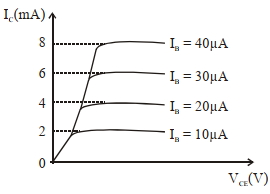 JEE Mains 2021 Medium
- A block of mass \(m = 10\,kg\) rests on a horizontal table. The coefficient of friction between the block and the table is \(0.05.\) When hit by a bullet of mass \(50\,g\) moving with speed \(v,\) that gets embedded in it, the block moves and comes to stop after moving a distance of \(2\,m\) on the table. If a freely falling object were to acquire speed \(\frac {v}{10}\) after being dropped from height \(H,\) then neglecting energy losses and taking \(g = 10\,ms^{-2},\) the value of \(H\) is close to ................. \(\mathrm{km}\)JEE Mains 2015 Hard
- A long cylindrical vessel is half filled with a liquid. When the vessel is rotated about its own vertical axis, the liquid rises up near the wall. If the radius of vessel is \(5\,cm\) and its rotational speed is \(2\) rotations per second, then the difference in the heights between the centre and the sides, in \(cm,\) will beJEE Mains 2019 Medium