


JEE Mains · Physics · STD 12 - 4. Moving charges and magnetism
A teacher in his physics laboratory allotted an experiment to determine the resistance \((G)\) of a galvanometer. Students took the observations for \(\frac{1}{3}\) deflection in the galvanometer. Which of the below is true for measuring value of \(G\) \(?\)
- A \(\frac{1}{3}\) deflection method cannot be used for determining the resistance of the galvanometer.
- B \(\frac{1}{3}\) deflection method can be used and in this case the \(G\) equals to twice the value of shunt resistance\((s).\)
- C \(\frac{1}{3}\) deflection method can be used and in this case, the \(G\) equals to three times the value of shunt resistance\((s)\)
- D \(\frac{1}{3}\) deflection method can be used and in this case the \(G\) value equals to the shunt resistance\((s).\)
Answer & Solution
Correct Answer
(B) \(\frac{1}{3}\) deflection method can be used and in this case the \(G\) equals to twice the value of shunt resistance\((s).\)
Step-by-step Solution
Detailed explanation
\(\Rightarrow\left( I - I _{ g }\right) S = I _{ g } G\) \(\frac{I_{g}}{I}=\frac{S}{S+G}\) \(\Rightarrow \frac{1}{3}=\frac{S}{S+G} \Rightarrow S+G=3 S \Rightarrow G=2 S\)
See the Complete Solution
Get step-by-step explanations for this and 2.5 Lakh+ more JEE, NEET & CET questions.
- Unlock all solutions
- Practice the full chapter
- Track accuracy across PYQs
4.8 rated on Google Play · 14,000+ reviews
More questions from Physics
- Identify the correct statements from the following descriptions of various properties of electromagnetic waves. \(A\). In a plane electromagnetic wave electric field and magnetic field must be perpendicular to each other and direction of propagation of wave should be along electric field or magnetic field. \(B.\) The energy in electromagnetic wave is divided equally between electric and magnetic fields. \(C.\) Both electric field and magnetic field are parallel to each other and perpendicular to the direction of propagation of wave. \(D.\) The electric field, magnetic field and direction of propagation of wave must be perpendicular to each other. \(E.\) The ratio of amplitude of magnetic field to the amplitude of electric field is equal to speed of light. Choose the most appropriate answer from the options given below:JEE Mains 2022 Medium
- A physical quantity \(y\) is represented by the formula \(y=m^{2}\, r^{-4}\, g^{x}\,l^{-\frac{3}{2}}\). If the percentage error found in \(y, m, r, l\) and \(g\) are \(18,1,0.5,4\) and \(p\) respectively, then find the value of \(x\) and \(p\).JEE Mains 2021 Medium
- In the experiment to determine the galvanometer resistance by half-deflection method, the plot of \(\frac{1}{\theta}\) vs the resistance \((R)\) of the resistance box is shown in the figure. The figure of merit of the galvanometer is _______ \(\times 10^{-1} \mathrm{~A} /\) division. [The source has emf 2V]
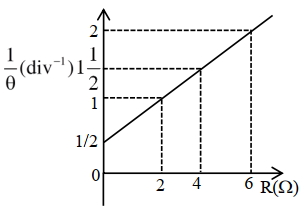 JEE Mains 2024 Hard
 - Identify the pair of physical quantities which have different dimensionsJEE Mains 2022 Medium
- A copper rod of cross-sectional area \(A\) carries a uniform current \(I\) through it. At temperature \(T\), if the volume charge density of the rod is \(\rho \), how long will the charges take to travel a distance \(d\) ?JEE Mains 2018 Medium
- One mole of diatomic gas having rotational modes only is kept in a cylinder with a piston system. The cross-section area of the cylinder is \(4\) cm\(^2\). The gas is heated slowly to raise the temperature by \(1.2\,^\circ\)C during which the piston moves by \(25\) mm. The amount of heat supplied to the gas is ________ J. (Atmospheric pressure \(=100\) kPa, \(R=8.3\) J/mol·K) (Neglect mass of the piston)JEE Mains 2026 Hard
More PYQs from JEE Mains
- If the constant term in the expansion of \(\left(3 x^{3}-2 x^{2}+\frac{5}{x^{5}}\right)^{10}\) is \(2^{k} . l\), where \(l\) is an odd integer, then the value of \(k\) is equal toJEE Mains 2022 Hard
- A letter \('A'\) is constructed of a uniform wire with resistance \(1.0\,\Omega \) per \(cm\) , The sides of the letter are \(20\, cm\) and the cross piece in the middle is \(10\, cm\) long. The apex angle is \(60\) . The resistance between the ends of the legs is close to ................ \(\Omega\)JEE Mains 2013 Hard
- Five identical cells each of internal resistance \(1\, \Omega\) and \(emf \;5\, {V}\) are connected in series and in parallel with an external resistance \('R'.\) For what value of \('R',\) current in series and parallel combination will remain the same ? (in \(\Omega\))JEE Mains 2021 Hard
- A parallel plate capacitor with plate area \('A'\) and distance of separation \('d'\) is filled with a dielectric. What is the capacity of the capacitor when permittivity of the dielectric varies as : \(\varepsilon(x)=\varepsilon_{0}+k x, \text { for }\left(0\,<\,x \leq \frac{d}{2}\right)\) \(\varepsilon(x)=\varepsilon_{0}+k(d-x)\), for \(\left(\frac{d}{2} \leq x \leq d\right)\)JEE Mains 2021 Hard
- Let m and \(\mathrm{n},(\mathrm{m} \lt \mathrm{n})\) be two 2-digit numbers. Then the total numbers of pairs \((m, n)\), such that \(\operatorname{gcd}(m, n)=6\), is ________JEE Mains 2025 Hard
- A thin bar of length \(L\) has a mass per unit length \(\lambda \), that increases linearly with distance from one end. If its total mass is \(M\) and its mass per unit length at the lighter end is \(\lambda_0\), then the distance of the centre of mass from the lighter end isJEE Mains 2014 Hard