


- JEE Mains 2020
- Hard
- MCQ
The electric fields of two plane electromagnetic plane waves in vacuum are given by \(\overrightarrow{\mathrm{E}}_{1}=\mathrm{E}_{0} \hat{\mathrm{j}} \cos (\omega \mathrm{t}-\mathrm{kx})\) and \(\overrightarrow{\mathrm{E}}_{2}=\mathrm{E}_{0} \hat{\mathrm{k}} \cos (\omega \mathrm{t}-\mathrm{ky})\) At \(t=0,\) a particle of charge \(q\) is at origin with a velocity \(\overrightarrow{\mathrm{v}}=0.8 \mathrm{c} \hat{\mathrm{j}}\) (\(c\) is the speed of light in vacuum). The instantaneous force experienced by the particle is
Answer & Solution
(C) \(\mathrm{E}_{0} \mathrm{q}(0.8 \hat{\mathrm{i}}+\hat{\mathrm{j}}+0.2 \hat{\mathrm{k}})\)
Step-by-step Solution
Detailed explanation
Its corresponding magnetic field will be
\(\overrightarrow{\mathrm{B}}_{1}=\frac{\mathrm{E}_{0}}{\mathrm{c}} \hat{\mathrm{k}} \cos (\omega \mathrm{t}-\mathrm{kx})\)
\(\overrightarrow{\mathrm{E}}_{2}=\mathrm{E}_{0} \hat{\mathrm{k}} \cos (\omega \mathrm{t}-\mathrm{ky})\)
\(\overrightarrow{\mathrm{B}}_{2}=\frac{\mathrm{E}_{0}}{\mathrm{c}} \hat{\mathrm{i}} \cos (\omega \mathrm{t}-\mathrm{ky})\)
Net force on charge particle
\(=\mathrm{q} \overrightarrow{\mathrm{E}}_{1}+\mathrm{q} \overrightarrow{\mathrm{E}}_{2}+\mathrm{q} \overrightarrow{\mathrm{v}} \times \mathrm{B}_{1}+\mathrm{q} \overrightarrow{\mathrm{v}} \times \overrightarrow{\mathrm{B}}_{2}\)
\(=\mathrm{q} \mathrm{E}_{0} \hat{\mathrm{j}}+\mathrm{q} \mathrm{E}_{0} \hat{\mathrm{k}}+\mathrm{q}(0.8 \mathrm{c} \hat{\mathrm{j}}) \times\left(\frac{\mathrm{E}_{0}}{\mathrm{c}} \hat{\mathrm{k}}\right)+\mathrm{q}(0.8 \mathrm{c} \hat{\mathrm{j}}) \times\left(\frac{\mathrm{E}_{0}}{\mathrm{c}} \hat{\mathrm{i}}\right)\)
\(=\mathrm{q} \mathrm{E}_{0} \hat{\mathrm{j}}+\mathrm{q} \mathrm{E}_{0} \hat{\mathrm{k}}+0.8 \mathrm{q} \mathrm{E}_{0} \hat{\mathrm{i}}-0.8 \mathrm{q} \mathrm{E}_{0} \hat{\mathrm{k}}\)
\(\overrightarrow{\mathrm{F}}=\mathrm{q} \mathrm{E}_{0}[0.8 \hat{\mathrm{i}}+1 \hat{\mathrm{j}}+0.2 \hat{\mathrm{k}}]\)
More questions from Physics
- The magnitude of the magnetic field at the centre of an equilateral triangular loop of side \(1\,m\) which is carrying a current of \(10\,A\) is:......\(\mu T\) [Take \(\mu _0 = 4\pi \times 10^{-7}\,NA^{-2}\)]JEE Mains 2019 Medium
- Two capacitors \(C_1\) and \(C_2\) are charged to \(120\ V\) and \(200\ V\) respectively. It is found that connecting them together the potential on each one can be made zero. ThenJEE Mains 2013 Medium
- The focal lengths of objective lens and eye lens of a Galilean telescope are respectively \(30\, cm\) and \(3.0\, cm\). telescope produces virtual, erect image of an object situated far away from it at least distance of distinct vision from the eye lens. In this condition, the magnifying power of the Galilean telescope should beJEE Mains 2014 Medium
- A bat moving at \(10\,ms^{-1}\) towards a wall sends a sound signal of \(8000\,Hz\) towards it. On reflection it hears a sound of frequency \(f\). The value of \(f\) in \(Hz\) is close to (speed of sound \(= 320\,ms^{-1}\) )JEE Mains 2015 Hard
- The time period of a satellite in a circular orbit of radius \(R\) is \(T\). The period of another satellite in a circular orbit of radius \(9 R\) is............ \(T\)JEE Mains 2021 Medium
- Consider a spherical shell of radius \(R\) at temperature \(T\). The black body radiation inside it can be considered as an ideal gas of photons with internal energy per unit volume\(E=\) \(\frac{U}{V} \propto {T^4}\) and pressure \(P = \frac{1}{3}\left( {\frac{U}{V}} \right)\) If the shell now undergoes an adiabatic expansion the relation between \(T\) and \(R\) isJEE Mains 2015 Hard
More PYQs from JEE Mains
- The magnetic field vector of an electromagnetic wave is given by \({B}={B}_{o} \frac{\hat{{i}}+\hat{{j}}}{\sqrt{2}} \cos ({kz}-\omega {t})\); where \(\hat{i}, \hat{j}\) represents unit vector along \({x}\) and \({y}\)-axis respectively. At \(t=0\, {s}\), two electric charges \(q_{1}\) of \(4\, \pi\) coulomb and \({q}_{2}\) of \(2 \,\pi\) coulomb located at \(\left(0,0, \frac{\pi}{{k}}\right)\) and \(\left(0,0, \frac{3 \pi}{{k}}\right)\), respectively, have the same velocity of \(0.5 \,{c} \hat{{i}}\), (where \({c}\) is the velocity of light). The ratio of the force acting on charge \({q}_{1}\) to \({q}_{2}\) is :-JEE Mains 2021 Hard
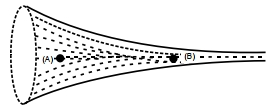
- The figure shows a liquid of given density flowing steadily in horizontal tube of varying cross-section. Cross sectional areas at \(A\) is \(1.5\,cm ^2\), and \(B\) is \(25\,mm ^2\), if the speed of liquid at \(B\) is \(60\,cm / s\) then \(\left( P _{ A }- P _{ B }\right)\) is :(Given \(P _{ A }\) and \(P _{ B }\) are liquid pressures at \(A\) and \(B\) points.Density \(\rho=1000\,kg\,m ^{-3}\) \(A\) and \(B\) are on the axis of tube \(............\,Pa\)
 JEE Mains 2023 Hard
- A litre of dry air at \(STP\) expands adiabatically to a volume of \(3\) litres. If \(\gamma=1.40,\) the work done by air is\((3^{1.4}=4.6555)\) [Take air to be an ideal gas \(]\)JEE Mains 2020 Medium
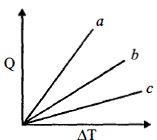
- Figure shows the variation in temperature \(\left( {\Delta T} \right)\) with the amount of heat supplied \((Q)\) in an isobaric process corresponding to a monoatomic \((M)\), diatomic \((D)\) and a polyatomic \((P)\) gas. The initial state of all the gases are the same and the scales for the two axes coincide. Ignoring vibrational degrees of freedom, the lines \(a, b\) and \(c\) respectively correspond to
 JEE Mains 2013 Medium
- Given below are two statements: Statement \(I:\) If heat is added to a system, its temperature must increase. Statement \(II:\) If positive work is done by a system in a thermodynamic process, its volume must increase. In the light of the above statements, choose the correct answer from the options given belowJEE Mains 2023 Medium
- The equation of state for a gas is given by \(PV = nRT + \alpha V\), where \(n\) is the number of moles and \(\alpha \) is a positive constant. The initial temperature and pressure of one mole of the gas contained in a cylinder are \(T_o\) and \(P_o\) respectively. The work done by the gas when its temperature doubles isobarically will beJEE Mains 2014 Hard