


enEnglishhiहिन्दी
JEE Mains · Physics · STD 12 - 11. Dual nature of radiation and matter
Particle \(A\) of mass \(m_{A}=\frac{m}{2}\) moving along the \(x-\)axis with velocity \(v_{0}\) collides elastically with another particle \(B\) at rest having mass \(m _{ B }=\frac{ m }{3}\) If both particles move along the \(x-\)axis after the collision, the change \(\Delta \lambda\) in \(de-\)Broglie wavelength of particle \(A,\) in terms of its \(de-\)Broglie wavelength \(\left(\lambda_{0}\right)\) before collision is
- A \(\Delta \lambda=4 \lambda_{0}\)
- B \(\Delta \lambda=\frac{5}{2} \lambda_{0}\)
- C \(\Delta \lambda=2 \lambda_{0}\)
- D \(\Delta \lambda=\frac{3}{2} \lambda_{0}\)
Answer & Solution
Correct Answer
(A) \(\Delta \lambda=4 \lambda_{0}\)
Step-by-step Solution
Detailed explanation
Applying momentum conservation \(\frac{m}{2} \times V_{0}+\frac{m}{3} \times(0)=\frac{m}{2} V_{A}+\frac{m}{3} V_{B}\) \(=\frac{V_{0}}{2}=\frac{V_{A}}{2}+\frac{V_{B}}{3}\) \(....(1)\) since, collision is elastic \(( e =1)\)…
See the Complete Solution
Get step-by-step explanations for this and 2.5 Lakh+ more JEE, NEET & CET questions.
- Unlock all solutions
- Practice the full chapter
- Track accuracy across PYQs
4.8 rated on Google Play · 14,000+ reviews
More questions from Physics
- A compound microscope is designed with two symmetric biconvex lenses. The objective lens is cut vertically, creating two identical plano-convex lenses. One of them is used in place of original objective lens. To retain same magnification keeping the object distance unchanged, the tube length has to beJEE Mains 2026 Hard
- Match List-I with List-II.
LIST - I LIST - II (A) Isobaric (I) ΔQ = ΔW (B) Isochoric (II) ΔQ = ΔU (C) Adiabatic (III) ΔQ = zero (D) Isothermal (IV) ΔQ = ΔU + PΔV
\(\Delta \mathrm{Q}=\) Heat supplied
\(\Delta \mathrm{W}=\) Work done by the system
\(\Delta \mathrm{U}=\) Change in internal energy
\(\mathrm{P}=\) Pressure of the system
\(\Delta \mathrm{V}=\) Change in volume of the system
Choose the correct answer from the options given below:JEE Mains 2025 Easy - A current through a wire depends on time as \(i =\alpha_{0} t +\beta t ^{2}\) where \(\alpha_{0}=20 A / s\) and \(\beta=8 As ^{-2} .\) Find the charge crossed through a section of the wire in \(15 \,s\) (in \(C\))JEE Mains 2021 Medium
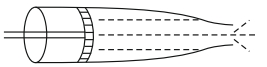
- Figure below shows a liquid being pushed out of the tube by a piston having area of cross section \(2.0\,cm ^2\). The area of cross section at the outlet is \(10\,mm ^2\). If the piston is pushed at a speed of \(4\,cm s ^{-1}\), the speed of outgoing fluidis \(.........\,cm s ^{-1}\).
 JEE Mains 2023 Easy
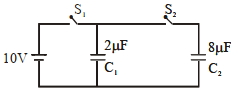
 - A \(2\, \mu F\) capacitor \(C _{1}\) is first charged to a potential difference of \(10\, V\) using a battery.Then the battery is removed and the capacitor is connected to an uncharged capacitor \(C _{2}\) of \(8\, \mu F\). The charge in \(C _{2}\) on equilibrium condition is \(\ldots\,\mu C\). (Round off to the Nearest Integer)
 JEE Mains 2021 Hard
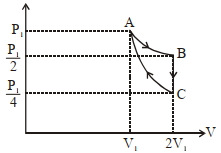
 - If one mole of an ideal gas at \(\left( P _{1}, V _{1}\right)\) is allowed to expand reversibly and isothermally (\(A\) to \(B\) ) its pressure is reduced to one-half of the original pressure (see \(figure\)). This is followed by a constant volume cooling till its pressure is reduced to one-fourth of the initial value \(( B \rightarrow C ) .\) Then it is restored to its initial state by a reversible adiabatic compression (\(C\) to \(A\)). The net workdone by the gas is equal to ...... .
 JEE Mains 2021 Hard
More PYQs from JEE Mains
- Let the circles \(C_1:(x-\alpha)^2+(y-\beta)^2=r_1^2\) and \(C_2:(x-8)^2+\left(y-\frac{15}{2}\right)^2=r_2^2\) touch each other externally at the point \((6,6)\). If the point \((6,6)\) divides the line segment joining the centres of the circles \(C_1\) and \(C_2\) internally in the ratio \(2: 1\), then \((\alpha+\beta)+4\left(r_1^2+r_2^2\right)\) equalsJEE Mains 2024 Hard
- The mean and variance of \(5\) observations are \(5\) and \(8\) respectively. If \(3\) observations are \(1,3,5\), then the sum of cubes of the remaining two observations isJEE Mains 2023 Hard
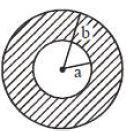
- A circular disc of radius \(b\) has a hole of radius \(a\) at its centre (see figure). If the mass per unit area of the disc varies as \(\left( {\frac{{{\sigma _0}}}{r}} \right)\), then the radius of gyration of the disc about its axis passing through the centre is
 JEE Mains 2019 Hard
 - Given below two statements:
Statement I: \(25^{13}+20^{13}+8^{13}+3^{13}\) is divisible by 7.
Statement II: The integral part of \((7+4\sqrt{3})^{25}\) is an odd number.
In the light of the above statements, choose the correct answer from the options given belowJEE Mains 2026 Hard - There are \(m\) men and two women participating in a chess tournament. Each participant plays two games with every other participant. If the number of games played by the men between themselves exceeds the number of games played between the men and the women by \(84,\) then the value of \(m\) isJEE Mains 2019 Hard
- A coil of inductance \(2\, H\) having negligible resistance is connected to a source of supply whose voltage is given by \(V=3 t\) volt. (where \(t\) is in second). If the voltage is applied when \(t =0,\) then the energy stored in the coil after \(4\, s\) is ............ \(J\).JEE Mains 2021 Hard