


- JEE Mains 2022
- Hard
- MCQ
\(A\). The drift velocity of electrons decreases with the increase in the temperature of conductor. \(B\). The drift velocity is inversely proportional to the area of cross-section of given conductor. \(C\). The drift velocity does not depend on the applied potential difference to the conductor. \(D\). The drift velocity of electron is inversely proportional to the length of the conductor. \(E\). The drift velocity increases with the increase in the temperature of conductor. Choose the correct answer from the options given below:
Answer & Solution
(B) \(A\) and \(D\) only
Step-by-step Solution
Detailed explanation
\(v _{ d }=\left(\frac{ e \tau}{ m }\right)\left(\frac{\Delta V }{\ell}\right)\)
\(\Delta V=\) Potential difference applied across the wire
As temperature increases, relaxation time decreases, hence \(V _{ d }\) decreases.
As per formula, \(V _{ d } \propto \frac{1}{\ell}\)
\(v _{ d }=\frac{ I }{\text { neA }}\), as it is not mentioned that current is at steady state neither it is mentioned that \(n\) is constant for given conductor. So it can't be said that \(v _{ d }\) is inversely proportional to \(A\).
\(I=n e A v_{d}=\frac{V}{R}=\frac{V}{\rho \ell} A\)
\(v _{ d }=\frac{ V }{\rho \ell \text { ne }} \quad\left( E =\frac{ V }{\ell}\right)\)
\(v _{ d }=\frac{ eE \tau}{ m }\)
\(\tau\) decrease with temperature increase.
First and fourth statements are correct.
More questions from Physics
- If \(R , X _{ L }\). and \(X _{ C }\) represent resistance, inductive reactance and capacitive reactance. Then which of the following is dimensionless:JEE Mains 2023 Easy
- \(512\) identical drops of mercury are charged to a potential of \(2\, V\) each. The drops are joined to form a single drop. The potential of this drop is ......... \(V.\)JEE Mains 2021 Hard
- A real gas within a closed chamber at \(27^{\circ} \mathrm{C}\) undergoes the cyclic process as shown in figure. The gas obeys \(P V^3=\mathrm{RT}\) equation for the path \(A\) to \(B\). The net work done in the complete cycle is _______.(assuming \(R=8 \mathrm{~J} / \mathrm{molK}\) )JEE Mains 2024 Hard
- Starting with the same initial conditions, an ideal gas expands from volume \(V_{1}\) to \(V_{2}\) in three different ways. The work done by the gas is \(W_{1}\) if the process is purely isothermal. \(W _{2}\). if the process is purely adiabatic and \(W _{3}\) if the process is purely isobaric. Then, choose the coned optionJEE Mains 2022 Medium
- If the potential energy between two molecules is given by \(U =\frac{-A }{ r ^{6}}+\frac{ B }{ r ^{12}},\) then at equilibrium, separation between molecules, and the potential energy areJEE Mains 2020 Hard
- Two capacitors of capacities \(2 {C}\) and \({C}\) are joined in parallel and charged up to potential \({V}\). The battery is removed and the capacitor of capacity \(C\) is filled completely with a medium of dielectric constant \({K}\). The potential difference across the capacitors will now beJEE Mains 2021 Medium
More PYQs from JEE Mains
- In the following digital circuit, what will be the output at \('Z',\) when the input \((A, B)\) are \((1,0), (0,0),(1,1),(0,1)\)
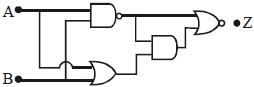 JEE Mains 2020 Hard
- The angular speed of truck wheel is increased from \(900\, rpm\) to \(2460\, rpm\) in \(26\) seconds. The number of revolutions by the truck engine during this time is (Assuming the acceleration to be uniform).JEE Mains 2021 Medium
- The moment of inertia of a uniform thin rod about a perpendicular axis passing through one end is \(I_{1}\). The same rod is bent into a ring and its moment of inertia about a diameter is \(I _{2}\). If \(\frac{ I _{1}}{ I _{2}}\) is \(\frac{ x \pi^{2}}{3}\), then the value of \(x\) will be ...............JEE Mains 2022 Medium
- In an adiabatic process, the density of a diatomic gas becomes \(32\) times its initial value. The final pressure of the gas is found to be \(n\) times the initial pressure. The value of \(n\) isJEE Mains 2020 Medium
- A slanted object \(A B\) is placed on one side of convex lens as shown in the diagram. The image is formed on the opposite side. Angle made by the image with principal axis is:
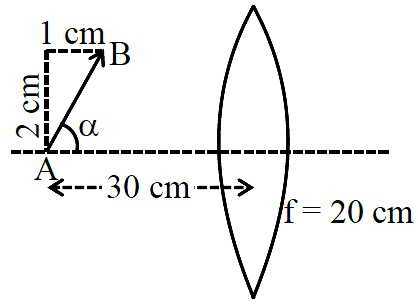 JEE Mains 2025 Medium