


Questions
45 questionsShowing 1–45 of 45 questions
-
- (A) \(45\)
- (B) \(40\)
- (C) \(12\)
- (D) \(33\)
Show answer and solution
Correct Answer: (A)
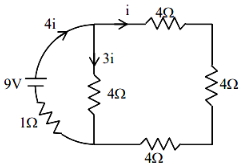
By KVL in outer loop\(9-12 i-4 i=0\)
\(16 i=9\)
\(8 i =\frac{9}{2}=4.5\)
\(=45 \times 10^{-1}\)
-
- (A) \(1\)
- (B) \(10\)
- (C) \(100\)
- (D) \(1000\)
Show answer and solution
Correct Answer: (C)
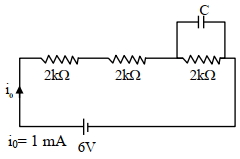
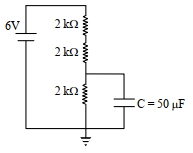
Pot. Diff. across each resistor \(=2\, {V}\)\({q}={CV}\)
\(=50 \times 10^{-6} \times 2=100 \times 10^{-6}=100\, \mu {C}\)
-
- (A) \(10.0\)
- (B) \(3.6\)
- (C) \(5.6\)
- (D) \(2.0\)
Show answer and solution
Correct Answer: (C)
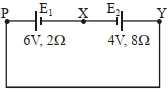
\(I =\frac{6-4}{10}=\frac{1}{5} A\)\(V _{ x }+4+8 \times \frac{1}{5}- V _{ y }=0\)
\(V _{ x }- V _{ y }=-5.6 \Rightarrow| Vx - Vy |=5.6 V\)
-
- (A) \(\frac{1}{4} \frac{ VA }{\rho l}\)
- (B) \(\frac{3}{4} \frac{ VA }{\rho l}\)
- (C) \(\frac{1}{4} \frac{\rho l}{ VA }\)
- (D) \(4 \frac{ VA }{\rho l}\)
Show answer and solution
Correct Answer: (A)
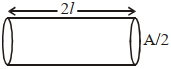
As per the questionResistance \(=\frac{\rho(2 l)}{( A / 2)}=\frac{4 \rho l}{ A }\)
\(\Rightarrow\) Current \(=\frac{ V }{ R }=\frac{ VA }{4 \rho l}\)
-
- (A) \(1.420\)
- (B) \(0.0858\)
- (C) \(2.170\)
- (D) \(0.858\)
Show answer and solution
Correct Answer: (D)
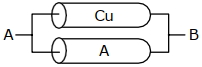
\(\frac{1}{R}=\frac{1}{R_{1}}+\frac{1}{R_{2}}\)\(R=\frac{R_{1} R_{2}}{R_{1}+R_{2}}=\frac{\ell}{A} \cdot \frac{\rho_{1} \rho_{2}}{\rho_{1}+\rho_{2}}\)
\(R=\frac{25 \times 10^{-2}}{3 \times 10^{-6}} \times \frac{1.7 \times 2.6 \times 10^{-16}}{4.3 \times 10^{-8}}\)
\(R=0.858\, {m}\, \Omega\)
-
- (A) \(2 \times 10^{6}\)
- (B) \(625 \times 10^{25}\)
- (C) \(2 \times 10^{25}\)
- (D) \(1 \times 10^{23}\)
Show answer and solution
Correct Answer: (B)
\(i =10 A , A =5 mm ^{2}=5 \times 10^{-6} m ^{2}\)and \(v _{ d }=2 \times 10^{-3} m / s\)
We know, \(i= neAvd\)
\(\therefore 10= n \times 1.6 \times 10^{-19} \times 5 \times 10^{-6} \times 2 \times 10^{-3}\)
\(\Rightarrow n =0.625 \times 10^{28}=625 \times 10^{25}\)
-
- (A) \(11 \times 10^{-3}\)
- (B) \(11 \times 10^{-5}\)
- (C) \(11 \times 10^{-7}\)
- (D) \(11 \times 10^{-2}\)
Show answer and solution
Correct Answer: (B)
\(I=\vec{J} \cdot \vec{A}=J A \cos (\theta)\)\(5=J\left(\frac{4}{100}\right) \times \cos (60)\)
\(J=5 \times 50=250\, {A} / {m}^{2}\)
Now, \(\vec{E}=\rho \cdot \vec{J}\)
\(=44 \times 10^{-8} \times 250=11 \times 10^{-5}\, {V} / {m}\)
-
- (A) \(2\)
- (B) \(1\)
- (C) \(3\)
- (D) \(5\)
Show answer and solution
Correct Answer: (A)
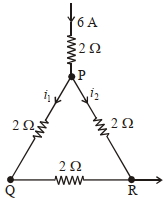
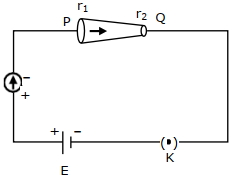
For parallel combination current devides in the inverse ratio of resistance.\(i _{ PQ }=\frac{2}{6} \times 6 \,A\)
-
- (A) \(2250\)
- (B) \(11250\)
- (C) \(2100\)
- (D) \(260\)
Show answer and solution
Correct Answer: (B)
\(i =20 t +8 t ^{2}\)\(i =\frac{ dq }{ dt } \Rightarrow \int d q =\int idt\)
\(\Rightarrow q =\int_{0}^{15}\left(20 t +8 t ^{2}\right) dt\)
\(q =\left(\frac{20 t ^{2}}{2}+\frac{8 t ^{3}}{3}\right)_{0}^{15}\)
\(q =10 \times(15)^{2}+\frac{8(15)^{3}}{3}\)
\(q =2250+9000\)
\(q =11250 C\)
-
- (A) \(5\)
- (B) \(10\)
- (C) \(8\)
- (D) \(15\)
Show answer and solution
Correct Answer: (A)
Conductivity \(\sigma=5 \times 10^{7} \,S / m\)Radius \(r =0.5 \,mm =5 \times 10^{-4}\, m\)
\(E =10 \times 10^{-3}\, \frac{ V }{ m }\)
\(J =\sigma E =10 \times 10^{-3} \times 5 \times 10^{7}\)
\(J =5 \times 10^{5}\)
\(\frac{ i }{ A }=5 \times 10^{5}\)
\(i =5 \times 10^{5} \times \pi r ^{2}\)
\(=5 \times 10^{5} \times \pi \times\left(5 \times 10^{-4}\right)^{2}\)
\(=125 \pi \times 10^{-3} \,Amp\)
\(i=125 \pi \, mA\)
\(x=5\)
-
- (A) \(1500\)
- (B) \(1000\)
- (C) \(500\)
- (D) \(2000\)
Show answer and solution
Correct Answer: (D)
\(500=(1.5)^{2} \times R \times 20\)\(E =(3)^{2} \times R \times 20\)
\(E =2000 \,J\)
-
- (A) \(8125\)
- (B) \(38400\)
- (C) \(384\)
- (D) \(3840\)
Show answer and solution
Correct Answer: (D)
\({E}={i}^{2} {Rt}\)\(192=16({R})(1)\)
\({R}=12\, \Omega\)
\({E}^{1}=(8)^{2}(12)(5)\)
\(=3840\, {J}\)
-
- (A) \(4\)
- (B) \(1\)
- (C) \(3\)
- (D) \(2\)
Show answer and solution
Correct Answer: (C)
\({R}_{e q}=3\, \Omega\)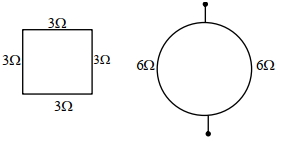
-
- (A) \(4\)
- (B) \(40\)
- (C) \(0.4\)
- (D) \(400\)
Show answer and solution
Correct Answer: (A)
First case \({P}_{1}=\frac{{V}^{2}}{{R}}=\frac{(240)^{2}}{36}\)Second case Resistance of each half \(=18 \,\Omega\)
\({P}_{2}=\frac{(240)^{2}}{18}+\frac{(240)^{2}}{18}=\frac{(240)^{2}}{9}\)
\(\frac{{P}_{1}}{{P}_{2}}=\frac{1}{4}\)
\({x}=4.00\)
-
- (A) \(56\)
- (B) \(25\)
- (C) \(12.5\)
- (D) \(76\)
Show answer and solution
Correct Answer: (A)
\(R _{0}=1\, \Omega\)\(\ell_{0}=1\, m\)
\(A _{0}= A\)
\(R _{1}=?\)
\(\ell_{1}=1.25\, m\)
As volume of wire remains constant so
\(A _{0} \ell_{0}= A _{1} \ell_{1} \Rightarrow A _{1}=\frac{\ell_{0} A _{0}}{\ell_{1}}\)
Now
Resistance \(( R )=\frac{\rho \ell}{ A }\)
\(\frac{ R _{0}}{ R _{1}}=\frac{\ell_{0} / A _{0}}{\rho \ell_{1} / A _{1}}\)
\(\frac{1}{ R _{1}}=\frac{\ell_{0}}{ A _{0}}\left(\frac{\ell_{0} A _{0}}{\ell_{1} \times \ell_{1}}\right) R _{1}=\frac{\ell_{1}^{2}}{\ell_{0}^{2}}=1.5625\, \Omega\)
So \% change in resistance
\(=\frac{ R _{1}- R _{0}}{ R _{0}} \times 100\, \%\)
\(=\frac{1.5625-1}{1} \times 100 \,\%\)
\(=56.25\, \%\)
-
- (A) \(20\)
- (B) \(30\)
- (C) \(5\)
- (D) \(10\)
Show answer and solution
Correct Answer: (A)
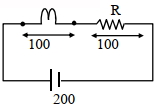
\({P}={Vi}\)\(500={Vi}\)
\({i}=5 {Amp}\)
\({V}={i} \times {R}\)
\({R}=20\)
-
- (A) \(15\)
- (B) \(20\)
- (C) \(5\)
- (D) \(50\)
Show answer and solution
Correct Answer: (D)
Power, \(P =\frac{ V ^{2}}{ R _{ B }}\)\(R_{B}=\frac{V^{2}}{P}=\frac{100 \times 100}{200}\)
\(R_{B}=50 \Omega\)
To produce same power, same voltage should be across the bulb
Hence, \(R=R_{B}=50 \Omega\)
-
- (A) \(40\)
- (B) \(64\)
- (C) \(48\)
- (D) \(24\)
Show answer and solution
Correct Answer: (C)
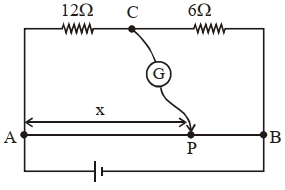
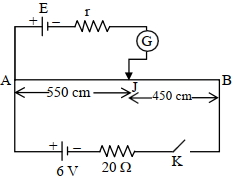
In \(B\) alanced conditions\(\frac{12}{6}=\frac{x}{72-x}\)
\(x=48\, cm\)
-
- (A) \(2\)
- (B) \(3\)
- (C) \(5\)
- (D) \(7\)
Show answer and solution
Correct Answer: (B)
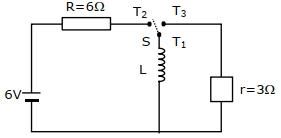
When \(T _{1}\) and \(T _{2}\) are connected, then the steady state current in the inductor \(I=\frac{6}{6}=1 A\)When \(T _{1}\) and \(T _{3}\) are connected then current through inductor remains same. So potential difference across \(3 \Omega\)
\(V = Ir =1 \times 3=3 \text { volt }\)
-
- (A) \(20\)
- (B) \(10\)
- (C) \(25\)
- (D) \(16\)
Show answer and solution
Correct Answer: (A)
In series\({R}_{{eq}}={nR}=10 {n}\)
\({i}_{{s}}=\frac{20}{10+10 {n}}=\frac{2}{1+{n}}\)
in parallel
\({R}_{{eq}}=\frac{10}{{n}}\)
\({i}_{{p}}=\frac{20}{\frac{10}{{n}}+10}=\frac{2 {n}}{1+{n}}\)
\(\frac{{i}_{{p}}}{{i}_{{s}}}=20\)
\(\frac{\left(\frac{2 {n}}{1+{n}}\right)}{\left(\frac{2}{1+{n}}\right)}=20\)
\({n}=20\)
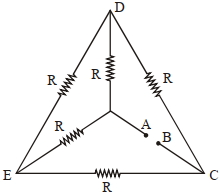
- 21. Five equal resistances are connected in a network as shown in figure. The net resistance between the points \(A\) and \(B\) is
 2021 Medium
- (A) \(2 R\)
- (B) \(\frac{ R }{2}\)
- (C) \(\frac{3 R }{2}\)
- (D) \(R\)
Show answer and solution
Correct Answer: (D)
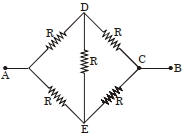
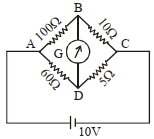
This diagram can be drawn likeIt is a wheat stone bridge
\(\therefore R _{ eq }=\frac{2 R \times 2 R }{2 R +2 R } \Rightarrow R\)
-
- (A) \(1\)
- (B) \(25\)
- (C) \(5\)
- (D) \(10\)
Show answer and solution
Correct Answer: (A)
\(i_{1}=\frac{25}{5+R}\)\(i_{2}=\frac{5}{R+\frac{1}{5}}\)
\(i_{1}=i_{2} \Rightarrow 5\left(R+\frac{1}{5}\right)=5+R\)
\(4 R=4\)
\(R=1\, \Omega\)
-
- (A) \(1\)
- (B) \(2\)
- (C) \(3\)
- (D) \(4\)
Show answer and solution
Correct Answer: (A)
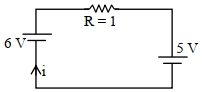
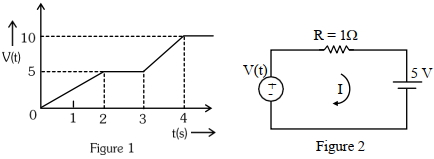
From graph voltage at \({t}=3.2 \,{sec}\) is \(6\, {volt} .\)\(i=\frac{6-5}{1}\)
\(i=1\, {A}\)
-
- (A) \(10\)
- (B) \(15\)
- (C) \(32\)
- (D) \(30\)
Show answer and solution
Correct Answer: (B)
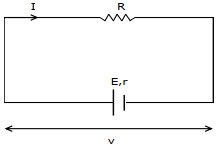
Terminal voltage \(v=i R=\frac{E R}{R+r}\)\(1^{s t} \rightarrow 1.25=\frac{E(5)}{5+r} . .(i)\)
\(2^{n d} \rightarrow 1=\frac{E(2)}{2+r}\, \cdots \text { (ii) }\)
By \((i)\) and \((ii)\)
\(r=1 \,\Omega, E=\frac{3}{2} \,V=\frac{15}{10}\, \text { volt }\)
\(\Rightarrow {x}=15\)
-
- (A) \(3.9\)
- (B) \(8.4\)
- (C) \(7.5\)
- (D) \(3.0\)
Show answer and solution
Correct Answer: (A)
\(R =\frac{\rho \ell}{ A }=\frac{ V }{ I }\)\(\rho=\frac{ AV }{ I \ell}=\frac{\pi d ^{2} V }{4 I \ell} \quad\left( A =\frac{\pi d ^{2}}{4}\right)\)
\(\therefore \frac{\Delta \rho}{\rho}=\frac{2 \Delta d }{ d }+\frac{\Delta V }{ V }+\frac{\Delta I }{ I }+\frac{\Delta \ell}{\ell}\)
\(\frac{\Delta \rho}{\rho}=2\left(\frac{0.01}{5.00}\right)+\frac{0.1}{5.0}+\frac{0.01}{2.00}+\frac{0.1}{10.0}\)
\(\frac{\Delta \rho}{\rho}=0.004+0.02+0.005+0.01\)
\(\frac{\Delta \rho}{\rho}=0.039\)
\(\%\) error \(=\frac{\Delta \rho}{\rho} \times 100=0.039 \times 100=3.90 \%\)
-
- (A) \(3\)
- (B) \(4\)
- (C) \(2\)
- (D) \(5\)
Show answer and solution
Correct Answer: (A)
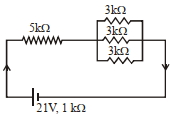
\(I=\frac{21}{5+1+1}=3 mA\)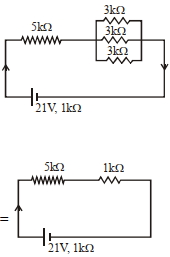
-
- (A) \(2\)
- (B) \(1\)
- (C) \(4\)
- (D) \(5\)
Show answer and solution
Correct Answer: (B)
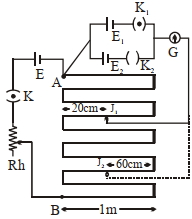
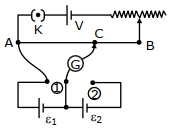
Length of \(AB =10 m\)For battery \(E _{1}\), balancing length is \(l_{1}\) \(l_{1}=380 cm [\) from end \(A ]\)
For battery \(E _{2}\), balancing length is \(l_{2}\) \(l_{2}=760 cm [\) [from end \(A ]\)
Now, we know that \(\frac{ E _{1}}{ E _{2}}=\frac{l_{1}}{l_{2}}\)
\(\Rightarrow \frac{E_{1}}{E_{2}}=\frac{380}{760}=\frac{1}{2}=\frac{a}{b}\)
\(\therefore a=1 \& b=2\)
\(a =1\)
-
- (A) Electric field decreases.
- (B) Drift velocity of electron increases.
- (C) Electron current decreases.
- (D) All of these
Show answer and solution
Correct Answer: (B)
Current is constant in conductor\(i=\) constant
Resistance of element \(d R=\frac{\rho d x}{\pi r^{2}}\)
\(d V=i d R=\frac{i \rho d x}{\pi r^{2}}\)
\(E=\frac{d V}{d x}=\frac{i \rho}{\pi r^{2}}\)
\(V_{d}=\frac{e E \tau}{m}\)
\(\therefore V_{d} \propto E\)
\(\rightarrow E \propto \frac{1}{r^{2}}\)
if \(r\) decreases, \(E\) will increase \(: V_{d}\) will increase
-
- (A) \(5\)
- (B) \(63\)
- (C) \(10\)
- (D) \(4\)
Show answer and solution
Correct Answer: (C)
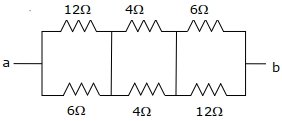
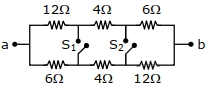
\(\frac{12 \times 6}{12+6}+2+\frac{6 \times 12}{6+12}\)\(\frac{72}{18}+2+\frac{72}{18}=4+2+4=10\, \Omega\)
-
- (A) \(1.32\)
- (B) \(0.65\)
- (C) \(2.2\)
- (D) \(4.4\)
Show answer and solution
Correct Answer: (C)
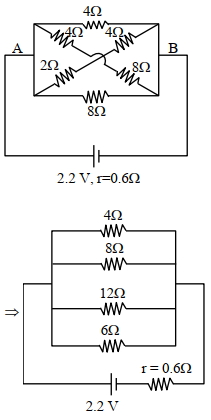
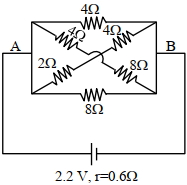
\(\frac{1}{R_{e q}}=\frac{1}{4}+\frac{1}{8}+\frac{1}{12}+\frac{1}{6}=\frac{6+3+2+4}{24}=\frac{15}{24}\)\(R_{e q}=\frac{24}{15}=1.6 \Rightarrow R_{T}=1.6+0.6=2.2 \,\Omega\)
\(P=\frac{V^{2}}{R_{T}}=\frac{(2.2)^{2}}{2.2}=2.2 \,{W}\)
-
- (A) \(6\)
- (B) \(2.25\)
- (C) \(5\)
- (D) \(2.75\)
Show answer and solution
Correct Answer: (C)
Max. voltage that can be measured by this potentiometer will be equal to potential drop across AB\(R _{ AB }=10 \times 0.1 \times 100=100 \Omega\)
\(\therefore V _{ AB }=\frac{6}{20+100} \times 100=6 \times \frac{100}{120}=5 V\)
-
- (A) \(\frac{4}{3}\)
- (B) \(\frac{3}{2}\)
- (C) \(\frac{5}{3}\)
- (D) \(\frac{8}{5}\)
Show answer and solution
Correct Answer: (C)
\(E_{1}=k l_{1} \ldots .\) (i)\(E_{1}+E_{2}=k l_{2} \ldots\) (ii)
\(\frac{E_{1}}{E_{1}+E_{2}}=\frac{l_{1}}{l_{2}}=\frac{250}{400}=\frac{5}{8}\)
\(8 E_{1}=5 E_{1}+5 E_{2}\)
\(3 E_{1}=5 E_{2}\)
\(\frac{E_{1}}{E_{2}}=\frac{5}{3}\)
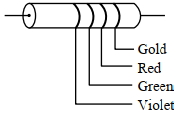
- 33. The colour coding on a carbon resistor is shown in the given figure. The resistance value of the given resistor is:
 2021 Medium
- (A) \((5700 \pm 285) \,\Omega\)
- (B) \((7500 \pm 750) \,\Omega\)
- (C) \((5700 \pm 375)\,\Omega\)
- (D) \((7500 \pm 375) \,\Omega\)
Show answer and solution
Correct Answer: (D)
\({R}=75 \times 10^{2} \pm 5 \%\) of \(7500\)\({R}=(7500 \pm 375)\, \Omega\)
-
- (A) \(3600\)
- (B) \(2800\)
- (C) \(2450\)
- (D) \(2500\)
Show answer and solution
Correct Answer: (D)
\(Q = i ^{2} RT\)\(R =\frac{ Q }{ i ^{2} t }=\frac{10 \times 10^{-3}}{4 \times 10^{-6} \times 1}=2500\,\Omega\)
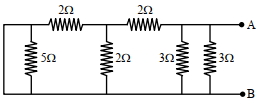
- 35. The equivalent resistance of the given circuit between the terminals \({A}\) and \({B}\) is \(....\Omega\)
 2021 Hard
- (A) \(0\)
- (B) \(3\)
- (C) \(9\)
- (D) \(1\)
Show answer and solution
Correct Answer: (D)
\({R}_{\text {eq }}=\frac{3 \times 3 / 2}{3+3 / 2}=\frac{9 / 2}{9 / 2}=1\, \Omega\)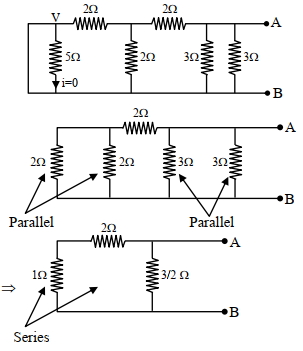
-
- (A) \(2.44\, \mu A\)
- (B) \(2.44\, mA\)
- (C) \(4.87\, mA\)
- (D) \(4.87\, \mu A\)
Show answer and solution
Correct Answer: (C)
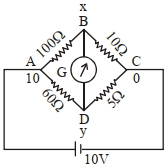
\(\frac{x-10}{100}+\frac{x-y}{15}+\frac{x-0}{10}=0\)\(53 x-20 y=30 \ldots \ldots(1)\)
\(\frac{y-10}{60}+\frac{y-x}{15}+\frac{y-0}{5}=0\)
\(17 y -4 x =10\)
on solving \((1)\,\&\,(2)\)
\(x=0.865\)
\(y =0.792\)
\(\Delta V =0.073 R =15\, \Omega\)
\(i =4.87 \,mA\)
-
- (A) \(\frac{40}{11}\, {V}\)
- (B) \(10\, {V}\)
- (C) \(\frac{40}{9} \,{V}\)
- (D) \(5 \,{V}\)
Show answer and solution
Correct Answer: (C)
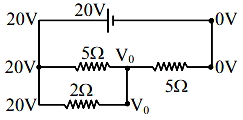
\(\frac{20- V _{0}}{5}+\frac{0- V _{0}}{5}+\frac{20- V _{0}}{2}=0\)\(4+10=\frac{2 V _{0}}{5}+\frac{ V _{0}}{2}\)
\(14=\frac{4 V _{0}+5 V _{0}}{10}\)
\(V _{0}=\frac{140}{9} Volt \)
Potential difference across \(2 \Omega\) resistor is \(20- V _{0}\)
That is \(\left(20-\frac{140}{9}\right)\) Volt
Hence answer is \(\left(\frac{40}{9}\right)\) Volt
-
- (A) \(11\)
- (B) \(9\)
- (C) \(10\)
- (D) \(8\)
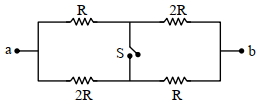
Show answer and solution
Correct Answer: (B)
\(R_{e q \text { open }}=\frac{3 R}{2}\)\(R_{e q \text { closed }}=2 \times \frac{R \times 2 R}{3 R}=\frac{4 R}{3}\)
\(\frac{{R}_{\text {eq open }}}{{R}_{\text {eq closed }}}=\frac{3 R}{2} \times \frac{3}{4 {R}}=\frac{9}{8}\)
\(\therefore \quad {X}=9\)
-
- (A) \(0.033\, {C}^{-1}\)
- (B) \(0.010\, {C}^{-1}\)
- (C) \(0.042\, {C}^{-1}\)
- (D) \(0.003^{\circ} \,{C}^{-1}\)
Show answer and solution
Correct Answer: (D)
variation of resistance with temperature\(16=R_{0}\left[1+\alpha\left(15-T_{0}\right)\right]\)
\(20=R_{0}\left[1+\alpha\left(100-T_{0}\right)\right]\)
Assuming \({T}_{0}=0^{\circ} {C}\), as a general convention.
\(\Rightarrow \frac{16}{20}=\frac{1+\alpha \times 15}{1+\alpha \times 100} \Rightarrow \alpha=0.003^{\circ} {C}^{-1}\)
-
- (A) \(4\)
- (B) \(6\)
- (C) \(8\)
- (D) \(10\)
Show answer and solution
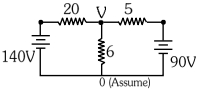
Correct Answer: (D)
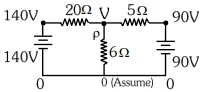
Applying \(KCL\) at point \(P,\)\(\frac{V-0}{6}+\frac{V-90}{5}+\frac{V-140}{20}=0\)
\(\Rightarrow 10 {V}+12 {V}-1080+3 {V}-420=0\)
\(\Rightarrow {V}=60\)
\(\therefore \text { Current in } 6 \Omega=\frac{{V}-0}{6}=10 {A}\)
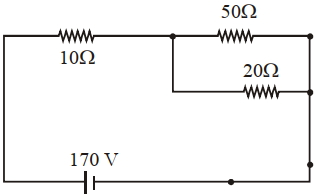
- 41. The voltage across the \(10\, \Omega\) resistor in the given circuit is \(x\) volt. The value of \('x'\) to the nearest integer is..........
 2021 Medium
- (A) \(72\)
- (B) \(60\)
- (C) \(70\)
- (D) \(65\)
Show answer and solution
Correct Answer: (C)
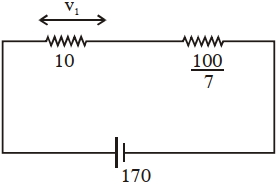
\(R _{ eq _{1}}=\frac{50 \times 20}{70}=\frac{100}{7}\)\(R _{ eq }=\frac{170}{7}\)
\(v _{1}=\left[\frac{\frac{170}{170}}{7}\right] \times 10=70 v\)
\(=70.00\)
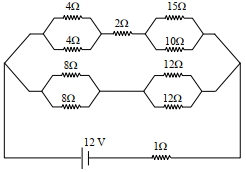
- 42. The voltage drop across \(15\, \Omega\) resistance in the given figure will be \(.....V.\)
 2021 Hard
- (A) \(8\)
- (B) \(60\)
- (C) \(6\)
- (D) \(9\)
Show answer and solution
Correct Answer: (C)
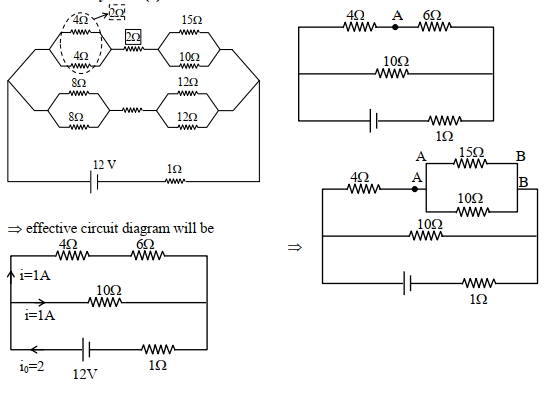
Point drop across \(6 \,\Omega=1 \times 6=6={V}_{{AB}}\)\(\Rightarrow\) Hence point drop across \(15 \,\Omega=6\) \(volt\) \(={V}_{{AB}}\)
-
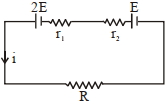
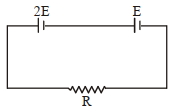
- (A) \(r _{1}+ r _{2}\)
- (B) \(\frac{ r _{1}}{2}- r _{2}\)
- (C) \(\frac{ r _{1}}{2}+ r _{2}\)
- (D) \(r _{1}- r _{2}\)
Show answer and solution
Correct Answer: (B)
\(i =\frac{3 E }{ R + r _{1}+ r _{2}}\)\(TPD =2 E - ir _{1}=0\)
\(2 E = ir _{1}\)
\(2 E =\frac{3 E \times r _{1}}{ R + r _{1}+ r _{2}}\)
\(2 R +2 r _{1}+2 r _{2}=3 r _{1}\)
\(R =\frac{ r _{1}}{2}- r _{2}\)
-
- (A) \(2\)
- (B) \(8\)
- (C) \(6\)
- (D) \(4\)
Show answer and solution
Correct Answer: (D)
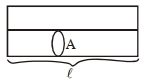
\(\because\) in parallel\(R _{ net }=\frac{ R _{1} R _{2}}{ R _{1}+ R _{2}}\)
\(\frac{\rho \ell}{2 A }=\frac{\rho_{1} \frac{\ell}{ A } \times \rho_{2} \frac{\ell}{ A }}{\rho_{1} \frac{\ell}{ A }+\rho_{2} \frac{\ell}{ A }}\)
\(\frac{\rho}{2}=\frac{6 \times 3}{6+3}=2\)
\(\rho=4\)
-
- (A) \(82\)
- (B) \(97\)
- (C) \(110\)
- (D) \(90\)
Show answer and solution
Correct Answer: (B)
\(\frac{{R}_{1} {R}_{2}}{{R}_{1}+{R}_{2}}=3\)\(\frac{\left(12 \times 10^{-6} \times 10^{-2}\right) \ell \times 4}{\frac{\pi(2)^{2} \times 10^{-6}} \times \frac{\left(51 \times 10^{-6} \times 10^{-2}\right) \ell \times 4}{\pi(2)^{2} \times 10^{-6}}}{\frac{63 \times 10^{-6} \times 10^{-2} \times \ell \times 4}{\pi(2)^{2} \times 10^{-6}}}\)
\(\Rightarrow \ell=97 {m}\)
No questions on this page match these filters.