


JEE Mains · Chemistry · STD 11 - Equilibrium - 1 (chemical Equilibrium)
- JEE Mains 2024
- Hard
- Numerical
Consider the following reaction at \(298 \mathrm{~K}\). \(\frac{3}{2} \mathrm{O}_{2(\mathrm{~g})} \rightleftharpoons \mathrm{O}_{3(\mathrm{~g})} \cdot \mathrm{K}_{\mathrm{P}}=2.47 \times 10^{-29} \text {. }\) \(\Delta_{\mathrm{r}} \mathrm{G}^{\ominus}\) for the reaction is_______ \(kJ\). (Given R \(\left.=8.314 \mathrm{JK}^{-1} \mathrm{~mol}^{-1}\right)\)
Pick an option to check your answer.
Answer & Solution
Correct Answer
(D) \(163\)
Step-by-step Solution
Detailed explanation
\(\frac{3}{2} \mathrm{O}_{2(\mathrm{~g})} \rightleftharpoons \mathrm{O}_{3(\mathrm{~g})} \cdot \mathrm{K}_{\mathrm{P}}=2.47 \times 10^{-29}\)
\(\Delta_{\mathrm{r}} \mathrm{G}^{\ominus}=-\mathrm{RT} \ln \mathrm{K}_{\mathrm{P}}\)
\(=-8.314 \times 10^{-3} \times 298 \times \ln \left(2.47 \times 10^{-29}\right)\)
\(=-8.314 \times 10^{-3} \times 298 \times(-65.87)\)
\(=163.19 \mathrm{~kJ}\)
More questions from Chemistry
- Iron (III) catalyses the reaction between iodide and persulphate ions, in which
A. \(Fe ^{3+}\) oxidises the iodide ion
B. \(Fe ^{3+}\) oxidises the persulphate ion
C. \(Fe ^{2+}\) reduces the iodide ion
D. \(Fe ^{2+}\) reduces the persulphate ion
Choose the most appropriate answer from the options given below:JEE Mains 2024 Medium - A commercially sold conc. \(HCl\) is \(35 \% HCl\) by mass. If the density of this commercial acid is \(1.46\) \(g / mL\), the molarity of this solution is ....\(M\) (Atomic mass : \(Cl =35.5 \,amu , H =1\, amu\) )JEE Mains 2022 Hard
- The following reaction is known as
 JEE Mains 2014 Hard
- In the presence of a small amount of phosphorous, aliphatic carboxylic acids react with chlorine or bromine to yield a compound in which \(\alpha -\) hydrogen has been replaced by halogen. This reaction is known asJEE Mains 2015 Hard
- In the following reaction sequence The compound \(I\) is \(\mathop I\limits_{({C_3}{H_6}C{l_2})} \xrightarrow{{KOH(aq)}}II\xrightarrow[{(ii){H_2}O/{H^ + }}]{{(i)C{H_3}MgBr}}III\xrightarrow{{Anhy.ZnC{l_2} + Conc.HCl}}\) given turbidity immediatelyJEE Mains 2017 Hard
- Match List \(I\) with List \(II\)
Choose the correct answer from the options given below:LIST - \(I\) (Technique) LIST - \(II\) (Application) \(A\). Distillation \(I\). Separation of glycerol from spent-lye \(B\). Fractional distillation \(II\). Aniline - Water mixture \(C\). Steam distillation \(III\). Separation of crude oil fractions \(D\). Distillation under reduced pressure \(IV\). Chloroform-Aniline JEE Mains 2024 Hard
More PYQs from JEE Mains
- For the forward biased diode characteristics shown in the figure, the dynamic resistance at \({I}_{{D}}=3 \,{mA}\) will be \(.....\,\Omega\)
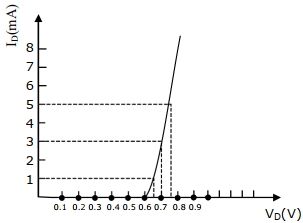 JEE Mains 2021 Medium
- An electron of mass \(m\) and a photon have same energy \(E.\) The ratio of de-Broglie wavelengths associated with them isJEE Mains 2021 Medium
- The charged particle moving in a uniform magnetic field of \((3\hat{i} + 2\hat{j})\) T has an acceleration \(\left(4\hat{i} - \dfrac{x}{2}\hat{j}\right)\) m/s\(^2\). The value of \(x\) is __________.JEE Mains 2026 Medium
- A long straight wire of radius ' \(a\) ' carries a steady current I. The current is uniformly distributed across its cross section. The ratio of the magnetic field at \(\frac{a}{2}\) and \(2\)a from axis of the wire is _______.JEE Mains 2024 Hard
- Given below are two statements: one is labelled as Assertion \((A)\) and the other is labelled as Reason \((R)\). Assertion \((A)\) : \(\mathrm{NH}_3\) and \(\mathrm{NF}_3\) molecule have pyramidal shape with a lone pair of electrons on nitrogen atom. The resultant dipole moment of \(\mathrm{NH}_3\) is greater than that of \(\mathrm{NF}_3\). Reason \((R)\) : In \(\mathrm{NH}_3\), the orbital dipole due to lone pair is in the same direction as the resultant dipole moment of the \(\mathrm{N}-\mathrm{H}\) bonds. \(\mathrm{F}\) is the most electronegative element. In the light of the above statements, choose the correct answer from the options given below:JEE Mains 2024 Medium
- The distance between charges \(+\mathrm{q}\) and \(-\mathrm{q}\) is \(2 l\) and between \(+2 \mathrm{q}\) and \(-2 \mathrm{q}\) is \(4 l\). The electrostatic potential at point \(P\) at a distance \(r\) from centre \(O\) is \(-\alpha\left[\frac{q l}{r^2}\right] \times 10^9 \mathrm{~V}\), where the value of \(\alpha\) is _______. (Use \(\left.\frac{1}{4 \pi \varepsilon_0}=9 \times 10^9 \mathrm{Nm}^2 \mathrm{C}^{-2}\right)\)
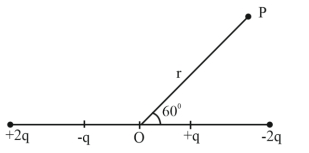 JEE Mains 2024 Hard