


JEE Mains · Chemistry · STD 11 - 3. Classification of elements and periodicity in properties
Identify the correct statements about p-block elements and their compounds. \((A)\) Non metals have higher electronegativity than metals. \((B)\) Non metals have lower ionisation enthalpy than metals. \((C)\) Compounds formed between highly reactive nonmetals and highly reactive metals are generally ionic. \((D)\) The non-metal oxides are generally basic in nature. \((E)\) The metal oxides are generally acidic or neutral in nature.
- A \((D)\) and \((E)\) only
- B \((A)\) and \((C)\) only
- C \((B)\) and \((E)\) only
- D \((B)\) and \((D)\) only
Answer & Solution
Correct Answer
(B) \((A)\) and \((C)\) only
Step-by-step Solution
Detailed explanation
As electronegativity increases non-metallic nature increases. Along the period ionisation energy increases. High electronegativity difference results in ionic bond formation. Oxides of metals are generally basic and that of non-metals are acidic in nature.
See the Complete Solution
Get step-by-step explanations for this and 2.5 Lakh+ more JEE, NEET & CET questions.
- Unlock all solutions
- Practice the full chapter
- Track accuracy across PYQs
4.8 rated on Google Play · 14,000+ reviews
More questions from Chemistry
- Consider the hypothetical situation where the azimuthal quantum number, \(l\), takes values \(0\) , \(1,2, \ldots \ldots n+1,\) where \(n\) is the principal quantum number. Then, the element with atomic numberJEE Mains 2020 Hard
- If one strand of a \(DNA\) has the sequence \(ATGCTTCA\), sequence of the bases in complementary strand is _______.JEE Mains 2024 Hard
- A solution of copper sulphate \((CuSO_4)\) is electrolysed for \(10\, minutes\) with a current of \(1.5\, amperes\). The mass of copper deposited at the cathode (at . mass of \(Cu = 63\,u\)) is ............ \(\mathrm{g}\)JEE Mains 2013 Hard
- The difference between electron gain enthalpies will be maximum between:JEE Mains 2023 Easy
- Sea water contains \(29.25 \%\) \(NaCl\) and \(19 \% \,MgCl _2\) by weight of solution. The normal boiling point of the sea water is \(..........{ }^{\circ} C\) (Nearest integer) Assume \(100 \%\) ionization for both \(NaCl\) and \(MgCl _2\) Given : \(K _{ b }\left( H _2 O \right)=0.52\,K\,kg\,mol ^{-1}\) Molar mass of \(NaCl\) and \(MgCl _2\) is 58.5 and \(95\,g\) \(mol ^{-1}\) respectively.JEE Mains 2023 Hard
- The number of statement(s) correct from the following for copper (at no. \(29\)) is/are \(...\) \((A)\,Cu\) \((II)\) complexes are always paramagnetic \((B)\,Cu\) \((I)\) complexes are generally colourless \((C)\,Cu\) \(( I )\) is easily oxidized \((D)\) In Fehling solution, the active reagent has \(Cu\) \(( I )\)JEE Mains 2022 Medium
More PYQs from JEE Mains
- The coefficient of \(x ^{101}\) in the expression \((5+x)^{500}+x(5+x)^{499}+x^{2}(5+x)^{498}+\ldots . x^{500}\) \(x>0\), isJEE Mains 2022 Hard
- In a hydrogen spectrum, \(\lambda\) be the wavelength of first transition line of Lyman series. The wavelength difference will be "a \(\lambda^{\prime}\) between the wavelength of \(3^{\text {rd }}\) transition line of Paschen series and that of \(2^{\text {nd }}\) transition line of Balmer Series where \(a=........\)JEE Mains 2022 Hard
- Tangents are drawn to the hyperbola \(4{x^2} - {y^2} = 36\) at the points \(P\) and \(Q.\) If these tangents intersect at the point \(T(0,3)\) then the area (in sq. units) of \(\Delta PTQ\) is :JEE Mains 2018 Hard
- Let A and B be two distinct points on the line \(\mathrm{L}: \frac{\mathrm{x}-6}{3}=\frac{\mathrm{y}-7}{2}=\frac{\mathrm{z}-7}{-2}\). Both A and B are at a distance \(2 \sqrt{17}\) from the foot of perpendicular drawn from the point \((1,2,3)\) on the line L . If O is the origin, then \(\overrightarrow{O A} \cdot \overrightarrow{O B}\) is equal to:JEE Mains 2025 Medium
- Two poles, \(\mathrm{AB}\) of length \(a\) metres and \(\mathrm{CD}\) of length \(\mathrm{a}+\mathrm{b}(\mathrm{b} \neq \mathrm{a})\) metres are erected at the same horizontal level with bases at \(\mathrm{B}\) and \(\mathrm{D} .\) If \(\mathrm{BD}=\mathrm{x}\) and \(\tan \angle\,ACB=\frac{1}{2}\), then:JEE Mains 2021 Hard
- Choose the correct set of reagents for the following conversion.
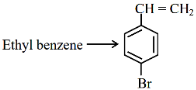 JEE Mains 2025 Medium