


JEE Mains · Chemistry · STD 11 - 6.1. Equilibrium - 1 (chemical Equilibrium)
At \(-20^{\circ} \mathrm{C}\) and \(1 \mathrm{~atm}\) pressure, a cylinder is filled with equal number of \(\mathrm{H}_2 . \mathrm{I}_2\) and \(\mathrm{HI}\) molecules for the reaction \(\mathrm{H}_2(\mathrm{~g})+\mathrm{I}_2(\mathrm{~g}) \rightleftharpoons 2 \mathrm{HI}(\mathrm{g})\), the \(\mathrm{K}_{\mathrm{p}}\) for the process is \(\mathrm{x} \times 10^{-1} \cdot \mathrm{x}=\) _______. [Given : \(\mathrm{R}=0.082 \mathrm{~L} \mathrm{~atm} \mathrm{~K}^{-1} \mathrm{~mol}^{-1}\) ]
- A \(2\)
- B \(1\)
- C \(10\)
- D \(0.01\)
Answer & Solution
Correct Answer
(C) \(10\)
Step-by-step Solution
Detailed explanation
\(\Delta \mathrm{n}_{\mathrm{g}}=0 \mathrm{~K}_{\mathrm{p}}=\frac{\left(\mathrm{n}_{\mathrm{HI}}\right)^2}{\mathrm{n}_{\mathrm{H}_2} \mathrm{n}_{\mathrm{I}_2}}\left(\frac{\mathrm{P}_{\mathrm{T}}}{\mathrm{n}_{\mathrm{T}}}\right)^{\Delta \mathrm{ng}_{\mathrm{g}}}\)…
See the Complete Solution
Get step-by-step explanations for this and 2.5 Lakh+ more JEE, NEET & CET questions.
- Unlock all solutions
- Practice the full chapter
- Track accuracy across PYQs
4.8 rated on Google Play · 14,000+ reviews
More questions from Chemistry
- The variation of equilibrium constant with temperature is given below Temperature \(\quad\) Equilibrium constant \(\begin{array}{ll} T _{1}=25^{\circ} C & K _{1}=100 \\ T _{2}=100^{\circ} C & K _{2}=100\end{array}\) The values of \(\Delta H ^{\circ}, \Delta G ^{\circ}\) at \(T _{1}\) and \(\Delta G ^{\circ}\) at \(T _{2}\) (in \(kJ\, mol ^{-1}\) ) respectively, are close to \(\left[\right.\) Use \(\left. R =8.314\, JK ^{-1} mol ^{-1}\right]\)JEE Mains 2020 Hard
- The region in the electromagnetic spectrum where the Balmer series lines appear isJEE Mains 2020 Easy
- Consider the following sequence of reactions to produce major product (A)
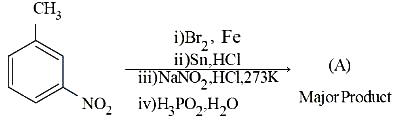
Molar mass of product \((\mathrm{A})\) is _______ \(\mathrm{g} \mathrm{mol}^{-1}\).
(Given molar mass in \(\mathrm{g} \mathrm{mol}^{-1}\) of \(\mathrm{C}: 12, \mathrm{H}: 1, \mathrm{O}: 16, \mathrm{Br}: 80, \mathrm{~N}: 14, \mathrm{P}: 31\) )JEE Mains 2025 Medium - A student has been given 0.314 g of an organic compound and asked to estimate Sulphur. During the experiment, the student has obtained 0.4813 g of barium sulphate. The percentage of sulphur present in the compound is __________
(Given Molar mass in \(g mol^{-1}\) S: 32, \(BaSO_{4}\): 233)JEE Mains 2026 Hard - An organic compound undergoes first order decomposition. The time taken for decomposition to \(\left(\frac{1}{8}\right)^{\text {th }}\) and \(\left(\frac{1}{10}\right)^{\text {th }}\) of its initial concentration are \( t_{1/8} \) and \( t_{1/10} \) respectively.
What is the value of \( \frac{t_{1/8}}{t_{1/10}} \times 10 \)?
(Given: \( \log 2 = 0.3 \))JEE Mains 2026 Medium - Match List \(I\) with List \(II\)
Choose the correct answer from the options given below:List \(I\) Oxide List \(II\) Type of Bond \(A\) \(N _2 O _4\) \(I\). \(1 N = O\) bond \(B\) \(NO _2\) \(II\). \(1 N - O - N\) bond \(C\) \(N _2 O _5\) \(III\). \(1 N - N\) bond \(D\) \(N _2 O\) \(IV\). \(1 N = N / N \equiv N\) bond JEE Mains 2023 Medium
More PYQs from JEE Mains
- Given below are two statements:
Statement I: The conversion proceeds well in the less polar medium.
\(\mathrm{CH}_3-\mathrm{CH}_2-\mathrm{CH}_2-\mathrm{CH}_2-\mathrm{Cl} \xrightarrow{\mathrm{HO}^{-}} \mathrm{CH}_3-\mathrm{CH}_2-\mathrm{CH}_2-\mathrm{CH}_2-\mathrm{OH}+\mathrm{Cl}^{(-)}\)
Statement II: The conversion proceeds well in the more polar medium.
In the light of the above statements, choose the correct answer from the options given belowJEE Mains 2025 Easy - If the volume of a spherical ball is increasing at the rate of \(4 \pi \, cc/sec\), then the rate of increase of its radius (in \(cm/sec\)), when the volume is \(288 \pi \, cc\)JEE Mains 2014 Hard
- In the given figure, each diode has a forward bias resistance of \(30\, \Omega\) and infinite resistance in reverse bias. The current \({I}_{1}\) will be \(....\,A\)
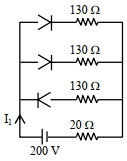 JEE Mains 2021 Hard
 - Let \( y=y(x) \) be the solution of the differential equation \( x^{4}dy + (4x^{3}y + 2\sin x)dx = 0 \), \( x>0 \), \( y(\frac{\pi}{2})=0 \). Then \( \pi^{4}y(\frac{\pi}{3}) \) is equal to:JEE Mains 2026 Hard
- In neutral or faintly alkaline medium, \(KMnO _{4}\) being a powerful oxidant can oxidize, thiosulphate almost quantitatively, to sulphate. In this reaction overall change in oxidation state of manganese will beJEE Mains 2022 Medium
- The minimum value of the twice differentiable function \(f(x)=\int_{0}^{x} e^{x-t} f^{\prime}(t) d t-\left(x^{2}-x+1\right) e^{x}, x \in R\), is.JEE Mains 2022 Hard