


JEE Mains · Chemistry · STD 11 - 5. Thermodynamics and thermochemistry
\(\begin{aligned}
& \mathrm{S}(\mathrm{~g})+\frac{3}{2} \mathrm{O}_2(\mathrm{~g}) \rightarrow \mathrm{SO}_3(\mathrm{~g})+2 x \mathrm{kcal} \\
& \mathrm{SO}_2(\mathrm{~g})+\frac{1}{2} \mathrm{O}_2(\mathrm{~g}) \rightarrow \mathrm{SO}_3(\mathrm{~g})+y \mathrm{kcal}
\end{aligned}\)
The heat of formation of \(\mathrm{SO}_2(\mathrm{~g})\) is given by :
- A \(x+y \mathrm{kcal}\)
- B \(y-2 x \mathrm{kcal}\)
- C \(\frac{2 x}{y} \mathrm{kcal}\)
- D \(2 x+y \mathrm{kcal}\)
Answer & Solution
Correct Answer
(B) \(y-2 x \mathrm{kcal}\)
Step-by-step Solution
Detailed explanation
(i) \(\mathrm{S}(\mathrm{g})+\frac{3}{2} \mathrm{O}_2(\mathrm{~g}) \rightarrow \mathrm{SO}_3(\mathrm{~g})+2 x\) kcal \(\Delta \mathrm{H}_1\) (ii) \(\mathrm{SO}_2(\mathrm{~g})+\frac{1}{2} \mathrm{O}_2(\mathrm{~g}) \rightarrow \mathrm{SO}_3(\mathrm{~g})+y\) kcal…
See the Complete Solution
Get step-by-step explanations for this and 2.5 Lakh+ more JEE, NEET & CET questions.
- Unlock all solutions
- Practice the full chapter
- Track accuracy across PYQs
4.8 rated on Google Play · 14,000+ reviews
More questions from Chemistry
- \(\mathrm{O}_2\) gas will be evolved as a product of electrolysis of :
(A) an aqueous solution of \(\mathrm{AgNO}_3\) using silver electrodes.
(B) an aqueous solution of \(\mathrm{AgNO}_3\) using platinum electrodes.
(C) a dilute solution of \(\mathrm{H}_2 \mathrm{SO}_4\) using platinum electrodes.
(D) a high concentration solution of \(\mathrm{H}_2 \mathrm{SO}_4\) using platinum electrodes.
Choose the correct answer from the options given below :JEE Mains 2025 Medium - The \(71^{st}\) electron of an element \(X\) with an atomic number of \(71\) enters into the orbital:JEE Mains 2019 Medium
- The octahedral diamagnetic low spin complex among the following isJEE Mains 2023 Medium
- Total number of stereo isomers possible for the given structure is _______.
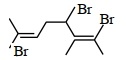 JEE Mains 2024 Medium
 - Which of the following statements is false ?JEE Mains 2015 Hard
- Given below are two statements:
Statement I: The Henry's law constant \(K_{H}\) is constant with respect to variations in solution's concentration over the range for which the solutions is ideally dilute.
Statement II: \(K_{H}\) does not differ for the same solute in different solvents.
In the light of the above statements, choose the correct answer from the options.JEE Mains 2026 Hard
More PYQs from JEE Mains
- Match List \(I\) with List \(II\)
Choose the correct answer from the options given below :-List\(I\) List\(II\) \(A.\) Cobalt catalyst \(I.\) \(\left( H _2+ Cl _2\right)\) production \(B.\) Syngas \(II.\) Water gas production \(C.\) Nickel catalyst \(III.\) Coal gasification \(D.\) Brine solution \(IV.\) Methanol production JEE Mains 2023 Hard - A particle of mass \(m\) is acted upon by a force \(F\) given by the empirical law \(F = \frac{R}{{{t^2}}}\,v(t)\). If this law is to be tested experimentally by observing the motion starting from rest, the best way is to plotJEE Mains 2016 Hard
- The resistive network shown below is connected to a \(D.C.\) source of \(16\, V\). The power consumed by the network is \(4\, Watt\). The value of \(R\) is ............. \(\Omega\)
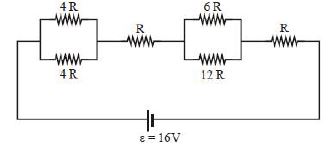 JEE Mains 2019 Medium
 - The one division of main scale of vernier callipers reads \(1\,mm\) and \(10\) divisions of Vernier scale is equal to the \(9\) divisions on main scale. When the two jaws of the instrument touch each other the \(zero\) of the Vernier lies to the right of \(zero\) of the main scale and its fourth division coincides with a main scale division. When a spherical bob is tightly placed between the two jaws, the \(zero\) of the Vernier scale lies in between \(4.1\,cm\) and \(4.2\,cm\) and \(6^{\text {th }}\) Vernier division coincides with a main scale division. The diameter of the bob will be \(.............10^{-2}\,cm\)JEE Mains 2022 Hard
- The isomer(s) of \(\left[\mathrm{Co}\left(\mathrm{NH}_{3}\right)_{4} \mathrm{Cl}_{2}\right]\) that has/have a \(\mathrm{Cl}-\mathrm{Co}-\mathrm{Cl}\) angle of \(90^{\circ},\) is/areJEE Mains 2020 Hard
- The absolute difference between the squares of the radii of the two circles passing through the point \((-9,4)\) and touching the lines \(x+y=3\) and \(x-y=3\), is equal to ______.JEE Mains 2025 Medium