


All Thermodynamics and thermochemistry questions
Newest firstShowing 51–100 of 204 questions
-
- (A) \(6535\)
- (B) \(6540\)
- (C) \(6545\)
- (D) \(6550\)
Show answer and solution
Correct Answer: (A)
\(6 \mathrm{C} \text { (graphite) }+3 \mathrm{H}_2(\mathrm{~g}) \rightarrow \mathrm{C}_6 \mathrm{H}_6(\ell) ; \Delta \mathrm{H}=48.5 \mathrm{~kJ} / \mathrm{mol}\)\(\mathrm{C} \text { (graphite) }+\mathrm{O}_2(\mathrm{~g}) \rightarrow \mathrm{CO}_2(\mathrm{~g}) ; \Delta \mathrm{H}=-393.5 \mathrm{~kJ} / \mathrm{mol}\)
\(\mathrm{H}_2^{(\mathrm{g})}+\frac{1}{2}(\mathrm{~g}) \longrightarrow \mathrm{H}_2 \mathrm{O}(\ell) ; \Delta \mathrm{H}=-286 \mathrm{~kJ} / \mathrm{mol}\)
\(\text { equation }-(1) \times 1+(2) \times 6+(3) \times 3\)
\(-48.5-6 \times 393.5-3 \times 286\)
\(=-3267.5 \mathrm{~kJ} \text { for } 1 \mathrm{~mol}\)
\(=-6535 \mathrm{~kJ} \text { for } 2 \mathrm{~mol}\)
Ans. \(6535 \mathrm{~kJ}\)
-
- (A) \(50\)
- (B) \(55\)
- (C) \(60\)
- (D) \(65\)
Show answer and solution
Correct Answer: (B)
\(\omega=-\mathrm{nRT} \ln \left(\frac{\mathrm{V}_2}{\mathrm{~V}_1}\right)\)\(=-1 \times .08206 \times 291.15 \ln \left(\frac{100}{10}\right)\)
\(=-55.0128\)
Work done by system \(\approx 55 \mathrm{~atm}\) lit.
-
- (A) \(37\)
- (B) \(38\)
- (C) \(39\)
- (D) \(40\)
Show answer and solution
Correct Answer: (A)
\( \Delta \mathrm{G}^{\circ}=\Delta \mathrm{H}^{\circ}-\mathrm{T} \Delta \mathrm{S}^{\circ} \)\( =77.2 \times 10^3-400 \times 122=28400 \mathrm{~J} \)
\( \Delta \mathrm{G}^{\circ}=-2.303 \mathrm{RT} \log \mathrm{K} \)
\( \Rightarrow 28400=-2.303 \times 8.314 \times 400 \log \mathrm{K} \)
\( \Rightarrow \log \mathrm{K}=-3.708=-37.08 \times 10^{-1}\)
-
- (A) \(1000\)
- (B) \(2000\)
- (C) \(100\)
- (D) \(200\)
Show answer and solution
Correct Answer: (B)
\(\Delta \mathrm{G}=0\)\(\mathrm{~T}=\frac{\Delta \mathrm{H}}{\Delta \mathrm{S}}=\frac{400}{0.2}=2000 \mathrm{~K}\)
-
- (A) (\(A\)) is true but (\(R\)) is false
- (B) Both (\(A\)) and (\(R\)) are true and (\(R\)) is the correct explanation of (\(A\))
- (C) (\(A\)) is false but (\(R\)) is true
- (D) Both (\(A\)) and (\(R\)) are true but (\(R\)) is not the correct explanation of (\(A\))
Show answer and solution
Correct Answer: (B)
Enthalpy of neutralization of \(SA \)& \(SB\) is always \(-57 \mathrm{~kJ} / \mathrm{mol}\) because strong monoacid gives one mole of \(\mathrm{H}^{+}\)and strong mono base gives one mole of \(\mathrm{OH}^{-}\)which form one mole of water. -
- (A) \(28719\)
- (B) \(28721\)
- (C) \(28722\)
- (D) \(28725\)
Show answer and solution
Correct Answer: (B)
It is isothermal reversible expansion, so work done negative\(\mathrm{W}=-2.303 \mathrm{nRT} \log \left(\frac{\mathrm{V}_2}{\mathrm{~V}_1}\right)\)
\(=-2.303 \times 5 \times 8.314 \times 300 \log \left(\frac{100}{10}\right)\)
\(=-28720.713 \mathrm{~J}\)
\(\equiv-28721 \mathrm{~J}\)
-
- (A) \(1100\)
- (B) \(3200\)
- (C) \(4700\)
- (D) \(1200\)
Show answer and solution
Correct Answer: (D)
Using, first law of thermodynamics,\( \Delta \mathrm{U}=\mathrm{Q}+\mathrm{W}, \)
\( \Delta \mathrm{U}=0: \text { Process is isothermal } \)
\( \mathrm{Q}=-\mathrm{W} \)
\( \mathrm{W}=-\mathrm{P}_{\text {ext }} \Delta \mathrm{V}: \text { Irreversible } \)
\( =-80 \times 10^3(45-30) \times 10^{-3} \)
\( =-1200 \mathrm{~J}\)
-
- (A) \(78\)
- (B) \(12\)
- (C) \(46\)
- (D) \(56\)
Show answer and solution
Correct Answer: (D)
\( \Delta \mathrm{H}_{\text {vap }}^0 \mathrm{CCl}_4=30.5 \mathrm{~kJ} / \mathrm{mol} \)\( \text { Mass of } \mathrm{CCl}_4=284 \mathrm{gm} \)
\( \text { Molar mass of } \mathrm{CCl}_4=154 \mathrm{~g} / \mathrm{mol} \)
\( \text { Moles of } \mathrm{CCl}_4=\frac{284}{154}=1.844 \mathrm{~mol} \)
\( \Delta \mathrm{H}_{\text {vap }}{ }^{\circ} \text { for } 1 \mathrm{~mole}=30.5 \mathrm{~kJ} / \mathrm{mol} \)
\( \Delta \mathrm{H}_{\text {vap }}{ }^{\circ} \text { for } 1.844 \mathrm{~mol}=30.5 \times 1.844 \)
\( \quad=56.242 \mathrm{~kJ}\)
-
- (A) \(125\)
- (B) \(128\)
- (C) \(130\)
- (D) \(135\)
Show answer and solution
Correct Answer: (A)
\(\mathrm{C}_2 \mathrm{H}_4(\mathrm{~g})+\mathrm{H}_2(\mathrm{~g}) \rightarrow \mathrm{C}_2 \mathrm{H}_6(\mathrm{~g})\)\(\Delta \mathrm{H}=\mathrm{BE}(\mathrm{C}=\mathrm{C})+4 \mathrm{BE}(\mathrm{C}-\mathrm{H})+\mathrm{BE}(\mathrm{H}-\mathrm{H})\)
\(-\mathrm{BE}(\mathrm{C}-\mathrm{C})-6 \mathrm{BE}(\mathrm{C}-\mathrm{H})\)
\(\Delta \mathrm{H}=\mathrm{BE}(\mathrm{C}=\mathrm{C})+\mathrm{BE}(\mathrm{H}-\mathrm{H})-\mathrm{BE}(\mathrm{C}-\mathrm{C})\)
\(-2 \mathrm{BE}(\mathrm{C}-\mathrm{H})\)
\(=615+435-347-2 \times 414\)
\(=-125 \mathrm{~kJ}\)
-
- (A) \(100\)
- (B) \(120\)
- (C) \(150\)
- (D) \(160\)
Show answer and solution
Correct Answer: (C)
\(\mathrm{C}_6 \mathrm{H}_5 \mathrm{COOH}(\mathrm{S})+\frac{15}{2} \mathrm{O}_2(\mathrm{~g}) \rightarrow 7 \mathrm{CO}_2(\mathrm{~g})+3 \mathrm{H}_2 \mathrm{O}(\ell)\)\(\Delta \mathrm{H}=\Delta \mathrm{U}+\Delta \mathrm{n}_g \mathrm{RT}\)
\(=-321.30-\frac{1}{2} \frac{\mathrm{R}}{100} \times 300\)
\(=(-321.30-150 \mathrm{R}) \mathrm{kJ}\)
-
- (A) \(82\)
- (B) \(85\)
- (C) \(89\)
- (D) \(90\)
Show answer and solution
Correct Answer: (A)
\(\text {from (1) (2) }\)
\(-70=x+12\)
\(x=-82\)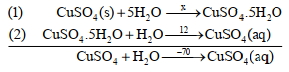
-
- (A) \(199\)
- (B) \(100\)
- (C) \(200\)
- (D) \(300\)
Show answer and solution
Correct Answer: (C)
As isothermal \(\Delta \mathrm{U}=0\)and process is irreversible
\(\mathrm{Q}=-\mathrm{W}=-\left[-\mathrm{P}_{\mathrm{ext}}\left(\mathrm{V}_2-\mathrm{V}_1\right)\right]\)
\(\mathrm{Q}=5(20-60)=-200 \mathrm{~atm}-\mathrm{L}\)
-
- (A) \(470\)
- (B) \(495\)
- (C) \(492\)
- (D) \(499\)
Show answer and solution
Correct Answer: (C)
\(2\mathrm{Fe}_{(\mathrm{s})}+\frac{3}{2} \mathrm{O}_{2(\mathrm{~g})} \rightarrow \mathrm{Fe}_2 \mathrm{O}_{3(\mathrm{~s})}, \Delta \mathrm{H}^{\mathrm{o}}=-822 \mathrm{~kJ} / \mathrm{mol}\) \(......(1)\)\(\mathrm{C}_{(\mathrm{s})}+\frac{1}{2} \mathrm{O}_{2(\mathrm{~g})} \rightarrow \mathrm{CO}_{(\mathrm{g})}, \Delta \mathrm{H}^{\mathrm{o}}=-110 \mathrm{~kJ} / \mathrm{mol}\) \(.......(2)\)
\(3\mathrm{C}_{(\mathrm{s})}+\mathrm{Fe}_2 \mathrm{O}_{3(\mathrm{~s})} \rightarrow 2 \mathrm{Fe}_{(\mathrm{s})}+3 \mathrm{CO}_{(\mathrm{g})}, \Delta \mathrm{H}_3=\text { ? }\)
\(\text { (3) }=3 \times(2)-(1)\)
\(\Delta \mathrm{H}_3=3 \times \Delta \mathrm{H}_2-\Delta \mathrm{H}_1\)
\(=3(-110)+822\)
\(=492 \mathrm{~kJ} / \mathrm{mole}\)+
-
- (A) \(38\)
- (B) \(39\)
- (C) \(40\)
- (D) \(45\)
Show answer and solution
Correct Answer: (A)
\(\mathrm{H}_2 \mathrm{O}(\ell) \rightleftharpoons \mathrm{H}_2 \mathrm{O}(\mathrm{g}) \quad \Delta \mathrm{H}_{\text {ap }}^0=40.79 \mathrm{~kJ} / \mathrm{mole}\)\(\Delta \mathrm{H}_{\text {vap }}^0=\Delta \mathrm{U}_{\text {vap }}^0+\Delta \mathrm{n}_{\mathrm{g}} \mathrm{RT}\)
\(40.79=\Delta \mathrm{U}_{\text {vap }}^0+\frac{1 \times 8.3 \times 373.15}{1000}\)
\(\Delta \mathrm{U}_{\text {Tap }}^0=40.79-3.0971\)
\(=37.6929\)
\(\Delta \mathrm{U}_{T \mathrm{ap}}^0 \simeq 38\)
-
- (A) \(2\)
- (B) \(5\)
- (C) \(8\)
- (D) \(9\)
Show answer and solution
Correct Answer: (A)
\(\mathrm{H}^{+}+\mathrm{OH} \rightarrow \mathrm{H}_2 \mathrm{O} \Rightarrow \mathrm{x}\)\(2 \mathrm{H}^{+}+2 \mathrm{OH} \rightarrow 2 \mathrm{H}_2 \mathrm{O} \Rightarrow 2 \mathrm{x}=\mathrm{y}\)
\(\mathrm{y} / \mathrm{x}=2\)
-
- (A) \(500\)
- (B) \(400\)
- (C) \(120\)
- (D) \(654\)
Show answer and solution
Correct Answer: (B)
At equilibrium \(\Delta \mathrm{G}_{\mathrm{PT}}=0\)\( \Delta \mathrm{H}_{\text {vap }}=\mathrm{T} \Delta \mathrm{S}_{\text {vap }} \)
\( 30 \times 1000=\mathrm{T} \times 75 \)
\( \mathrm{~T}=400 \mathrm{~K}\)
-
- (A) \(\Delta \mathrm{G}\) is negative for a spontaneous reaction
- (B) \(\Delta \mathrm{G}\) is positive for a spontaneous reaction
- (C) \(\Delta \mathrm{G}\) is zero for a reversible reaction
- (D) \(\Delta \mathrm{G}\) is positive for a non-spontaneous reaction
Show answer and solution
Correct Answer: (B)
\((\Delta \mathrm{G})_{\mathrm{P}, \mathrm{T}}=(+) \text { ve for non-spontaneous process }\) -
- (A) \(1005\)
- (B) \(1006\)
- (C) \(1004\)
- (D) \(1003\)
Show answer and solution
Correct Answer: (B)
Bomb calorimeter \(\rightarrow\) const volumeHeat released
By combustion of \(1\) mole
\(C _2 H _6(\Delta U )=-\frac{20 \times 0.5}{0.3} \times 30=-1000\,kJ\)
\(C _2 H _6( g )+7 / 2 O _2( g ) \rightarrow 2 CO _2( g )+3 H _2 O (l)\)
\(\Delta ng =2-(2+7 / 2)=-(7 / 2)\)
\(\Delta H =\Delta U +\Delta nRT\)
\(=-1000-7 / 2 \times 8.3 \times 300\,kJ\)
\(=-1000-6.225\)
\(=-1006\,kJ\)
So heat released \(=1006\,kJ\,mol ^{-1}\)
-
- (A) \(120\)
- (B) \(130\)
- (C) \(140\)
- (D) \(150\)
Show answer and solution
Correct Answer: (D)
\(q =0\)\(\Delta U = w\)
\(1 \times 20 \times\left[ T _2-300\right]=-3000\)
\(T _2-300=-150\)
\(T _2=150\,K\)
-
- (A) \(1070\)
- (B) \(1060\)
- (C) \(1050\)
- (D) \(1040\)
Show answer and solution
Correct Answer: (A)
\(\Delta S =\frac{\Delta H }{ T _{ mp }}\)\(28.4=\frac{30.4 \times 1000}{ T _{ mp }}\)
\(T _{ mp }=1070.422\,K\)
-
- (A) \(600\)
- (B) \(200\)
- (C) \(800\)
- (D) \(500\)
Show answer and solution
Correct Answer: (C)
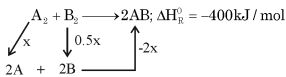
\(A _2+ B _2 \rightarrow 2 AB ; \Delta H _{ r }^0=-200\,kJ\,mol ^{-1}\)\(\Rightarrow \Delta H _{ p }^0( AB )=-200\,kJ\,mol\,m ^{-1}\)
\(\therefore \Delta H _{ R }^0\) for reaction \(A _2+ B _2 \rightarrow 2 AB\) is \(-400\,kJ\,mol ^{-1}\)
Given: Bond Enthalpy of \(A _2, B _2\) and \(AB\) is \(1: 0.5: 1\)
Assuming bond enthalpy of \(A _2\) be \(x\, kJ\, mol { }^{-1}\)
\(\therefore\) Bond enthalpy \(B _2=0.5 \times kJ\, mol ^{-1}\)
\(\therefore\) Bond enthalpy \(AB =( x ) kJ\, mol\, m ^{-1}\)
\(-400= x +0.5 x -2 x\)
\(-400=-0.5 x\)
\(\therefore x =800\,kJ / mol\)
-
- (A) \(180\)
- (B) \(360\)
- (C) \(90\)
- (D) \(45\)
Show answer and solution
Correct Answer: (B)
\(C _6 H _{12} O _6( s )+6 O _2 \rightarrow 6 CO _2( g )+6 H _2 O ( l )\)Extra energy used to convert \(H _2 O (1)\) into \(H _2 O (1)\) into \(H _2 O ( g )\)
\(=\frac{1800}{2}=900\,kJ\)
\(900= n _{ H _2 O } \times 45\)
\(n _{ H _2 O }=\frac{900}{45}=20\,mole\)
\(W _{ H _2 O }=20 \times 18=360\,g\)
-
- (A) \(3\)
- (B) \(6\)
- (C) \(8\)
- (D) \(2\)
Show answer and solution
Correct Answer: (D)
\(B\) and \(D\) options are correct. -
- (A) \(6\)
- (B) \(3\)
- (C) \(12\)
- (D) \(9\)
Show answer and solution
Correct Answer: (A)
\(\because \Delta G ^{\circ}=- RT \ln K _{ eq }\)\(\text { and } K _{ eq }=\frac{ K _{ f }}{ K _{ b }}\)
\(\therefore K _{ eq }=\frac{10^3}{10^2}=10\)
\(\therefore \Delta G =- RT \ln 10\)
\(\Rightarrow-(8.3 \times 300 \times 2.3)=-5.7\,kJ\,mole ^{-1} \approx 6\,kJ\)
\(\text { mole }{ }^{-1}(\text { nearest integer) }\)
\(\text { Ans }=6\)
-
- (A) \(6\)
- (B) \(4\)
- (C) \(8\)
- (D) \(2\)
Show answer and solution
Correct Answer: (D)
For, Spontaneous process \(dG < 0\)For, Equilibrium \(dG =0\)
For, Nonspontaneous process \(dG > 0\)
\(\therefore\) \(A\) Wrong
\(B\) Correct
\(C\) Correct
\(D\) Wrong
-
- (A) \(172\)
- (B) \(174\)
- (C) \(173\)
- (D) \(176\)
Show answer and solution
Correct Answer: (C)
\(\Delta_{ r } H =\sum H _{ p }-\sum H _{ R }\)\(=(-394+4 \times-92)-(-105+(2 \times-242))\)
\(=-173\,kJ / mol\)
-
- (A) \(1411\)
- (B) \(1412\)
- (C) \(1413\)
- (D) \(1414\)
Show answer and solution
Correct Answer: (A)
\(C _2 H _{4( g )}+3 O _{2( g )} \longrightarrow 2 CO _{2( g )}+2 H _2 O_{(l)}\)\(\Delta U =-1406\,KJ\,mol ^{-1}, T =300\,K\)
\(\Delta H =\Delta U +\Delta n _{ g } RT\)
\(\Delta H =-1406+(-2) \times 8.3 \times 300=-1406-4.98\)
\(=-1410.98\,KJ\,mol ^{-1} \approx-1411\)
\(\Delta H = T \Delta S =-1411\,KJ\,mol ^{-1}\)
-
- (A) \(4\)
- (B) \(6\)
- (C) \(2\)
- (D) \(8\)
Show answer and solution
Correct Answer: (C)
\(\Delta G =\Delta H - T \Delta S\)\(A : \Delta G \left( J\,mol ^{-1}\right)=-25 \times 10^3+80 \times 300:- ve\)
\(B : \Delta G \left( J\,mol ^{-1}\right)=-22 \times 10^3-40 \times 300:- ve\)
\(C : \Delta G \left( J\,mol ^{-1}\right)=25 \times 10^3+300 \times 50:+ ve\)
\(D : \Delta G \left( J\,mol ^{-1}\right)=22 \times 10^3-20 \times 300:+ ve\)
Processes \(C\) and \(D\) are non-spontaneous.
-
- (A) \(\frac{x-2 y}{2}\)
- (B) \(\frac{x+2 y}{2}\)
- (C) \(\frac{2 x - y }{2}\)
- (D) \(2 y-x\)
Show answer and solution
Correct Answer: (A)
Target equation\(C \text { (graphite) }+\frac{1}{2} O _{2( g )} \rightarrow CO _{( g )} \ldots \text {.(i) } \Delta H\)
\(C \left(\text { graphite) }+ O _{2( g )} \rightarrow CO _{2( g )} \text {.(ii) } \Delta H _1=- y\,kJ / mole \right.\)
\(CO _{2( g )} \rightarrow CO _{( g )}+\frac{1}{2} O _{2( g )} \ldots \text { (iii) } \Delta H _2=\frac{ x }{2}\,kJ / mole\)
\(\text { eq. (i) }=\text { eq.(ii) }+ \text { eq (iii) }\)
\(\therefore \Delta H =\frac{ x }{2}- y =\frac{ x -2 y }{2}\)
-
- (A) \(NaI < NaBr < NaCl < NaF\)
- (B) \(NaF < NaCl < NaBr < NaI\)
- (C) \(NaCl < NaF < NaBr < NaI\)
- (D) \(NaI < NaBr < NaF < NaCl\)
Show answer and solution
Correct Answer: (A)
For a given metal \(\Delta_{ f } H ^0\) always becomes less negative from fluoride to iodide. -
- (A) \(4\)
- (B) \(3\)
- (C) \(5\)
- (D) \(6\)
Show answer and solution
Correct Answer: (B)
\(\Delta \underset{\text { }}{S}= nR \ell n \left(\frac{ V _2}{ V _1}\right)\)\(=1 \times 8.314 \ell n \left(\frac{3}{2}\right)\)
\(\Delta S_{\text {System }}=3.37\)
\(\Delta S_{\text {Surr. }}=3.37\)
-
- (A) \(620\)
- (B) \(621\)
- (C) \(623\)
- (D) \(624\)
Show answer and solution
Correct Answer: (A)
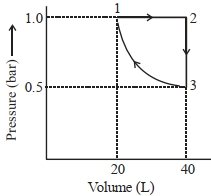
\(1 \rightarrow 2 \Rightarrow \text { Isobaric process }\)\(2 \rightarrow 3 \Rightarrow \text { Isochoric process }\)
\(3 \rightarrow 1 \Rightarrow \text { Isothermal process }\)
\(W = W _{1 \rightarrow 2}+ W _{2 \rightarrow 3}+ W _{3 \rightarrow 1}\)
\(=\left(- P \left( V _2- V _1\right)+0\left[- P _1 V _1 \ln \left(\frac{ V _2}{ V _1}\right)\right]\right)\)
\(=\left[-1 \times(40-20)+0+\left[-1 \times 20 \ln \left(\frac{20}{40}\right)\right]\right]\)
\(=-20+20 \ln 2\)
\(=-20+20 \times 2.3 \times 0.3\)
\(=-6.2 \text { bar } L\)
\(| W |=6.2 \text { bar } 1=620\,J\)
-
- (A) \(3\)
- (B) \(2\)
- (C) \(5\)
- (D) \(4\)
Show answer and solution
Correct Answer: (D)
\(Fe _2 O _3+2 Al \rightarrow Al _2 O _3+2 Fe\)Molar mass \(160\,g \quad 27\,g\)
\(\left(\Delta H _{ f }^0\right)_{\text {reaction }}=\left[\left(\Delta H _{ f }^0\right)_{ Al _2 O _3}+2\left(\Delta H _{ f }^0\right)_{ Fe }\right]\)
\(- \left[\left(\Delta H _{ f }^0\right)_{ Fe _2 O _3}+2\left(\Delta H _{ f }^0\right)_{ Al }\right]\)\(=[-1700+0]-[-840+0]\)
\(=-860\,kJ / mol\)
\(\text { Total mass of mixture }= Fe _2 O _3+ Al (1: 2 \text { molar }\)
\(\text { ratio })\)
\(=160+2 \times 27\)
\(=214\,g / mol\)
\(\text { Heat evolved per gram }=\frac{860}{214}=4\,kJ / g\)
-
- (A) \(600\)
- (B) \(620\)
- (C) \(630\)
- (D) \(610\)
Show answer and solution
Correct Answer: (D)
\(\frac{1}{2} Cl _{2( g )} \rightarrow Cl _{( g )} \rightarrow Cl _{( g )}^{-} \rightarrow Cl _{( aq .)}^{-}\)\(\Delta H ^{\circ}=\frac{1}{2} \times 240+(-350)+(-380)\)
\(=-610 \text { ans. }\)
-
- (A) \(3\)
- (B) \(2\)
- (C) \(4\)
- (D) \(1\)
Show answer and solution
Correct Answer: (C)
\(A \rightarrow\) Endothermic (Atomisation)\(B \rightarrow\) Endothermic (Atomisation)
\(C \rightarrow\) Endothermic (Vapourisation)
\(D \rightarrow\) Exothermic (Combustion)
\(E \rightarrow\) Endothermic (Dissolution)
- 86. The standard electrode potential of \(M ^{+} / M\) in aqueous solution does not depend on 2023 Medium
- (A) Ionisation of a solid metal atom
- (B) Sublimation of a solid metal
- (C) Ionisation of a gaseous metal atom
- (D) Hydration of a gaseous metal ion
Show answer and solution
Correct Answer: (A)
Factual -
- (A) \(4\)
- (B) \(8\)
- (C) \(2\)
- (D) \(6\)
Show answer and solution
Correct Answer: (A)
Extensive \(\Rightarrow\) Mole, Volume, Gibbs free energy.Intensive \(\Rightarrow\) Molar mass, Molar heat capacity, Molarity, \(E ^\theta\) cell.
-
- (A) \(11\)
- (B) \(12\)
- (C) \(14\)
- (D) \(10\)
Show answer and solution
Correct Answer: (D)
\(\Delta G ^0=\Delta H ^0- T \Delta S\)\(\Rightarrow \Delta G ^0=(-54070-10 \times 298)\)
Also, \(\Delta G ^0=(-2.303 RT \log K )\)
\(\Rightarrow(-54070-10 \times 298)\)
\(=(-2.303 \times 8.134 \times 298 \log K )\)
\(\Rightarrow \log K =10 \text { Ans: } 10\)
-
- (A)
System \(A\) System \(B\) Adiabatic system Temprature rise - (B)
System \(A\) System \(B\) Temprature falls Diathermic system - (C)
System \(A\) System \(B\) Temprature falls Temprature remains same - (D)
System \(A\) System \(B\) Temprature remains same Temprature rise
Show answer and solution
Correct Answer: (A)
Adiabatic boundary does not allow heat exchange thus heat generated in container can't escape out thereby increasing the temperature.In case of Diathermic container, heat flow can occur to maintain the constant temperature.
- (A)
-
- (A) \(1\)
- (B) \(0\)
- (C) \(2\)
- (D) \(3\)
Show answer and solution
Correct Answer: (B)
For ideal gas \(U = f ( T )\)and for isothermal process, \(\Delta U =0\)
-
- (A) \(1100\)
- (B) \(1200\)
- (C) \(1000\)
- (D) \(1600\)
Show answer and solution
Correct Answer: (B)
Power of heater \(=60\,W\) \(=60\,J / sec\)Total energy emitted \(=60 \times 100=6000\,J\)
Heat capacity \(\times\) temp difference \(=6000\)
Heat capacity \(=\frac{6000}{5}=1200\,JK ^{-1}\)
-
- (A) \(C\) and \(D\) only
- (B) \(B\) and \(C\) only
- (C) \(A\) and \(B\) only
- (D) \(B\) and \(D\) only
Show answer and solution
Correct Answer: (B)
Only \((B)\) and \((C)\) are correct.\((B)\) \(G = H - TS\)
At constant \(T\)
\(\Delta G =\Delta H - T \Delta S\)
(A) First law is given by
\(\Delta U = Q + W\)
If we apply constant \(P\) and reversible work
\(\Delta U = Q - P \Delta V\)
(C)By definition of entropy change
\(dS =\frac{ dq _{ rer }}{ T }\)
At constant \(T\)
\(\Delta S=\frac{q_{\text {rev }}}{T}\)
(D) \(H = U + PV\)
For ideal gas
\(H = U + nRT\)
At constant \(T\)
\(\Delta H =\Delta U +\Delta nRT\)
-
- (A) \(81\)
- (B) \(117\)
- (C) \(453\)
- (D) \(751\)
Show answer and solution
Correct Answer: (B)
Given data is for \(1 \,moles\) and asked for \(5\, moles\) so value is \(23.4 \times 5=117\, kJ\) -
- (A) \(455\)
- (B) \(45\)
- (C) \(95\)
- (D) \(195\)
Show answer and solution
Correct Answer: (D)
\(N _{2} O\) moles \(=\frac{2.2}{44}=\frac{1}{20}\)\(\Delta H = nC _{ p } \Delta T =\frac{1}{20} \times 100(-40)=-200\, J\)
\(\Delta U = q _{ p }+ w\)
\(w =- P _{\text {ext. }} \Delta\, V\)
\(W =-1 \frac{(167.75-217.1)}{1000} \times 101.3 \,J\)
\(W =+5 \,J\)
\(\Delta U =-200+5=-195\, J\)
-
- (A) \(201\)
- (B) \(202\)
- (C) \(203\)
- (D) \(200\)
Show answer and solution
Correct Answer: (D)
\(C ( s )+ O _{2}( g ) \rightarrow CO _{2}( g ) ; \Delta H =- x kJ / mole\) \(Q = C \Delta T =20\,kJ \times 2\)\(40\,kJ\) heat is released for \(2.4\,g\) of \(C\)
For \(1\,mole\) ' \(C\) ' : \(\quad Q =\frac{40}{2.4} \times 12\)
\(=\frac{400}{24} \times 12=200\,kJ / \text { mole }\)
\(Q =\Delta E =\Delta H =200\,kJ \left(\because \Delta n _{ g }=0\right)\)
\(x =200\)
-
- (A) \(10\)
- (B) \(20\)
- (C) \(0\)
- (D) \(1\)
Show answer and solution
Correct Answer: (C)
For free expansion:\(P _{\text {ext }}=0, w =0\)
\(q =0, \Delta U =0\)
-
- (A) \(66\)
- (B) \(96\)
- (C) \(50\)
- (D) \(38\)
Show answer and solution
Correct Answer: (D)
\(H _{2} O (l) \rightarrow H _{2} O\, ( g )\)\(n =\frac{36}{18}=2\, mol\)
\(\Delta U =\Delta H -\Delta n _{ g } RT\)
\(=41.1-\frac{1 \times 8.31 \times 373}{1000} \,kJ / mol\)
\(=38\, kJ / mol\)
-
- (A) \(35\)
- (B) \(34\)
- (C) \(33\)
- (D) \(32\)
Show answer and solution
Correct Answer: (A)
Let \(x g\) is burnt\(\text { moles }=\frac{ x }{280}\)
heat released by \(\frac{ x }{280}\) mole \(=2.5 \times 0.45\,kJ\)
heat released by \(1\,mole\) \(=\frac{2.5 \times 0.45 \times 280}{ x } kJ\)
\(\Delta H =\Delta U +\Delta ngRT\)
\(\Delta H \simeq \Delta U\)
\(9=\frac{2.5 \times 280 \times 0.45}{ x }\)
\(x =35\,g\)
-
- (A) \(2\)
- (B) \(3\)
- (C) \(4\)
- (D) \(6\)
Show answer and solution
Correct Answer: (B)
Internal energy, volume enthalpy are state variable -
- (A) \(+54.0\, kJ \,mol ^{-1}\)
- (B) \(-68.0 \,kJ \,mol ^{-1}\)
- (C) \(-86.0\, kJ \,mol ^{-1}\)
- (D) \(+97.0\, kJ \,mol ^{-1}\)
Show answer and solution
Correct Answer: (C)
\(C _{2} H _{6}( g )+\frac{7}{2} O _{2}( g ) \rightarrow 2 CO _{2}( g )+3 H _{2} O (\ell)\)\(\Delta_{ C } H \left( C _{2} H _{6}\right)=2 \Delta_{ f } H CO _{2}( g )+3 \Delta_{ f } H \left( H _{2} O , \ell\right)\)
\(-\Delta_{ f } H ^{\prime}\left( C _{2} H _{6}, g \right)\)
\(-1560=2(-394)+3(-286)-\Delta_{ f } H \left( C _{2} H _{6}, g \right)\)
\(\Delta_{ f } H \left( C _{2} H _{6}, g \right)=-86 \,kJ / mole\)
No questions on this page match these filters.