


All Thermodynamics and thermochemistry questions
Newest firstShowing 101–150 of 204 questions
-
- (A) \(+\,324\)
- (B) \(+\,632\)
- (C) \(-\,632\)
- (D) \(-\,324\)
Show answer and solution
Correct Answer: (C)
\(\Delta H =\sum \Delta H _{\text {Combustion }}\) (Reactant) \(-\sum \Delta H _{\text {Combustion }}\) (Product)\(=3 \times(-1300)\,-\,[-3268]\)
\(=-632\, kJ\, mol ^{-1}\)
-
- (A) \(1600\; kJ\)
- (B) \(3200\; kJ\)
- (C) \(4400\; kJ\)
- (D) \(6600\; kJ\)
Show answer and solution
Correct Answer: (D)
\(C ( S )+ O _{2}( g ) \rightarrow CO _{2}( g )+400\; kJ\)\(1\; g \;mole\)
\(C ( s )+\frac{1}{2} O _{2}( g ) \rightarrow CO ( g )+100\; kJ \ldots (II)\)
\(0.6 \times 1000\)
\(=600 \;gm\)
\(600 \times \frac{60}{100}\) (Pure Carbon)
\(=360 \;gm =\frac{360}{12}=30 \;mole\) (Pure Carbon)
Carbon converted into \(CO _{2}=\left(30-30 \times \frac{60}{100}\right)\)
\(=12\; mole\)
and carbon converted in \(CO =30 \times \frac{60}{100}=18\; mole\)
Energy generated during \(II\) equation
\(=18 \times 100\)
\(=1800 \;kJ\)
Energy generated during \(I^{st}\) equation
\(=12 \times 400\)
\(=4800\)
Total \(=1800+4800=6600\; kJ\)
-
- (A) \(1200\)
- (B) \(600\)
- (C) \(120\)
- (D) \(900\)
Show answer and solution
Correct Answer: (B)
\(Mg ( s )+\frac{1}{2} O _{2}( g ) \rightarrow MgO ( s )\)\(\Delta H =\Delta U +\Delta n _{ g } RT\)
\(-601.70 \times 10^{3}=\Delta U -\frac{1}{2} \times 8.3 \times 300\)
\(-601.70\, kJ =\Delta U -1.245\, kJ\)
\(\Delta U =-600.455\, kJ\)
-
- (A) \(314\)
- (B) \(632\)
- (C) \(552\)
- (D) \(727\)
Show answer and solution
Correct Answer: (D)
\(\Delta U =-726\, KJ / mol\)\(\Delta ng =1-3 / 2=\frac{-1}{2}\)
\(\Delta H =\Delta U +\Delta ngRT\)
\(=-726-\frac{1}{2} \times \frac{8.3 \times 300}{1000}\)
\(=-727.245\)
-
- (A) \(A\) and \(D\) only
- (B) \(A\) and \(C\) only
- (C) \(B\) and \(C\) only
- (D) \(B\) and \(D\) only
Show answer and solution
Correct Answer: (C)
For micelle formation, \(\Delta S >0\) (hydrophobic effect) This is possible because, the decrease in entropy due to clustering is offset by increase in entropy due to desolvation of the surfactant, Also \(\Delta H >0\) -
- (A) \(57\)
- (B) \(55\)
- (C) \(56\)
- (D) \(54\)
Show answer and solution
Correct Answer: (A)
\(\Delta H =\Delta U +\Delta n _{ g } RT\)\(\Delta H =-59.6+1 \times 8.314 \times 300 \times 10^{-3}=-57.10\)
-
- (A) \(5\)
- (B) \(96\)
- (C) \(51\)
- (D) \(57\)
Show answer and solution
Correct Answer: (C)
\(\frac{1}{2} H _{2}+ Ag ^{+} \rightarrow H ^{+}+ Ag\)\(\Delta G ^{\circ}=- nE ^{\circ} F\)
\(=-1 \times 0.5332 \times 96500 \,J\)
\(=-51.35 \,kJ\)
\(\left( n =2 \text { for } H _{2}+2 Ag ^{+} \rightarrow 2 H ^{+}+2 Ag \right)\)
-
- (A) \(( A )-( III ),( B )-( II ),( C )-( IV ),( D )-( I )\)
- (B) \(( A )-( II ),( B )-( III ),( C )-( IV ),( D )-( I )\)
- (C) \(( A )-( II ),( B )-( III ),( C )-( I ),( D )-( IV )\)
- (D) \(( A )-( II ),( B )-( I ),( C )-( III ),( D )-( IV )\)
Show answer and solution
Correct Answer: (B)
\((A)\) For a spontaneous process \(\Delta G _{ T , p }\, < \,0\)\((B)\;\Delta P =0 \rightarrow\) Isobaric process
\(\Delta T =0 \rightarrow\) Isothermal process
\((C)\;\Delta H _{\text {reaction }}=(\Sigma\) Bond energies of reactants \() - (\Sigma\) bond energies of products)
\((D)\;\Delta H\, < \,0\) is for exothermic reaction
-
- (A) \(105\)
- (B) \(106\)
- (C) \(104\)
- (D) \(103\)
Show answer and solution
Correct Answer: (C)
\(3 C _{( gr )}+4 H _{2( g )} \rightarrow C _{3} H _{8( g )}\)\(=-103.7\,kJ\,mol ^{-1}\)
-
- (A) \(1\)
- (B) \(2\)
- (C) \(3\)
- (D) \(4\)
Show answer and solution
Correct Answer: (B)
\(C _{ p , m }= C _{ v , m }+ R\)\(\Rightarrow C _{ v , m }=20.785-8.314=12.471\,J\,k ^{-1}\,ml ^{-1}\)
\(\Delta U = nC _{ r , m } \Delta T\)
\(\Rightarrow n =\frac{5000}{12.471 \times 200}=\frac{25}{12.471} \approx 2\)
-
- (A) \(30\)
- (B) \(300\)
- (C) \(210\)
- (D) \(670\)
Show answer and solution
Correct Answer: (B)
\(\Delta G =\Delta H - T \Delta S =0\) at equilibrium\(\Rightarrow-165 \times 10^{3}- T \times(-505)=0\)
\(\Rightarrow T =300\, K\)
-
- (A) \(6574\)
- (B) \(1245\)
- (C) \(9130\)
- (D) \(8630\)
Show answer and solution
Correct Answer: (D)
\(n =5 \,mol\)\(T =300\, K\)
\(V _{1}=10\, L\)
\(V _{2}=20 \,L\)
\(W =- nRT \ell n \frac{ V _{2}}{ V _{1}}\)
\(=-5 \times 8.3 \times 300 \times \ell n \frac{20}{10}\)
\(=-8630.38\, J\)
-
- (A) \(53\)
- (B) \(54\)
- (C) \(55\)
- (D) \(56\)
Show answer and solution
Correct Answer: (B)
\(HNO _{3} \quad NaOH\)\(600 \;mL \times 0.2\; M \quad 400 \;mL \times 0.1 \;M\)
\(=120\; m \;mol \quad=40 \;m\; mol\)
\(HNO _{3}+ NaOH \rightarrow NaNO _{3}+ H _{2} O\)
\(\begin{array}{lccc}\text { Bef. } & 120 & 40 \\ \text { Aft. } & 80 & 0 & 40\; m\; mol\end{array}\)
\(\Delta_{ r } H =40 \;m \;mol \times\left(57 \times 10^{3}\right) \frac{ J }{ mol }\)
\(=40 \times 10^{-3} mol \times 57 \times 10^{3} \frac{ J }{ mol }\)
\(=2280\; J\)
\(m\; S \Delta T =2280\)
\(\Rightarrow 1000\; mL \times \frac{1 gm }{ mL } \times 4,2 \times \Delta T =2280\)
\(\Delta T =\frac{2280}{4.2} \times 10^{-3}\)
\(=\frac{22800}{42} \times 10^{-3}\)
\(=542.86 \times 10^{-3}\)
\(\Delta T =54.286 \times 10^{-2}\; K\)
\(\Delta T =54.286 \times 10^{-20} \;C\)
Ans \(54.286\)
-
- (A) \(\Delta H =\Delta U - P \Delta V\)
- (B) \(\Delta U = q + W\)
- (C) \(\Delta S _{ syz }+\Delta S _{ suxr } \geq 0\)
- (D) \(\Delta G =\Delta H - T \Delta S\)
Show answer and solution
Correct Answer: (A)
If \(U + P _{ V }\) (By definition)\(\Delta 14=\Delta U +\Delta( Pr )\) at constant pressure
\(\Delta H =\Delta U + P \Delta V\)
-
- (A) \(5\)
- (B) \(2\)
- (C) \(4\)
- (D) \(3\)
Show answer and solution
Correct Answer: (B)
\(\Delta H _{\text {ionisation }}\) of \(CH _{3} COOH =|-57.3-(-55.3)|\)\(=2\,KJ / mol\)
-
- (A) \(12\)
- (B) \(125\)
- (C) \(82\)
- (D) \(74\)
Show answer and solution
Correct Answer: (C)
\(\Rightarrow \text { Millimoles of } \mathrm{HCl}=200 \times 0.2=40\)\(\Rightarrow \text { Millimoles of } \mathrm{NaOH}=300 \times 0.1=30\)
\(\Rightarrow \text { Heat released }=\left(\frac{30}{1000} \times 57.1 \times 1000\right)=1713 \,\mathrm{~J}\)
\(\Rightarrow \text { Mass of solution }=500 \,\mathrm{ml} \times 1 \,\mathrm{gm} / \mathrm{ml}=500 \,\mathrm{gm}\)
\(\Rightarrow \Delta \mathrm{T}=\frac{\mathrm{q}}{\mathrm{m} \times \mathrm{C}}=\frac{1713\, \mathrm{~J}}{500\, \mathrm{~g} \times 4.18\, \frac{\mathrm{J}}{\mathrm{g}-\mathrm{K}}}=0.8196\, \mathrm{~K}\)
\(=81.96 \times 10^{-2}\, \mathrm{~K}\)
-
- (A) \(50\)
- (B) \(55\)
- (C) \(60\)
- (D) \(40\)
Show answer and solution
Correct Answer: (A)
\(w=-200\, J, q=+150: \Delta U=q+w\)\(\Delta U=150-200=-50\, \mathrm{~J}\)
\(\text { magnitude }=50 \,\mathrm{~J}=|\Delta \mathrm{U}|\)
-
- (A) \(700\)
- (B) \(667\)
- (C) \(845\)
- (D) \(321\)
Show answer and solution
Correct Answer: (B)
\(2700\, \mathrm{~kJ}\) energy requires \(=180\, \mathrm{gm}\)\(10000\, \mathrm{~kg}\) energy requires \(=\frac{180 \times 10000}{2700} \,\mathrm{gm}\)
mass of glucose \(=667\, \mathrm{gm}\)
-
- (A) \(855\)
- (B) \(952\)
- (C) \(412\)
- (D) \(1054\)
Show answer and solution
Correct Answer: (A)
\(3 HC \equiv CH _{( g )} \rightarrow C _{6} H _{6}(\ell): \Delta G ^{0}=- RT \ln k\)\(\Delta G _{ f }^{0}-2.04 \times 10^{5} \,\frac{ J }{ mol }-1.24 \times 10^{5}\, \,J / mol\)
\(\Rightarrow \Delta G ^{0}=\sum\left(\Delta G _{ f }^{0}\right)_{ P }-\sum\left(\Delta G _{ f }^{0}\right)_{ R }\)
\(\Rightarrow- RT \,\ell nk =1 \times\left(-124 \times 10^{5}\right)-\left(-3 \times 2.04 \times 10^{5}\right)\)
\(\Rightarrow-2.303 \times R \times T \log\, k =4.88 \times 10^{5}\)
\(\Rightarrow \log k =-\frac{4.88 \times 10^{5}}{2.303 \times R \times T }=-\frac{488000}{5705.848}=-85.52\)
\(=855 \times 10^{-1}\)
\(\Rightarrow x =855\)
-
- (A) \(2218\)
- (B) \(2222\)
- (C) \(2988\)
- (D) \(3418\)
Show answer and solution
Correct Answer: (A)
\(T =298 \,K , R =8.314\, \frac{ J }{ molK }\)\(\rightarrow\) Chemical reaction is
\(Fe +2 HCl \rightarrow FeCl _{2}+ H _{2}( g )\)
\(50\,g\) \(\quad\quad\quad\quad P =1\, bar\)
\(=\frac{50}{55.85} \,mol\)
\(\rightarrow\) Work done for \(1 \,mol\) gas \(=- P _{ ext } \times \Delta\, V\)
\(=\Delta ng \,RT\)
\(=-1 \times 8.314 \times 298\, J\)
\(\rightarrow\) Work done for \(\frac{50}{55.85}\, mol\) of gas
\(=-1.8314 \times 298 \times \frac{50}{55.85}\, J\)
\(=-2218.059 \,J\)
\(\simeq-2218\, J\)
-
- (A) \(E_{H}=\frac{1}{2} E_{D}\)
- (B) \(E_{H}=E_{D}\)
- (C) \(E_{H}=2 E_{D}\)
- (D) \(E_{H} \simeq E_{D}-7.5\)
Show answer and solution
Correct Answer: (D)
Enthalpy of bond dissociation \((\mathrm{kJ} / \mathrm{mole})\) at \(298.2\, \mathrm{~K}\)For, hydrogen \(=4.35 .88\)
For, Deuterium \(=443.35\)
\(\therefore E_{H}=E_{D}-7.5\)
-
- (A) \(99\)
- (B) \(100\)
- (C) \(101\)
- (D) \(201\)
Show answer and solution
Correct Answer: (C)
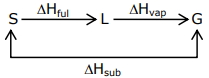
\(\Delta \mathrm{H}_{\text {sub }}=\Delta \mathrm{H}_{\text {fus. }}+\Delta \mathrm{H}_{\text {vap. }}\)\(=2.8+98.2\)
\(=101\, \mathrm{KJ} / \mathrm{mol}\)
-
- (A) \(0.25\)
- (B) \(2.5\)
- (C) \(250\)
- (D) \(25\)
Show answer and solution
Correct Answer: (D)
\(\Delta \mathrm{G}^{\circ}=-\mathrm{nFE}^{\circ}=\Delta \mathrm{H}^{\circ}-\mathrm{T} \Delta \mathrm{S}^{\circ}\)\(=\frac{\Delta \mathrm{H}^{\circ}+\mathrm{nFE}^{\circ}}{\mathrm{T}}\)
\(=\frac{\left(-825.2 \times 10^{3}\right)+(2 \times 96487 \times 4.315)}{298}\)
\(=\frac{-825.2 \times 10^{3}+832.682 \times 10^{3}}{298}\)
\(=\frac{7.483 \times 10^{3}}{298}=25.11\, \mathrm{JK}^{-1}\, \mathrm{~mol}^{-1}\)
\(\therefore\) Nearest integer answer is \(25\)
-
- (A) \(964\)
- (B) \(864\)
- (C) \(96.4\)
- (D) \(9.64\)
Show answer and solution
Correct Answer: (A)
\(\mathrm{T}_{\min }=\left(\frac{\Delta^{0} \mathrm{H}}{\Delta^{0} \mathrm{~S}}\right)\)\(\Delta^{0} \mathrm{H}_{\mathrm{rxn}}=\left[\Delta_{\mathrm{f}}^{0} \mathrm{H}(\mathrm{Fe})+\Delta_{\mathrm{f}}^{0} \mathrm{H}(\mathrm{CO})\right]-\)
\(=\left[\Delta_{\mathrm{f}}^{0} \mathrm{H}(\mathrm{FeO})+\Delta_{\mathrm{f}}^{0} \mathrm{H}\left(\mathrm{C}_{(\text {graphite })}\right)\right]\)
\(=[0-110.5]-[-266.3+0]\)
\(=155.8 \, \mathrm{~kJ} / \mathrm{mol}\)
\(\Delta^{0} \mathrm{~S}_{\mathrm{rxn}}=\left[\Delta^{0} \mathrm{~S}(\mathrm{Fe})+\Delta^{0} \mathrm{~S}(\mathrm{CO})\right]-\)
\(\left[\Delta^{0} \mathrm{~S}(\mathrm{FeO})+\Delta^{0} \mathrm{~S}\left(\mathrm{C}_{(\mathrm{graphite})}\right)\right]\)
\(=[27.28+197.6]-[57.49+5.74]\)
\(=161.65 \,\mathrm{~J} / \mathrm{mol}-\mathrm{K}\)
\(\mathrm{T}_{\min }=\frac{155.8 \times 10^{3} \,\mathrm{~J} / \mathrm{mol}}{161.65\, \mathrm{~J} / \mathrm{mol}-\mathrm{K}}=963.8\, \mathrm{~K}\)
\(\simeq 964 \,\mathrm{k}\) (nearest integer)
-
- (A) \((A), (B), (C)\) and \((D)\) only
- (B) \((B)\) and \((C)\) only
- (C) \((A)\) and \((E)\) only
- (D) \((A), (C)\) and \((E)\) only
Show answer and solution
Correct Answer: (A)
\((A)\) Water \(\stackrel{0^{\circ} C }{\longrightarrow}\) ice \(; \Delta S =- ve\)\((B)\) Water \(\stackrel{-10^{\circ} C }{\longrightarrow}\) ice; \(\Delta S =- ve\)
\((C)\) \(N _{2}( g )+3 H _{2}( g ) \rightarrow 2 NH _{3}( g ) ; \Delta S =- ve\)
\((D)\) Adsorption; \(\Delta S =- ve\)
\((E)\) \(NaCl ( s ) \rightarrow Na ^{+}( aq )+ Cl ^{-}( aq ) ; \Delta S =+ ve\)
-
- (A) \(50\)
- (B) \(250\)
- (C) \(200\)
- (D) \(150\)
Show answer and solution
Correct Answer: (C)
\(\Delta G ^{0}=\Delta H ^{0}- T \times \Delta S ^{0}\)\(\Delta G ^{0}=\Delta H ^{0}- T \times(2 T )\)
\(T =200\, K\)
-
- (A) \(360\)
- (B) \(390\)
- (C) \(460\)
- (D) \(551\)
Show answer and solution
Correct Answer: (A)
Given chemical reaction:\(\mathrm{A} \underset{\mathrm{T}\, 300\, \mathrm{~K}}{\longrightarrow} \mathrm{B}\)
\([\Delta \mathrm{G}]_{\mathrm{P}, \mathrm{T}}=-49.4\, \mathrm{~kJ} / \mathrm{mol}\)
\(\Delta \mathrm{H}_{\mathrm{rxn}}=51.4 \,\mathrm{~kJ} / \mathrm{mol}\)
\(\Delta \mathrm{S}_{\mathrm{rxn}}=?\)
\(\Rightarrow\) From the relation \([\Delta \mathrm{G}]_{\mathrm{P}, \mathrm{T}}=\Delta \mathrm{H}-\mathrm{T} \Delta \mathrm{S}\)
\(\Rightarrow \Delta S_{\text {rxn }} =\frac{\Delta H_{r x n}-[\Delta G]_{p, T}}{T}\)
\(=\frac{[51.4-(-49.4)] \times 100}{300} \,\frac{\mathrm{J}}{\mathrm{mol} \mathrm{K}}\)
\(\Rightarrow \Delta \mathrm{S}_{\mathrm{rxn}} =336\, \frac{\mathrm{J}}{\mathrm{mol} \mathrm{K}}\)
-
- (A) \(49\)
- (B) \(36\)
- (C) \(55\)
- (D) \(46\)
Show answer and solution
Correct Answer: (D)
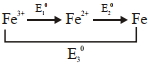
\(E _{1}^{0}+2 E _{2}^{0}=3 E _{3}^{0}\)\(E _{1}^{0}=3 E _{3}^{0}-2 E _{2}^{0}\)
\(=3(-0.036)-2(-0.44)\)
\(=+0.772 V\)
\(E _{\text {cell }}^{0}= E _{ Fe ^{3+} / Fe ^{2+}}^{0}+ E _{ I / I _{2}}^{0}=0.233\)
\(\Delta_{ r } G ^{0}=-2 \times 96.5 \times 0.233=-45 kJ\)
-
- (A) \(15\)
- (B) \(10\)
- (C) \(5\)
- (D) \(8\)
Show answer and solution
Correct Answer: (C)
\(\Delta \mathrm{G}=\Delta \mathrm{H}-\mathrm{T} \Delta \mathrm{S}\)\(\Delta \mathrm{G}=57.8-\frac{298(-176)}{1000}\)
\(\Delta \mathrm{G}=-5.352 \,\mathrm{~kJ} / \mathrm{mole}\)
\(\mid\) Nearest integer value \(\mid=5\)
-
- (A) \(25\)
- (B) \(30\)
- (C) \(20\)
- (D) \(35\)
Show answer and solution
Correct Answer: (C)
\(\Delta G ^{\circ}=- RT \ell n K _{ eq }\)Given \(\Delta G ^{\circ}=-9.478 KJ / mole\)
So \(-9.478 \times 10^{3}=-495 \times 8.314 \times \ell n K _{ eq }\)
\(\ell n K _{ eq }=2.303\)
\(=\ell n 10\)
So \(K _{ eq }=10\)
Now \(A ( g ) \rightleftharpoons B ( g )\)
\(\begin{array}{lll} t =0 & 22 0\end{array}\)
\(\begin{array}{lll}t=t 22-x x\end{array}\)
\(K _{ eq }=\frac{[ B ]}{[ C ]}=\frac{ x }{22- x }=10\)
or \(x=20\)
So millmoles of \(B =20\)
-
- (A) \(120\)
- (B) \(132\)
- (C) \(128\)
- (D) \(125\)
Show answer and solution
Correct Answer: (C)
\(\Delta_{ r } H =\left[\epsilon_{ C - C }+2 \epsilon_{ C - H }\right]-\left[\epsilon_{ C = C }+\epsilon_{ H - H }\right]\)\(=[347+2 \times 414]-[611+436]\)
\(=128\)
-
- (A) \(70\)
- (B) \(89\)
- (C) \(40\)
- (D) \(31\)
Show answer and solution
Correct Answer: (D)
\(\mathrm{H}_{2} \mathrm{O}_{(\ell)} \rightleftharpoons \mathrm{H}_{2} \mathrm{O}_{(\mathrm{v})}\)\(\Delta \mathrm{H}=\Delta \mathrm{U}+\Delta \mathrm{n}_{\mathrm{g}} \mathrm{RT}\)
for \(1\, mole\) waters;
\(\Delta \mathrm{n}_{\mathrm{g}}=1\)
\(\therefore \Delta \mathrm{n}_{\mathrm{g}} \mathrm{RT}=1 \,\mathrm{~mol} \times 8.31\, \mathrm{~J} / \mathrm{mol}-\mathrm{k} \times 373\, \mathrm{~K}\)
\(=3099.63\, \mathrm{~J} \cong 31 \times 10^{2}\, \mathrm{~J}\)
-
- (A) \(3.8\)
- (B) \(38\)
- (C) \(380\)
- (D) \(410\)
Show answer and solution
Correct Answer: (B)
Given equation is\(\mathrm{H}_{2} \mathrm{O}(\ell) \longrightarrow \mathrm{H}_{2} \mathrm{O}(\mathrm{g}): \Delta \mathrm{H}=41\, \frac{\mathrm{kJ}}{\mathrm{mol}}\)
\(\Rightarrow \text { From the relation : } \Delta \mathrm{H}=\Delta \mathrm{U}+\Delta \mathrm{n}_{\mathrm{g}} \mathrm{RT}\)
\(\qquad \Rightarrow 41\, \frac{\mathrm{kJ}}{\mathrm{mol}}=\Delta \mathrm{U}+(1) \times \frac{8.3}{1000} \times 373\)
\(\Rightarrow \mathrm{DU}=41-3.0959\)
\(=38\, \mathrm{~kJ} / \mathrm{mol}\)
-
- (A) \(718\)
- (B) \(951\)
- (C) \(632\)
- (D) \(521\)
Show answer and solution
Correct Answer: (A)
\(\Delta_{\mathrm{f}} \mathrm{H}_{\mathrm{KCl}}^{\Theta}=\Delta_{\text {sub }} \mathrm{H}_{(\mathrm{K})}^{\Theta}+\Delta_{\text {ionization }} \mathrm{H}_{(\mathrm{K})}^{\Theta}+\frac{1}{2} \Delta_{\mathrm{bond}} \mathrm{H}_{\left(\mathrm{Cl}_{2}\right)}^{\Theta}\)\(+\Delta_{\text {electron gain }} \mathrm{H}_{(\mathrm{Cl})}^{\ominus}+\Delta_{\text {lattice }} \mathrm{H}_{(\mathrm{KCl})}^{\ominus}\)
\(\Rightarrow-436.7=89.2+419.0+\frac{1}{2}(243.0)+\{-348.6\}\)
\(+\Delta_{\text {lattice }} \mathrm{H}_{(\mathrm{KCl})}^{\ominus}\)
\(\Rightarrow \Delta_{\text {lattice }} \mathrm{H}_{(\mathrm{KCl})}^{\ominus}=-717.8 \mathrm{~kJ}\, \mathrm{~mol}^{-1}\)
The magnitude of lattice enthalpy of \(\mathrm{KCl}\) in \(\mathrm{kJ}\,\mathrm{mol}^{-1}\) is \(718\) (Nearest integer).
-
- (A) \(5581\)
- (B) \(4856\)
- (C) \(5596\)
- (D) \(5576\)
Show answer and solution
Correct Answer: (D)
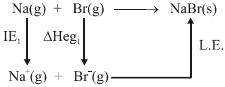
\(\Delta H _{\text {formation }}= IE _{1}+\Delta Heg _{1}+ LE\)\(=495.8+(-325)+(-728.4)\)
\(=-557.6\)
\(=-5576 \times 10^{-1} KJ / mol .\)
Note: The above calculation is not for \(\Delta H _{\text {formation }}\) but for \(\Delta H _{ Reaction}\)
But on the basis of given data it is the best ans.
-
- (A) \(343\)
- (B) \(741\)
- (C) \(783\)
- (D) \(561\)
Show answer and solution
Correct Answer: (B)
\(\Delta H =\Delta U +\Delta n _{ g } RT\)\(=-742.24+\frac{1}{2} \times \frac{8.314}{1000} \times 298\)
\(=-741 kJ / mol\)
-
- (A) \(220\)
- (B) \(240\)
- (C) \(230\)
- (D) \(250\)
Show answer and solution
Correct Answer: (C)
Given reaction:\(3 CaO + Al \rightarrow Al _{2} O _{3}+3 Ca\)
Now, \(\Delta_{ r } H ^{\circ}=\Sigma \Delta_{ f } H _{\text {Products }}^{\circ}-\Sigma \Delta_{ f } H _{\text {Reactants }}^{\circ}\)
\(=[1 \times(-1675)+3 \times 0]-[3 \times(-635)+2 \times 0]\)
\(=+230 kJ mol ^{-1}\)
-
- (A) \(4\)
- (B) \(2\)
- (C) \(86\)
- (D) \(90\)
Show answer and solution
Correct Answer: (B)
\(\mathrm{n}_{\mathrm{H}^{+}}=\frac{400 \times 0.2}{1000} \times 2=0.16\)\(\mathrm{n}_{\mathrm{OH}^{-}}=\frac{600 \times 0.1}{1000}=0.06\, \text { (L.R.) }\)
Now, heat liberated from reaction
\(=\) heat gained by solutions
or, \(0.06 \times 57.1 \times 10^{3}\)
\(=(1000 \times 1.0) \times 4.18 \times \Delta \mathrm{T}\)
\(\therefore \Delta \mathrm{T}=0.8196\, \mathrm{~K}\)
\(=81.96 \times 10^{-2}\, \mathrm{~K} \approx 82 \times 10^{-2} \,\mathrm{~K}\)
-
- (A) all the atoms of a given element have identical properties including identical mass. Atoms of different elements differ in mass
- (B) chemical reactions involve reorganisation of atoms. These are neither created nor destroyed in a chemical reaction.
- (C) when gases combine or reproduced in a chemical reaction they do so in a simple ratio by volume provided all gases are at the same \(T\) and \(P.\)
- (D) matter consists of indivisible atoms.
Show answer and solution
Correct Answer: (C)
according to Gaylussac's law of volume combination when gases combine or reproduced in a chemical reaction they do so in a simple ratio by volume provided all gases are at the same \(T\) and \(P.\) -
- (A) \(6\)
- (B) \(8\)
- (C) \(10\)
- (D) \(12\)
Show answer and solution
Correct Answer: (A)
\(\Delta G ^{\circ}=- AFE ^{\circ}=-3 \times 96500 \times E ^{\circ}\)\(\Rightarrow E ^{\circ}=-6 \times 10^{-2} V\)
-
- (A) \(7.25\)
- (B) \(6.75\)
- (C) \(7\)
- (D) \(6.25\)
Show answer and solution
Correct Answer: (D)
For ideal gas:\(\Delta \mathrm{U}=\mathrm{nC}_{\mathrm{V}}\left[\mathrm{T}_{2}-\mathrm{T}_{1}\right]\)
\(\Rightarrow \quad 5000=4 \times \mathrm{C}_{\mathrm{V}}[500-300]\)
\(\Rightarrow \quad \mathrm{C}_{\mathrm{v}}=\frac{5000}{800}=6.25 \mathrm{J}\) \(mole\) \(^{-1} \mathrm{K}^{-1}\)
- 142. Five moles of an ideal gas at \(1\) bar and \(298\, K\) is expanded into vacuum to double the volume. The work done is :- 2020 Medium
- (A) \(C _{ V }\left( T _{2}- T _{1}\right)\)
- (B) \(- RT \ln V _{2} / V _{1}\)
- (C) \(- RT \left( V _{2}- V _{1}\right)\)
- (D) zero
Show answer and solution
Correct Answer: (D)
As the expansion is done in vaccum that is in absence of \(p _{\text {ext }}\) so\(W=\) zero
-
- (A) \(13536.6\)
- (B) \(-13537.6\)
- (C) \(-13535.5\)
- (D) \(13530.2\)
Show answer and solution
Correct Answer: (B)
\(\Delta G^{\circ}=\Delta H^{\circ}-T \Delta S^{\circ}\)\(=\left(\Delta U^{\circ}+\Delta n_{g} R T\right)-T \Delta S^{\circ}\)
\(\left.=\left[\{-20+(-1)) \frac{8.314}{1000} \times 298\right\}-\frac{298}{1000} \times(-30)\right] k J\)
\(=-13.537572 kJ\)
\(=-13537.57\) Joule
-
- (A) \(-1.3\)
- (B) \(-2.7\)
- (C) \(-3.7\)
- (D) \(-4.2\)
Show answer and solution
Correct Answer: (B)
\(\mathrm{A}(\ell) \longrightarrow 2 \mathrm{B}(\mathrm{g})\)\(\Delta \mathrm{U}=2.1 \mathrm{Kcal}, \Delta \mathrm{S}=20 \mathrm{cal} \mathrm{K}^{-1}\) at \(300 \mathrm{K}\)
\(\Delta \mathrm{H}=\Delta \mathrm{U}+\Delta \mathrm{n}_{\mathrm{g}} \mathrm{RT}\)
\(\Delta \mathrm{G}=\Delta \mathrm{H}-\mathrm{T} \Delta \mathrm{S}\)
\(\Delta \mathrm{G}=\Delta \mathrm{U}+\Delta \mathrm{n}_{\mathrm{g}} \mathrm{RT}-\mathrm{T} \Delta \mathrm{S}\)
\(=2.1+\frac{2 \times 2 \times 300}{1000}-\frac{300 \times 20}{1000}\)
\(\left(\mathrm{R}=2 \mathrm{cal} \mathrm{K}^{-1} \mathrm{mol}^{-1}\right)\)
\(=2.1+1.2-6=-2.70 \mathrm{Kcal} / \mathrm{mol}\)
-
- (A) is \(x = y\)
- (B) is \(x < y\)
- (C) does not exist
- (D) is \(x > y\)
Show answer and solution
Correct Answer: (D)
Enthalpy of atomisation of \(\mathrm{Br}_{2}(l)\)\(\mathrm{Br}_{2}(l) \stackrel{\Delta \mathrm{H}_{\mathrm{vap}}}{\longrightarrow} \mathrm{Br}_{2}(\mathrm{g}) \stackrel{\Delta \mathrm{H}_{\mathrm{BE}}}{\longrightarrow} 2 \mathrm{Br}(\underline{\mathrm{g}})\)
\(\Delta \mathrm{H}_{\mathrm{atom}}=\Delta \mathrm{H}_{\mathrm{vap}}+\Delta \mathrm{H}_{\mathrm{BE}}\)
\(\mathrm{x}=\Delta \mathrm{H}_{\mathrm{vap}}+\mathrm{y}\)
So, \(x>y\)
-
- (A) \(-780\)
- (B) \(-784\)
- (C) \(780\)
- (D) \(784\)
Show answer and solution
Correct Answer: (B)
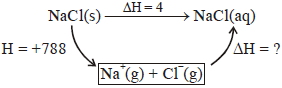
\(4=788+\Delta H\)\(\Delta H =-784 kJ\)
-
- (A) \(326400\)
- (B) \(312400\)
- (C) \(322425\)
- (D) \(322500\)
Show answer and solution
Correct Answer: (A)
\(C _{2} H _{5} OH _{(\ell)}+3 O _{2( g )} \longrightarrow 2 CO _{2( g )}+3 H _{2} O _{(\ell)}\)\(\Delta n _{ g }=2-3=-1\)
\(\Delta_{ C } H =\Delta_{ c } U +\left(\Delta n _{ g }\right) RT\)
\(\Delta_{ c } H =\Delta_{ c } U - RT\)
\(\Delta_{ c } U =\Delta_{ c } H + RT\)
\(=-327 \times 10^{3}+2 \times 300\)
\(=-326400 cal\)
: Heat evolved
\(=326400 cal\)
-
- (A) \(189494\)
- (B) \(189480\)
- (C) \(189989\)
- (D) \(189950\)
Show answer and solution
Correct Answer: (A)
\(H _{2} O (\ell) \rightleftharpoons H _{2} O ( g ) \quad 90 gm\) of \(H _{2} O\)\(\Delta H =\Delta U +\Delta n _{ g } RT \quad \Rightarrow 5\) moles of \(H _{2} O\)
\(5 \times 41000 J =\Delta U +1 \times 8.314 \times 373 \times 5\)
\(\Delta U =189494.39\) Joule
-
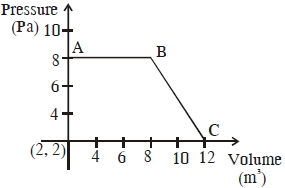
- (A) \(40\)
- (B) \(48\)
- (C) \(45\)
- (D) \(96\)
Show answer and solution
Correct Answer: (B)
Area enclosed under\(P V\) curve \(= 48\)
\(= 48\; Joule\)
-
- (A) \(Ar _{( g )}+ e ^{-} \rightarrow Ar _{( g )}^{-}\)
- (B) \(H _{( g )}+ e ^{-} \rightarrow H _{( g )}^{-}\)
- (C) \(Na _{( g )} \rightarrow Na _{( g )}^{+}+ e ^{-}\)
- (D) \(O _{( g )}^{-}+ e ^{-} \rightarrow O _{( g )}^{2-}\)
Show answer and solution
Correct Answer: (B)
\(H _{( g )}+ e ^{-} \rightarrow H ^{-} \quad\) is exothermic rest of all endothermic process.
No questions on this page match these filters.