


JEE Mains · Chemistry · STD 11 - Thermodynamics and thermochemistry
- JEE Mains 2025
- Hard
- MCQ
Match List - I with List - II.
| List - I (Partial Derivatives) | List - II (Thermodynamic Quantity) |
| (A)\(\left(\frac{\partial \mathrm{G}}{\partial \mathrm{T}}\right)_{\mathrm{P}}\) | (I) Cp |
| (B) \(\left(\frac{\partial \mathrm{H}}{\partial \mathrm{T}}\right)_{\mathrm{P}}\) | (II) -S |
| (C) \(\left(\frac{\partial G}{\partial P}\right)_T\) | (III) Cv |
| (D) \(\left(\frac{\partial \mathrm{U}}{\partial \mathrm{T}}\right)_{\mathrm{V}}\) | (IV) V |
Choose the correct answer from the options given below :
Pick an option to check your answer.
Answer & Solution
Correct Answer
(C) (A)-(II), (B)-(I), (C)-(IV), (D)-(III)
Step-by-step Solution
Detailed explanation
\(\begin{aligned} & \because \mathrm{dH}=\mathrm{dq} \text { (at } \mathrm{P}=\text { constant) } \\ & \mathrm{dH}=\mathrm{CpdT}^{\mathrm{dT}} \\ & \left(\frac{\mathrm{dH}}{\mathrm{dT}}\right)_{\mathrm{P}}=\mathrm{C}_{\mathrm{P}} \\ & \mathrm{dU}=\mathrm{dq} \quad \text { (at } \mathrm{V}=\text { constant) } \\ & \mathrm{dU}=\mathrm{C}_{\mathrm{V}} \mathrm{dT} \\ & \left(\frac{\mathrm{dU}}{\mathrm{dT}}\right)_{\mathrm{V}}=\mathrm{C}_{\mathrm{V}} \\ & \because \mathrm{dG}=\mathrm{VdP}-\mathrm{SdT} \\ & \text { at } \mathrm{P}=\text { constant, } \mathrm{dP}=0\end{aligned}\)
\(\left(\frac{d G}{d T}\right)_P=-S\)
at \(\mathrm{T}=\) constant
\(\left(\frac{\mathrm{dG}}{\mathrm{dP}}\right)_{\mathrm{T}}=\mathrm{V}\)
More questions from Chemistry
- \(\mathrm{NO}_2\) required for a reaction is produced by decomposition of \(\mathrm{N}_2 \mathrm{O}_5\) in \(\mathrm{CCl}_4\) as by equation \(2 \mathrm{~N}_2 \mathrm{O}_{5(\mathrm{~g})} \rightarrow 4 \mathrm{NO}_{2(\mathrm{~g})}+\mathrm{O}_{2(\mathrm{~g})}\)The initial concentration of \(\mathrm{N}_2 \mathrm{O}_5\) is \(3 \mathrm{~mol} \mathrm{~L}^{-1}\) and it is \(2.75 \mathrm{~mol} \mathrm{~L}^{-1}\) after 30 minutes.The rate of formation of \(\mathrm{NO}_2\) is \(\mathrm{x} \times 10^{-3} \mathrm{~mol} \mathrm{~L}^{-1}\) \(\min ^{-1}\), value of \(x\) is _______.JEE Mains 2024 Hard
- Which one the following compounds will readily react with dilute \(\mathrm{NaOH}\) ?JEE Mains 2024 Medium
- Which one of the following complexes will exhibit the least paramagnetic behaviour ? [Atomic number, \(\mathrm{Cr}=24, \mathrm{Mn}=25, \mathrm{Fe}=26, \mathrm{Co}=27\) ]JEE Mains 2024 Medium
- Given below are two statements : Statement \(I\) : Picric acid is \(2, 4, 6\)-trinitrotoluene. Statement \(II\) : Phenol\(-2, 4-\)disulphuric acid is treated with conc. \(\mathrm{HNO}_3\) to get picric acid. In the light of the above statement, choose the most appropriate answer from the options given below :JEE Mains 2024 Medium
- The \(IUPAC\) nomenclature of an element with electronic configuration \([ Rn ] 5 f ^{14} 6 d ^{1} 7 s ^{2}\) is.JEE Mains 2022 Medium
- Number of \(\sigma\) and \(\pi\) bonds present in ethylene molecule is respectively _______.JEE Mains 2024 Medium
More PYQs from JEE Mains
- Match the LIST-I with LIST-II.
LIST-I LIST-II (A) \(_0^1n + _{92}^{235}U \rightarrow _{54}^{140}Xe + _{38}^{94}Sr + 2_0^1n\) (I) Chemical reaction (B) \(2H_2 + O_2 \rightarrow 2H_2O\) (II) Fusion with +ve Q value (C) \(_1^2H + _1^2H \rightarrow _2^3He + _0^1n\) (III) Fission (D) \(_1^1H + _1^3H \rightarrow _1^2H + _1^2H\) (IV) Fusion with -ve Q value
Choose the correct answer from the options given below :JEE Mains 2025 Medium - Consider a \(72\, cm\) long wire \(AB\) as shown in the figure. The galvanometer jockey is placed at \(P\) on \(A B\) at a distance \(x cm\) from \(A\). The galvanometer shows zero deflection. The value of \(x,\) to the nearest integer, is ..... \(cm\)
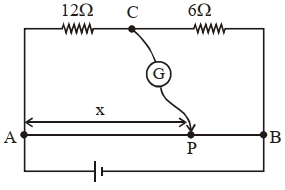 JEE Mains 2021 Medium
- The number of ions from the following that have the ability to liberate hydrogen from a dilute acid is _______.
\(Ti ^{2+}, Cr ^{2+}\) and \(V ^{2+}\)JEE Mains 2024 Medium - What is the standard reduction potential \((E^o)\) for \(Fe^{3+} \to Fe\) ? ............... \(\mathrm{V}\) Given that : \(F{e^{2 + }} + 2{e^ - } \to Fe;\) \({E^o}_{F{e^{2 + }}/Fe} = - 0.47\,V\) \(F{e^{3 + }} + {e^ - } \to F{e^{2 + }};\) \({E^o}_{F{e^{3 + }}/F{e^{2 + }}} = + 0.77\,V\)JEE Mains 2017 Hard
- The co-ordinates of a particle moving in \(x-y\) plane are given by : \(\mathrm{x}=2+4 \mathrm{t}, \mathrm{y}=3 \mathrm{t}+8 \mathrm{t}^2 .\) The motion of the particle is _______.JEE Mains 2024 Hard
- Two uniform circular discs are rotating independently in the same direction around their common axis passing through their centres. The moment of inertia and angular velocity of the first disc are \(0.1 \;kg - m ^{2}\) and \(10\; rad \,s^{-1}\) respectively while those for the second one are \(0.2 \;kg - m ^{2}\) and \(5\; rad \,s ^{-1}\) respectively. At some instant they get stuck together and start rotating as a single system about their common axis with some angular speed. The Kinetic energy of the combined system is ...........\(J\)JEE Mains 2020 Hard