


JEE Mains · Chemistry · STD 11 - Thermodynamics and thermochemistry
- JEE Mains 2025
- Medium
- MCQ
Consider the given data :
(a) \(\mathrm{HCl}(\mathrm{g})+10 \mathrm{H}_2 \mathrm{O}(\mathrm{l}) \rightarrow \mathrm{HCl}.10 \mathrm{H}_2 \mathrm{O}\)
\(\Delta \mathrm{H}=-69.01 \mathrm{~kJ} \mathrm{~mol}^{-1}\)
(b) \(\mathrm{HCl}(\mathrm{g})+40 \mathrm{H}_2 \mathrm{O}(\mathrm{l}) \rightarrow \mathrm{HCl}.40 \mathrm{H}_2 \mathrm{O}\)
\(\Delta \mathrm{H}=-72.79 \mathrm{~kJ} \mathrm{~mol}^{-1}\)
Choose the correct statement :
Pick an option to check your answer.
Answer & Solution
Correct Answer
(B) The heat of solution depends on the amount of solvent.
Step-by-step Solution
Detailed explanation
From the given information
\(\Delta \mathrm{H}\) is negative so it means dissolution of gas \(\mathrm{HCl}(\mathrm{g})\) is exothermic.
\(\mathrm{HCl}(\mathrm{g})+10 \mathrm{H}_2 \mathrm{O}(\mathrm{l}) \rightarrow \mathrm{HCl}.10 \mathrm{H}_2 \mathrm{O}\) ...(1)
\(\Delta \mathrm{H}_1=-69.01 \frac{\mathrm{~kJ}}{\mathrm{~mol}}\)
\(\mathrm{HCl}(\mathrm{g})+40 \mathrm{H}_2 \mathrm{O}(\mathrm{l}) \rightarrow \mathrm{HCl}.40 \mathrm{H}_2 \mathrm{O}\) ...(2)
\(\Delta \mathrm{H}_2=-72.79 \frac{\mathrm{~kJ}}{\mathrm{~mol}}\)
Hence heat of solution depends upon amount of solvent
By equation..(2) - equation
\(\mathrm{HCl}.10 \mathrm{H}_2 \mathrm{O}+30 \mathrm{H}_2 \mathrm{O}(\ell) \rightarrow \mathrm{HCl} \cdot 40 \mathrm{H}_2 \mathrm{O}\)
So Heat of dilution \(=-72.79-(-69.01)\)
\(=-3.78 \frac{\mathrm{~kJ}}{\mathrm{~mol}}\)
Hence option (3) is incorrect.
For heat of formation reactant should be in elemental form hence option (4) is incorrect
More questions from Chemistry
- The compound used in the treatment of lead poisoning isJEE Mains 2019 Hard
- Which one of the following alkenes when treated with \(HCl\) yields majorly an anti Markovnikov product?JEE Mains 2019 Hard
- A solution of \(( -)-1 -\) chloro \({-1}-\) phenylethane in toluene racemises slowly in the presence of a small amount of \(SbCl_5,\) due to the formation of :JEE Mains 2013 Hard
- \(Fex _{2}\) and \(Fey _{3}\) are known when \(x\) and \(y\) are :JEE Mains 2021 Easy
- Five moles of an ideal gas at \(1\) bar and \(298\, K\) is expanded into vacuum to double the volume. The work done is :-JEE Mains 2020 Medium
- Consider the following sequence of reactions to give the major product \((X)\)
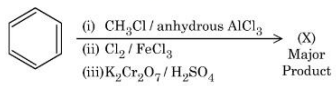
\(P\) g of the major product \((X)\) formed is reacted with \(NaHCO_3\) solution to liberate a gas which occupied \(11.2\) dm\(^3\) at STP. \(P = \) _____ g. (Given molar mass in g mol\(^{-1}\) H:\(1\), C:\(12\), O:\(16\), Cl:\(35.5\))JEE Mains 2026 Hard
More PYQs from JEE Mains
- After understanding the assertion and reason, choose the correct option.
Assertion : In the bonding molecular orbital \((MO)\) of \(H_2,\) electron density is increased between the nuclei.
Reason : The bonding \(MO\) is \({\psi _A}\, + \,\,{\psi _{B,}}\) which shows destructive interference of the combining electron waves.JEE Mains 2015 Hard - A transformer has an efficiency of \(80 \%\) and works at \(10 \mathrm{~V}\) and \(4 \mathrm{~kW}\). If the secondary voltage is \(240 \mathrm{~V}\), then the current in the secondary coil is _______.JEE Mains 2024 Hard
- Which of the following is the energy of a possible excited state of hydrogen ? ............ \(\mathrm{eV}\)JEE Mains 2015 Hard
- The value of \(K _{ C }\) is \(64\) at \(800\, K\) for the reaction \(N _{2}( g )+3 H _{2}( g ) \rightleftharpoons 2 NH _{3}( g )\) The value of \(K _{ C }\) for the following reaction is : \(NH_{3}(g) \rightleftharpoons \frac{1}{2} N _{2}(g)+\frac{3}{2} H_{2}(g)\)JEE Mains 2020 Medium
- Projectiles \(A\) and \(B\) are thrown at angles of \(45^{\circ}\) and \(60^{\circ}\) with vertical respectively from top of a \(400 \mathrm{~m}\) high tower. If their ranges and times of flight are same, the ratio of their speeds of projection \(v_A: v_B\) is _______.JEE Mains 2024 Hard
- In a transverse wave the distance between a crest and neighbouring trough at the same instant is \(4.0\, cm\) and the distance between a crest and trough at the same place is \(1 .0\, cm\) . The next crest appears at the same place after a time interval of \(0.4\,s\). The maximum speed of the vibrating particles in the medium isJEE Mains 2013 Easy