


JEE Mains · Chemistry · STD 11 - 6.1. Equilibrium - 1 (chemical Equilibrium)
Consider the following chemical equilibrium of the gas phase reaction at a constant temperature :
\(\mathrm{A}(\mathrm{~g}) \rightleftharpoons \mathrm{B}(\mathrm{~g})+\mathrm{C}(\mathrm{~g})\)
If \(p\) being the total pressure, \(K_p\) is the pressure equilibrium constant and \(\alpha\) is the degree of dissociation, then which of the following is true at equilibrium?
- A If p value is extremely high compared to \(\mathrm{K}_{\mathrm{p}}, \alpha \approx 1\)
- B When \(p\) increases \(\alpha\) decreases
- C If \(k_p\) value is extremely high compared to \(p, \alpha\) becomes much less than unity
- D When \(p\) increases \(\alpha\) increases
Answer & Solution
Correct Answer
(B) When \(p\) increases \(\alpha\) decreases
Step-by-step Solution
Detailed explanation
a moles of \(A(g)\) taken initially and at time Now moles fraction of \(\mathrm{A}(\mathrm{g}), \mathrm{B}(\mathrm{g})\) and \(\mathrm{C}(\mathrm{g})\) are…
See the Complete Solution
Get step-by-step explanations for this and 2.5 Lakh+ more JEE, NEET & CET questions.
- Unlock all solutions
- Practice the full chapter
- Track accuracy across PYQs
4.8 rated on Google Play · 14,000+ reviews
More questions from Chemistry
- Consider the above reaction. The number of \(\pi\) electrons present in the product ' \(P\) ' is ...... .
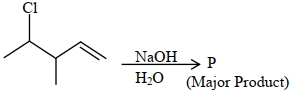 JEE Mains 2022 Easy
 - Enthalpies of formation of \(CCl _{4( g )}, H _2 O_{( g )}, CO _{2( g )}\) and \(HCl_{ ( g )}\) are \(-105,-242,-394\) and \(-92\,kJ\,mol ^{-1}\) respectively. The magnitude of enthalpy of the reaction given below is \(......kJ\,mol ^{-1}\) (nearest integer) \(CCl _{4( g )}+2 H _2 O_{( g )} \rightarrow CO _{2( g )}+4 HCl_{( g )}\)JEE Mains 2023 Medium
- The correct order of electronegativity for given elements is:JEE Mains 2023 Medium
- Match List-I with List-II.
List-I (Purification technique) List-II (Used to separate) A. Simple distillation I. Steam volatile compound B. Fractional distillation II. Two liquids with large difference in boiling points C. Steam distillation III. Liquid decomposing at its boiling point D. Distillation under reduced pressure IV. Two liquids with close boiling points
Choose the correct answer from the options given below :JEE Mains 2026 Easy - The adsorbent used in adsorption chromatography is _______. \(A\). silica gel \(B\). alumina \(C\). quick lime \(D\). magnesia Choose the most appropriate answer from the options given below :JEE Mains 2024 Medium
- The increasing order of reactivity of the following compounds towards aromatic electrophilic substitution reaction is
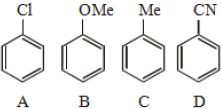 JEE Mains 2019 Hard
More PYQs from JEE Mains
- Let \([t]\) denote the greatest integer \(\leq t\) and \(\mathop {\lim }\limits_{x \to 0} x\left[\frac{4}{x}\right]=A .\) Then the function. \(\mathrm{f}(\mathrm{x})=\left[\mathrm{x}^{2}\right] \sin (\pi \mathrm{x})\) is discontinuous, when \(\mathrm{x}\) is equal toJEE Mains 2020 Hard
- For the circuit shown, the value of current at time \({t}=3.2\, {s}\) will be ...... \({A}\). [Voltage distribution \(V(t)\) is shown by Fig. \((1)\) and the circuit is shown in Fig. \((2)\)]
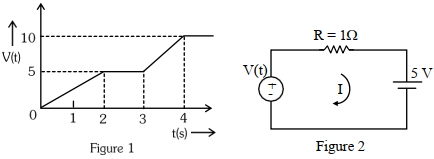 JEE Mains 2021 Hard
 - The given circuit works as :
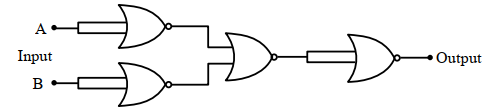 JEE Mains 2026 Easy
 - The time dependence of the position of a particle of mass \(m = 2\) is given by \(\vec r\,(t)\, = \,2t\,\hat i\, - 3{t^2}\hat j\) Its angular momentum with respect to the origin at time \(t = 2\) isJEE Mains 2019 Hard
- For an adiabatic expansion of an ideal gas, the fractional change in its pressure is equal to (where \(\gamma\) is the ratio of specific heats):JEE Mains 2021 Medium
- When Ethane-1,2-diamine is added progressively to an aqueous solution of Nickel (II) chloride, the sequence of colour change observed will be :JEE Mains 2025 Medium