


enEnglishguગુજરાતી
JEE Mains · Chemistry · STD 11 - Equilibrium - 1 (chemical Equilibrium)
- JEE Mains 2023
- Medium
- Numerical
Consider the following equation: \(2 SO _2( g )+ O _2( g ) \rightleftharpoons 2 SO _3( g ), \Delta H =-190\,kJ\) The number of factors which will increase the yield of \(SO _3\) at equilibrium from the following is \(.............\). \(A.\) Increasing temperature \(B.\) Increasing pressure \(C.\) Adding more \(SO _2\) \(D.\) Adding more \(O _2\) \(E.\) Addition of catalyst
Pick an option to check your answer.
Answer & Solution
Correct Answer
(D) \(3\)
Step-by-step Solution
Detailed explanation
The yield of \(SO _3\) at equilibrium will be due to:
\(B.\) Increasing pressure
\(C.\) Adding more \(SO _2\)
\(D.\) Adding more \(O _2\)
More questions from Chemistry
- For the reaction \(2 \mathrm{H}_{2}(\mathrm{g})+2 \mathrm{NO}(\mathrm{g}) \rightarrow \mathrm{N}_{2}(\mathrm{g})+2 \mathrm{H}_{2} \mathrm{O}(\mathrm{g})\) the observed rate expression is, rate \(=\mathrm{k}_{\mathrm{f}}[\mathrm{NO}]^{2}\left[\mathrm{H}_{2}\right] .\) The rate expression of the reverse reaction isJEE Mains 2020 Medium
- Trigonal bipyramidal geometry is shown byJEE Mains 2013 Hard
- The increasing order of basicity for the following intermediates is (from weak to strong) \((i)\) \(\begin{array}{*{20}{c}}
{\,\,\,\,\,\,\,\,\,\,\,\,\,\,\,\,\,\,\,\,C{H_3}} \\
{\,\,\,\,\,\,\,\,\,\,\,\,\,\,\,|} \\
{C{H_3} - {C^ \mathbf{-} }} \\
{\,\,\,\,\,\,\,\,\,\,\,\,\,\,\,|} \\
{\,\,\,\,\,\,\,\,\,\,\,\,\,\,\,\,\,\,C{H_3}}
\end{array}\) \((ii)\) \(H _{2} C = CH - CH _{2}\) \((iii)\) \(HC \equiv \stackrel{\ominus}{ C }\) \((iv)\) \(\stackrel{\ominus}{ CH _{3}}\) \((v)\) \(\stackrel{\ominus}{{ }_{ CN }}\)JEE Mains 2020 Hard - A graph of vapour pressure and temperature for three different liquids \(X, Y\) and \(Z\) is shown below The following inferences are made \((A)\) \(\mathrm{X}\) has higher intermolecular interactions compared to \(Y\). \((B)\) \(\mathrm{X}\) has lower intermolecular interactions compared to \(Y\). \((C)\) \(\mathrm{Z}\) has lower intermolecular interactions compared to \(Y.\) The correct inference(s) is/are
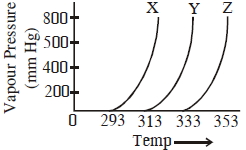 JEE Mains 2020 Medium
- Given below are two statements:
Statement-I: Element 'X' and 'Y' are the most and least electronegative elements, respectively among N, As, Sb and P. The nature of the oxides \(X_{2}O_{3}\) and \(Y_{2}O_{3}\) is acidic and amphoteric, respectively.
Statement-II: \(BCl_{3}\) is covalent in nature and gets hydrolysed in water. It produces \([B(OH)_{4}]^{-}\) and \([B(H_{2}O)_{6}]^{3+}\) in aqueous medium.
In the light of the above statements, choose the correct answer from the options given below :JEE Mains 2026 Hard - Match List\(-I\) with List\(-II :\)
Choose the correct answer from the options given below:List\(-I\) List\(-II\) \((a)\) \(\left[ Co \left( NH _{3}\right)_{6}\right]\left[ Cr ( CN )_{6}\right]\) \((i)\) Linkage isomerism \((b)\) \(\left[ Co \left( NH _{3}\right)_{3}\left( NO _{2}\right)_{3}\right]\) \((ii)\)Solvate isomerism \((c)\) \(\left[ Cr \left( H _{2} O \right)_{6}\right] Cl _{3}\) \((iii)\) Co-ordination isomerism \((c)\) \(cis-[CrCl\) \(\left._{2}(\text { ox })_{2}\right]^{3-}\) \((iv)\) Optical isomerism JEE Mains 2021 Medium
More PYQs from JEE Mains
- Consider the following compounds
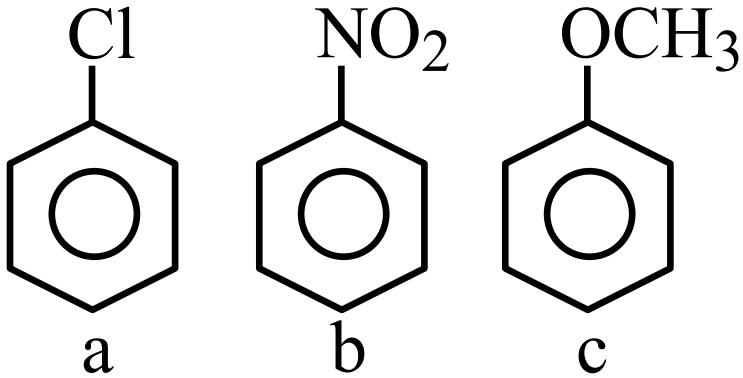
Arrange these compounds in the increasing order of reactivity with nitrating mixture.JEE Mains 2026 Hard - A bicycle tyre is filled with air having pressure of \(270\,kPa\) at \(27^{\circ}\,C\). The approximate pressure of the air in the tyre when the temperature increases to \(36^{\circ}\,C\) is \(............kPa\)JEE Mains 2023 Easy
- In a screw gauge the zero of main scale reference line coincides with the fifth division of the circular scale when two studs are in contact. There are \(100\) divisions in circular scale and pitch of screw gauge is \(0.1\) mm. When diameter of a sphere is measured, the reading of main scale is \(5\) mm and \(50^{\text{th}}\) division of circular scale coincides with the reference line of main scale. The diameter of sphere is _______ mm.JEE Mains 2026 Medium
- A boy is rolling a \(0.5\, kg\) ball on the frictionless floor with the speed of \(20\, ms ^{-1}\). The ball gets deflected by an obstacle on the way. After deflection it moves with \(5 \%\) of its initial kinetic energy. What is the speed of the ball now ? (in \(ms ^{-1}\))JEE Mains 2021 Medium
- A solution containing \(2\,g\) of a non-volatile solute in \(20\,g\) of water boils at \(373.52\,K\). The molecular mass of the solute is \(.......g\,mol ^{-1}\). (Nearest integer) Given, water boils at \(373\,K,K _{ b }\) for water \(=0.52\,K\,kg\,mol ^{-1}\)JEE Mains 2023 Medium