


JEE Mains · Chemistry · STD 11 - Equilibrium - 1 (chemical Equilibrium)
- JEE Mains 2025
- Medium
- MCQ
Consider the reaction \(\mathrm{X}_2 \mathrm{Y}(\mathrm{~g})=\mathrm{X}_2(\mathrm{~g})+\frac{1}{2} \mathrm{Y}_2(\mathrm{~g})\)
The equation representing correct relationship between the degree of dissociation (x) of \(\mathrm{X}_2 \mathrm{Y}(\mathrm{g})\) with its equilibrium constant Kp is ______ .
Assume \(x\) to be very very small.
Pick an option to check your answer.
Answer & Solution
Correct Answer
(B) \(x=\sqrt[3]{\frac{2 \mathrm{Kp}^2}{\mathrm{p}}}\)
Step-by-step Solution
Detailed explanation
\(\begin{aligned} & 1 \mathrm{~mol} \\ & \mathrm{X}_2 \mathrm{Y}(\mathrm{g}) \rightarrow \underset{\mathrm{x}}{\mathrm{X}} \mathrm{X}_2(\mathrm{~g})+\frac{1}{2} \mathrm{Y}_2(\mathrm{~g}) \\ & \frac{\mathrm{x}}{2} \\ & \therefore \quad P_{\mathrm{x}_2 \mathrm{y}} \\ & =\frac{1-\mathrm{x}}{1+\frac{x}{2}} \times \mathrm{p} \\ & P_{x_2}=\frac{x}{1+\frac{x}{2}} \times p\end{aligned}\)
\(\begin{aligned}
& P_{y_2}=\frac{x / 2}{1+\frac{x}{2}} \times p \\
\therefore \quad K_p= & \frac{\left(\frac{x}{1+\frac{x}{2}} p\right)\left(\frac{x}{2\left(1+\frac{x}{2}\right)} p\right)^{1 / 2}}{\left(\frac{1-x}{1+\frac{x}{2}}\right) \times p} \\
\therefore \quad & K_p=\left(\frac{x}{1-x}\right)\left(\frac{x}{2\left(1+\frac{x}{2}\right)}\right)^{1 / 2} \times p^{1 / 2}
\end{aligned}\)
\(\therefore \quad \mathrm{x}\) to be very small
\(\begin{aligned}
\therefore & K_p=\frac{x^{3 / 2}}{2^{(1 / 2)}} \times p^{1 / 2} \\
\therefore & x^{3 / 2}=\frac{K_p \times 2^{1 / 2}}{p^{1 / 2}} \\
& x^3=\frac{K_p^2 \times 2}{p} \\
& x=\left(\frac{K_p^2 \times 2}{p}\right)^{1 / 3}
\end{aligned}\)
More questions from Chemistry
- Arrange the bonds in order of increasing ionic character in the molecules.
[\(\mathrm{LiF}, \mathrm{K}_2 \mathrm{O}, \mathrm{N}_2, \mathrm{SO}_2\) and \(\mathrm{CIF}_3\)]JEE Mains 2024 Hard - The correct trend in the first ionization enthalpies of the elements in the \(3^{rd}\) period of periodic table is:JEE Mains 2026 Hard
- The number of compounds from the following which can undergo reaction with Br\(_2\)/KOH (alcoholic) to give respective products and these respective products can also be obtained separately by Gabriel phthalimide reaction is :
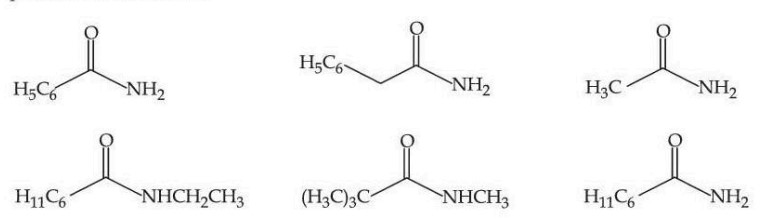 JEE Mains 2026 Hard
- The strongest reducing agent amont the following is _______.JEE Mains 2024 Medium
- The Born-Haber cycle for \(\mathrm{KCl}\) is evaluated with the following data : \(\Delta_{f} \mathrm{H}^{\ominus}\) for \(\mathrm{KCl}=-436.7 \,\mathrm{~kJ}\, \mathrm{~mol}^{-1}\) \(\Delta_{\text {sub }} \mathrm{H}^{\ominus}\) for \(\mathrm{K}=89.2 \,\mathrm{~kJ}\, \mathrm{~mol}^{-1}\) \(\Delta_{\text {ionization }} \,\mathrm{H}^{-}\) for \(\mathrm{K}=419.0\, \mathrm{~kJ}\, \mathrm{~mol}^{-1}\) \(\Delta_{\text {electron gain }} \mathrm{H}^{\ominus}\) for \(\mathrm{Cl}_{(\text {e) }}=-348.6 \,\mathrm{~kJ} \,\mathrm{~mol}^{-1}\) \(\Delta_{\mathrm{bond}} \mathrm{H}^{-}\) for \(\mathrm{Cl}_{2}=243.0 \,\mathrm{~kJ} \,\mathrm{~mol}^{-1}\) The magnitude of lattice enthalpy of \(\mathrm{KCl}\) in \(\mathrm{kJ} \mathrm{mol}^{-1}\) is ..... . (Nearest integer)JEE Mains 2021 Medium
- A system does \(200\,J\) of work and at the same time absorbs \(150 \,\mathrm{~J}\) of heat. The magnitude of the change in internal energy is \(.....\,J.\) (Nearest integer)JEE Mains 2021 Medium
More PYQs from JEE Mains
- An organic compound gives \(0.220 g\) of \(CO _2\) and \(0.126 g\) of \(H _2 O\) on complete combustion. If the \(\%\) of carbon is 24 then the \(\%\) hydrogen is \(......\times 10^{-1} \cdot(\) Nearest integer \()\)JEE Mains 2023 Hard
- If \(L , C\) and \(R\) are the self inductance, capacitance and resistance respectively, which of the following does not have the dimension of time?JEE Mains 2022 Medium
- A particle of mass ' \(m\) ' and charge ' \(q\) ' is fastened to one end ' \(A\) ' of a massless string having equilibrium length \(l\), whose other end is fixed at point ' \(O\) '. The whole system is placed on a frictionless horizontal plane and is initially at rest. If uniform electric field is switched on along the direction as shown in figure, then the speed of the particle when it crosses the x -axis is
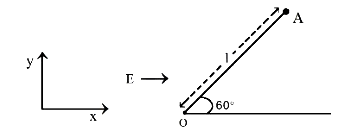 JEE Mains 2025 Hard
- The correct decreasing order for metallic character isJEE Mains 2022 Easy
- On heating water, bubbles being formed at the bottom of the vessel detach and rise. Take the bubbles to be spheres of radius \(R\) and making a circular contact of radius \(r\) with the bottom of the vessel. If \(r < < R\), and the surface tension of water is \(T\), value of \(r\) just before bubbles detach is (density of water is \(\rho_{w}\))
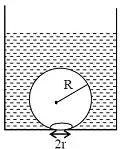 JEE Mains 2014 Hard
- Which of the following amino acid will give violet coloured complex with neutral ferric chloride solution?JEE Mains 2026 Medium