


JEE Mains · Physics · STD 11 - System of particles and rotational motion
- JEE Mains 2025
- Medium
- Numerical
A thin solid disk of 1 kg is rotating along its diameter axis at the speed of 1800 rpm. By applying an external torque of \(25 \pi \mathrm{Nm}\) for 40 s, the speed increases to 2100 rpm. The diameter of the disk is ________ m.
Pick an option to check your answer.
Answer & Solution
Correct Answer
(C) 40
Step-by-step Solution
Detailed explanation
Given, \(\mathrm{m}=1 \mathrm{~kg}\)
\(\begin{aligned}
& \omega_{\mathrm{i}}=1800 \mathrm{rpm}=1800 \times \frac{2 \pi}{60}=60 \pi \frac{\mathrm{rad}}{\mathrm{sec}} \\
& \omega_{\mathrm{f}}=2100 \mathrm{rpm}=2100 \times \frac{2 \pi}{60}=70 \pi \frac{\mathrm{rad}}{\mathrm{sec}} \\
& \tau_{e x t}=25 \pi \mathrm{Nm} \\
& \mathrm{t}=40 \mathrm{sec}
\end{aligned}\)
Using equation of motion
\(\begin{aligned}
& \omega_{\mathrm{f}}=\omega_{\mathrm{i}}+\alpha \mathrm{t} \\
& 70 \pi=60 \pi+\alpha(40) \\
& \alpha=\frac{\pi}{4} \mathrm{rad} / \mathrm{sec}^2
\end{aligned}\)
Also, \(\tau=\mathrm{I} \alpha\)
\(\tau=\frac{\mathrm{mR}^2}{4} \alpha\)
\(\begin{aligned}
& 25 \pi=\frac{1 \times \mathrm{R}^2}{4} \times \frac{\pi}{4} \\
& \mathrm{R}=20 \mathrm{~m}
\end{aligned}\)
Hence, diameter of disk \(=2 \mathrm{R}=2 \times 20=40 \mathrm{~m}\)
\(\begin{aligned}
& \omega_{\mathrm{i}}=1800 \mathrm{rpm}=1800 \times \frac{2 \pi}{60}=60 \pi \frac{\mathrm{rad}}{\mathrm{sec}} \\
& \omega_{\mathrm{f}}=2100 \mathrm{rpm}=2100 \times \frac{2 \pi}{60}=70 \pi \frac{\mathrm{rad}}{\mathrm{sec}} \\
& \tau_{e x t}=25 \pi \mathrm{Nm} \\
& \mathrm{t}=40 \mathrm{sec}
\end{aligned}\)
Using equation of motion
\(\begin{aligned}
& \omega_{\mathrm{f}}=\omega_{\mathrm{i}}+\alpha \mathrm{t} \\
& 70 \pi=60 \pi+\alpha(40) \\
& \alpha=\frac{\pi}{4} \mathrm{rad} / \mathrm{sec}^2
\end{aligned}\)
Also, \(\tau=\mathrm{I} \alpha\)
\(\tau=\frac{\mathrm{mR}^2}{4} \alpha\)
\(\begin{aligned}
& 25 \pi=\frac{1 \times \mathrm{R}^2}{4} \times \frac{\pi}{4} \\
& \mathrm{R}=20 \mathrm{~m}
\end{aligned}\)
Hence, diameter of disk \(=2 \mathrm{R}=2 \times 20=40 \mathrm{~m}\)
More questions from Physics
- A particle of mass \(20\,g\) is released with an initial velocity \(5\,m/s\) along the curve from the point \(A,\) as shown in the figure. The point \(A\) is at height \(h\) from point \(B.\) The particle slides along the frictionless surface. When the particle reaches point \(B,\) its angular momentum about \(O\) will be ......... \(kg - m^2/s\). [Take \(g = 10\,m/s^2\) ]
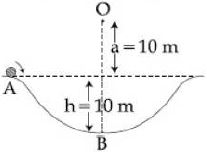 JEE Mains 2019 Medium
- A scientist is observing a bacteria through a compound microscope. For better analysis and to improve its resolving power he should. (Select the best option)JEE Mains 2023 Medium
- In the cube of side \(a\) shown in the figure, the vector from the central point of the face \(ABOD\) to the central point of the face \(BEFO\) will be
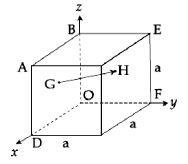 JEE Mains 2019 Medium
- A \(15\,g\) mass of nitrogen gas is enclosed in a vessel at a temperature \(27\,^oC.\) Amount of heat transferred to the gas, so that rms velocity of molecules is doubled, is about ...... \(kJ\) [Take \(R = 8.3\,J/K\,mole\) ]JEE Mains 2019 Medium
- A source of sound emits sound waves at frequency \(f_0\). It is moving towards an observer with fixed speed \(v_s\) (\(v_s < v\), where \(v\) is the speed of sound in air). If the observer were to move towards the source with speed \(v_0\), one of the following two graphs (\(A\) and \(B\)) will given the correct variation of the frequency \(f\) heard by the observer as \(v_0\) is changed The variation of \(f\) with \(v_0\) is given correctly by
 JEE Mains 2015 Easy
- An electric dipole of mass m, charge q, and length \(l\) is placed in a uniform electric field \(\overrightarrow{\mathrm{E}}=\mathrm{E}_0 \hat{i}\). When the dipole is rotated slightly from its equilibrium position and released, the time period of its oscillations will be:JEE Mains 2025 Medium
More PYQs from JEE Mains
- If average depth of an ocean is \(4000 \mathrm{~m}\) and the bulk modulus of water is \(2 \times 10^9 \mathrm{Nm}^{-2}\), then fractional compression \(\frac{\Delta V}{V}\) of water at the bottom of ocean is \(\alpha \times 10^{-2}\). The value of \(\alpha\) is ___________(Given, \(\mathrm{g}=10 \mathrm{~ms}^{-2}, \rho=1000 \mathrm{~kg} \mathrm{~m}^{-3}\) )JEE Mains 2024 Hard
- A current of \(2\,A\) flows through a wire of crosssectional area \(25.0\,mm ^2\). The number of free electrons in a cubic meter are \(2.0 \times 10^{28}\). The drift velocity of the electrons is \(...............\times 10^{-6}\,ms ^{-1}\) (given, charge on electron \(=1.6 \times 10^{-19}\,C\) )JEE Mains 2023 Easy
- Given below are two statements: One is labelled as Assertion \((A)\) and the other is labelled as Reason \((R).\) Assertion \((A)\) : In an uniform magnetic field, speed and energy remains the same for a moving charged particle. Reason \((R)\) : Moving charged particle experiences magnetic force perpendicular to its direction of motion.JEE Mains 2022 Medium
- Three long straight wires carrying current are arranged mutually parallel as shown in the figure. The force experienced by 15 cm length of wire Q is ___________.

\(\left(\mu_0=4 \pi \times 10^{-7} T . m / A \right)\)JEE Mains 2026 Medium - Find the magnetic field at the point \(P\) in figure. The curved portion is a semicircle connected to two long straight wires.
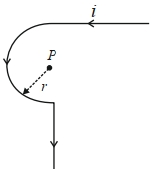 JEE Mains 2023 Medium
- Two coherent monochromatic light beams of intensities \(I\) and \(4I\) are superimposed. The difference between maximum and minimum possible intensities in the resulting beam is \(x\)I. The value of \(x\) is _______.JEE Mains 2024 Hard