


JEE Mains · Physics · STD 12 - 4. Moving charges and magnetism
A proton moving with a constant velocity passes through a region of space without any change in its velocity. If \(\vec{E}\) and \(\vec{B}\) represent the electric and magnetic fields respectively, then the region of space may have : (\(A\)) \(\mathrm{E}=0, \mathrm{~B}=0\) (\(B\)) \(\mathrm{E}=0, \mathrm{~B} \neq 0\) (\(C\)) \(\mathrm{E} \neq 0, \mathrm{~B}=0\) (\(D\)) \(\mathrm{E} \neq 0, \mathrm{~B} \neq 0\) Choose the most appropriate answer from the options given below :
- A \((A)\), \((B)\) and \((C)\) only
- B \((A)\), \((C)\) and \((D)\) only
- C \((A)\), \((B)\) and \((D)\) only
- D \((B)\), \((C)\) and \((D)\) only
Answer & Solution
Correct Answer
(C) \((A)\), \((B)\) and \((D)\) only
Step-by-step Solution
Detailed explanation
Net force on particle must be zero i.e. \(\mathrm{q} \overrightarrow{\mathrm{E}}+\mathrm{q} \overrightarrow{\mathrm{V}} \times \overrightarrow{\mathrm{B}}=0\) Possible cases are \((i)\) \(\overrightarrow{\mathrm{E}} \& \overrightarrow{\mathrm{B}}=0\) \((ii)\)…
See the Complete Solution
Get step-by-step explanations for this and 2.5 Lakh+ more JEE, NEET & CET questions.
- Unlock all solutions
- Practice the full chapter
- Track accuracy across PYQs
4.8 rated on Google Play · 14,000+ reviews
More questions from Physics
- A parallel plate capacitor with plate area \('A'\) and distance of separation \('d'\) is filled with a dielectric. What is the capacity of the capacitor when permittivity of the dielectric varies as : \(\varepsilon(x)=\varepsilon_{0}+k x, \text { for }\left(0\,<\,x \leq \frac{d}{2}\right)\) \(\varepsilon(x)=\varepsilon_{0}+k(d-x)\), for \(\left(\frac{d}{2} \leq x \leq d\right)\)JEE Mains 2021 Hard
- A wheel is rolling on a plane surface. The speed of a particle on the highest point of the rim is \(8 \mathrm{~m} / \mathrm{s}\). The speed of the particle on the rim of the wheel at the same level as the centre of wheel, will be :JEE Mains 2025 Medium
- pendulum made of a uniform wire of cross sectional area \(A\) has time period \(T\). When an additional mass \(M\) is added to its bob, the time period changes to \(T_M\). If the Young's modulus of the material of the wire is \(Y\) then \(\frac{1}{Y}\) is equal to : (\(g\) = gravitational acceleration)JEE Mains 2015 Hard
- Two capacitors of capacitances \(C\) and \(2\, C\) are charged to potential differences \(V\) and \(2\, V\), respectively. These are then connected in parallel in such a manner that the positive terminal of one is connected to the negative terminal of the other. The final energy of this configuration is\(.....CV^2\)JEE Mains 2020 Hard
- A force \(\overrightarrow{ F }=4 \hat{ i }+3 \hat{ j }+4 \hat{ k }\) is applied on an intersection point of \(x =2\) plane and \(x\) -axis. The magnitude of torque of this force about a point \((2,3,4)\) is.......... . (Round off to the Nearest Integer)JEE Mains 2021 Hard
- A unit scale is to be prepared whose length does not change with temperature and remains \(20\,cm\), using a bimetallic strip made of brass and iron each of different length. The length of both components would change in such a way that difference between their lengths remains constant. If length of brass is \(40\,cm\) and length of iron will be\(...cm\) \(\left(\alpha_{\text {iron }}=1.2 \times 10^{-5} K ^{-1}\right.\) and \(\left.\alpha_{\text {brass }}=1.8 \times 10^{-5} K ^{-1}\right)\).JEE Mains 2022 Hard
More PYQs from JEE Mains
- A ray of light entering from air into a denser medium of refractive index \(\frac{4}{3}\), as shown in figure. The light ray suffers total internal reflection at the adjacent surface as shown. The maximum, value of angle \(\theta\) should be equal to -
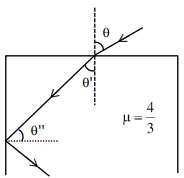 JEE Mains 2021 Hard
 - Given below are two statements: one is labelled as Assertion \(A\) and the other is labelled as Reason \(R\). Assertion \(A :\) The escape velocities of planet \(A\) and \(B\) are same. But \(A\) and \(B\) are of unequal mass. Reason \(R :\) The product of their mass and radius must be same, \(M _{1} R _{1}= M _{2} R _{2}\) In the light of the above statements, choose the most appropriate answer from the options given belowJEE Mains 2021 Medium
- Let the foci and length of the latus rectum of an ellipse \(\frac{\mathrm{x}^2}{\mathrm{a}^2}+\frac{\mathrm{y}^2}{\mathrm{~b}^2}=1, \mathrm{a}>\mathrm{b}\) be \(( \pm 5,0)\) and \(\sqrt{50}\), respectively. Then, the square of the eccentricity of the hyperbola \(\frac{\mathrm{x}^2}{\mathrm{~b}^2}-\frac{\mathrm{y}^2}{\mathrm{a}^2 \mathrm{~b}^2}=1\) equalsJEE Mains 2024 Hard
- Name the logic gate equivalent to the diagram attached
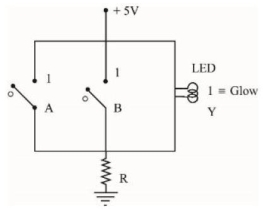 JEE Mains 2023 Medium
 - The shortest distance between the lines \(\dfrac{x-4}{1} = \dfrac{y-3}{2} = \dfrac{z-2}{-3}\) and \(\dfrac{x+2}{2} = \dfrac{y-6}{4} = \dfrac{z-5}{-5}\) is :JEE Mains 2026 Easy
- Let \(a \in R\) and let \(\alpha, \beta\) be the roots of the equation \(x^2+60^{\frac{1}{4}} x+a=0\). If \(\alpha^4+\beta^4=-30\), then the product of all possible values of \(a\) is \(......\)JEE Mains 2023 Hard