


JEE Mains · Physics · STD 11 - System of particles and rotational motion
- JEE Mains 2024
- Hard
- Numerical
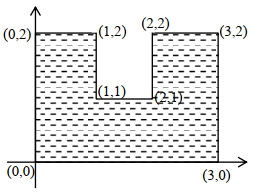
A uniform thin metal plate of mass \(10 \mathrm{~kg}\) with dimensions is shown. The ratio of \(x\) and \(y\) coordinates of center of mass of plate in \(\frac{n}{9}\). The value of \(n\) is _______.
Pick an option to check your answer.
Answer & Solution
Correct Answer
(A) \(15\)
Step-by-step Solution
Detailed explanation
\(\mathrm{m}_1 =\sigma \times 5=10 \mathrm{Kg}\)
\(\mathrm{m}_1 =\sigma \times 5=10 \mathrm{Kg} \quad \mathrm{m}_2=\sigma \times 1=2 \mathrm{Kg}\)
\(\mathrm{m}_3=\sigma \times 6=12 \mathrm{Kg}\)
\(\Rightarrow \mathrm{m}_1 \mathrm{x}_1+\mathrm{m}_2 \mathrm{x}_2=\mathrm{m}_3 \mathrm{x}_3\)
\(10 \mathrm{x}_1+2(1.5)=12(1.5) \Rightarrow \mathrm{x}_1=1.5 \mathrm{~cm}\)
\(\Rightarrow \mathrm{m}_1 \mathrm{y}_1+\mathrm{m}_2 \mathrm{y}_2=\mathrm{m}_3 \mathrm{y}_3\)
\(10 \mathrm{y}_1+2(1.5)=12 \times 1 \Rightarrow \mathrm{y}_1=0.9 \mathrm{~cm}\)
\(\frac{\mathrm{x}_1}{\mathrm{y}_1}=\frac{1.5}{0.9}=\frac{15}{9}\)
\(\mathrm{n}=15\)
More questions from Physics
- A stationary horizontal disc is free to rotate about its axis. When a torque is applied on it, its kinetic energy as a function of \(\theta ,\) where \(\theta \) is the angle by which it has rotated, is given as \(k\theta ^2.\) If its moment of inertia is \(I\) then the angular acceleration of the disc isJEE Mains 2019 Hard
- The electric field in a region of space is given by, \(\overrightarrow E = {E_0}\hat i + 2{E_0}\hat j\) where \(E_0\, = 100\, N/C\). The flux of the field through a circular surface of radius \(0.02\, m\) parallel to the \(Y-Z\) plane is nearlyJEE Mains 2014 Hard
- Given below are two statements: Statement \(I :\) An electric dipole is placed at the centre of a hollow sphere. The flux of electric field through the sphere is zero but the electric field is not zero anywhere in the sphere. Statement \(II :\) If \(R\) is the radius of a solid metallic sphere and \(Q\) be the total charge on it. The electric field at any point on the spherical surface of radius \(r ( < R )\) is zero but the electric flux passing through this closed spherical surface of radius \(r\) is not zero. In the light of the above statements, choose the correct answer from the options given below:JEE Mains 2021 Hard
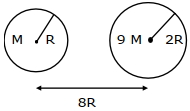
- Suppose two planets (spherical in shape) of radii \({R}\) and \(2 {R}\), but mass \({M}\) and \(9\, {M}\) respectively have a centre to centre separation \(8\, {R}\) as shown in the figure. A satellite of mass \('{m}'\) is projected from the surface of the planet of mass \('M'\) directly towards the centre of the second planet. The minimum speed \('v'\) required for the satellite to reach the surface of the second planets is \(\sqrt{\frac{a}{7} \frac{G M}{R}}\) then the value of \('a'\) is \(....\) [Given: The two planets are fixed in their position]
 JEE Mains 2021 Hard
- Train A is moving along two parallel rail tracks towards north with speed \(72 \mathrm{~km} / \mathrm{h}\) and train B is moving towards south with speed \(108 \mathrm{~km} / \mathrm{h}\). Velocity of train \(B\) with respect to \(A\) and velocity of ground with respect to \(B\) are _______ (in \(\mathrm{ms}^{-1}\) ).JEE Mains 2024 Hard
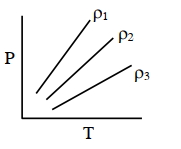
- \(P-T\) diagram of an ideal gas having three different densities \(\rho_1, \rho_2, \rho_3\) (in three different cases) is shown in the figure. Which of the following is correct?
 JEE Mains 2024 Hard
More PYQs from JEE Mains
- A tuning fork of frequency \(480\, Hz\) is used in an experiment for measuring speed of sound \((\nu )\) in air by resonance tube method. Resonance is observed to occur at two successive lengths of the air column, \({\ell _1} = 30\,cm\) and \({\ell _2} = 70\,cm\). Then \(\nu\) is equal to ..... \(ms^{-1}\)JEE Mains 2019 Hard
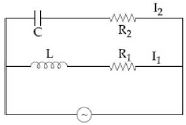
- In the below circuit, \(C\, = \,\frac{{\sqrt 3 }}{2}\,\mu F,\,R = 20\,\,\Omega ,\,L = \frac{{\sqrt 3 }}{{10}}H\) and \({R_1} = 10\,\,\Omega .\) Current in \(L-R_1\) path is \(I_1\) and \(C-R_2\) path is \(I_2.\) The voltage of \(A.C\) source is given by, \(V\, = \,200\sqrt 2 \,\sin \,(100\,t)\,volts.\) The phase difference between \(I_1\) and \(I_2\) is
 JEE Mains 2019 Hard
- A bakelite beaker has volume capacity of \(500\, cc\) at \(30^{\circ} C\). When it is partially filled with \(V _{ m }\) volume (at \(30^{\circ}\) ) of mercury, it is found that the unfilled volume of the beaker remains constant as temperature is varied. If \(\gamma_{\text {(beaker) }}=6 \times 10^{-6}{ }^{\circ} C ^{-1}\) and \(\gamma_{(\text {mercury })}=1.5 \times 10^{-4}{ }^{\circ} C ^{-1},\) where \(\gamma\) is the coefficient of volume expansion, then \(V _{ m }(\)in \(cc )\) is close toJEE Mains 2020 Hard