


JEE Mains · Physics · STD 11 - Vectors
- JEE Mains 2024
- Hard
- Numerical
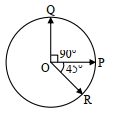
Three vectors \(\overrightarrow{\mathrm{OP}}, \overrightarrow{\mathrm{OQ}}\) and \(\overrightarrow{\mathrm{OR}}\) each of magnitude \(A\) are acting as shown in figure. The resultant of the three vectors is \(A \sqrt{x}\). The value of \(x\) is _______.
Pick an option to check your answer.
Answer & Solution
Correct Answer
(D) \(3\)
Step-by-step Solution
Detailed explanation
Explanation:
1. Components of the Vectors: Based on the given coordinate system in the figure, we can resolve each vector into its horizontal (\( \hat{i} \)) and vertical (\( \hat{j} \)) components:
• \( \vec{\text{OP}} \) acts along the positive x-axis: \( \vec{\text{OP}} = A\hat{i} \)
• \( \vec{\text{OQ}} \) acts along the positive y-axis: \( \vec{\text{OQ}} = A\hat{j} \)
• \( \vec{\text{OR}} \) acts at an angle of \( 45^\circ \) below the positive x-axis (in the fourth quadrant): \( \vec{\text{OR}} = A\cos 45^\circ\hat{i} - A\sin 45^\circ\hat{j} = \frac{A}{\sqrt{2}}\hat{i} - \frac{A}{\sqrt{2}}\hat{j} \)
2. Finding the Resultant Vector (\( \vec{R} \)):
Summing all three vectors together:
\( \vec{R} = \vec{\text{OP}} + \vec{\text{OQ}} + \vec{\text{OR}} \)
\( \vec{R} = (A\hat{i}) + (A\hat{j}) + \left(\frac{A}{\sqrt{2}}\hat{i} - \frac{A}{\sqrt{2}}\hat{j}\right) \)
\( \vec{R} = \left(A + \frac{A}{\sqrt{2}}\right)\hat{i} + \left(A - \frac{A}{\sqrt{2}}\right)\hat{j} \)
3. Calculating the Magnitude (\( |\vec{R}| \)):
\( |\vec{R}| = \sqrt{\left(A + \frac{A}{\sqrt{2}}\right)^2 + \left(A - \frac{A}{\sqrt{2}}\right)^2} \)
\( |\vec{R}| = \sqrt{\left(A^2 + \sqrt{2}A^2 + \frac{A^2}{2}\right) + \left(A^2 - \sqrt{2}A^2 + \frac{A^2}{2}\right)} \)
\( |\vec{R}| = \sqrt{2A^2 + A^2} = \sqrt{3A^2} = A\sqrt{3} \)
Comparing this with the given resultant magnitude \( A\sqrt{x} \):
\( A\sqrt{x} = A\sqrt{3} \implies x = 3 \)
Hence, Option D is the correct choice.
More questions from Physics
- A solid sphere and a solid cylinder of same mass and radius are rolling on a horizontal surface without slipping. The ratio of their radius of gyrations respectively \(\left( k _{\text {sph }}: k _{ cyl }\right)\) is \(2: \sqrt{ x }\), then value of \(x\) is .............JEE Mains 2023 Medium
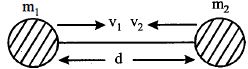
- Two hypothetical planets of masses \(m_1\) and \(m_2\) are at rest when they are infinite distance apart. Because of the gravitational force they move towards each other along the line joining their centres . What is their speed when their separation is \('d'\) ? (Speed of \(m_1\) is \(v_1\) and that of \(m_2\) is \(v_2\) )
 JEE Mains 2014 Hard
- In an adiabatic process, the density of a diatomic gas becomes \(32\) times its initial value. The final pressure of the gas is found to be \(n\) times the initial pressure. The value of \(n\) isJEE Mains 2020 Medium
- The four arms of a Wheatstone bridge have resistances as shown in the figure. A galvanometer of \(15\, \Omega\) resistance is connected across \(BD\). Calculate the current through the galvanometer when a potential difference of \(10\, V\) is maintained across \(AC.\)
 JEE Mains 2021 Hard
- A heating element has a resistance of \(100\,\Omega \) at room temperature. When it is connected to a supply of \(220\,V,\) a steady current of \(2\,A\) passes in it and temperature is \(500\,^oC\) more than room temperature. What is the temperature coefficient resistance of the heating element?JEE Mains 2018 Hard
- The maximum error in the measurement of resistance, current and time for which current flows in an electrical circuit are \(1 \%, 2 \%\) and \(3 \%\) respectively. The maximum percentage error in the detection of the dissipated heat will beJEE Mains 2022 Easy
More PYQs from JEE Mains
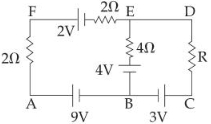
- In the electric network shown, when no current flows through the \(4\, \Omega \) resistor in the arm \(EB\), the potential difference between the points \(A\) and \(D\) will be ............... \(V\)
 JEE Mains 2015 Hard
- Two identical tennis balls each having mass \(m\) and charge \(q\) are suspended from a fixed point by threads of length \(l\). What is the equilibrium separation when each thread makes a small angle \(\theta\) with the vertical?JEE Mains 2021 Hard
- In a photoelectric experiment, increasing the intensity of incident light :JEE Mains 2021 Medium
- A disc of radius \(R\) and mass \(M\) is rolling horizontally without slipping with speed \(v\). It then moves up an inclined smooth surface as shown in figure. The maximum height that the disc can go up the incline is _______.
 JEE Mains 2024 Hard
- An electron with mass ' \(m\) ' with an initial velocity \((\mathrm{t}=0) \overrightarrow{\mathrm{v}}=\mathrm{v}_0 \hat{\mathrm{i}} \quad\left(\mathrm{v}_0 \gt 0\right)\) enters a magnetic field \(\vec{B}=B_0 \hat{j}\). If the initial de-Broglie wavelength at \(\mathrm{t}=0\) is \(\lambda_0\) then its value after time ' t ' would be :JEE Mains 2025 Medium
- If the total energy transferred to a surface in time \(t\) is \(6.48 \times 10^5 \mathrm{~J}\), then the magnitude of the total momentum delivered to this surface for complete absorption will be _______.JEE Mains 2024 Hard