


JEE Mains · Physics · STD 11 - Vectors
- JEE Mains 2024
- Hard
- MCQ
The resultant of two vectors \(\vec{A}\) and \(\vec{B}\) is perpendicular to \(\overrightarrow{\mathrm{A}}\) and its magnitude is half that of \(\vec{B}\). The angle between vectors \(\vec{A}\) and \(\vec{B}\) is _______.
Pick an option to check your answer.
Answer & Solution
Correct Answer
(C) \(150^\circ\)
Step-by-step Solution
Detailed explanation

Explanation:
Let the angle between vector \(\vec{A}\) and vector \(\vec{B}\) be \(\alpha\), and let the resultant vector be \(\vec{R}\). We can analyze the vector components geometrically or analytically:
1. Analytical Method:
The magnitude of the component of \(\vec{B}\) perpendicular to \(\vec{A}\) must balance out to form the resultant vector \(\vec{R}\), since \(\vec{R}\) has no component along the direction of \(\vec{A}\). This means that the components can be split as:
- Along the direction of \(\vec{A}\): \(A + B \cos\alpha = 0 \implies \cos\alpha = -\frac{A}{B}\)
- Perpendicular to \(\vec{A}\): \(R = B \sin\alpha\)
2. Using the Given Conditions:
We are given that the magnitude of the resultant is half of \(\vec{B}\), so \(R = \frac{B}{2}\). Substituting this into the perpendicular component equation yields:
\( \frac{B}{2} = B \sin\alpha \implies \sin\alpha = \frac{1}{2} \)
3. Determining the Angle (\(\alpha\)):
Since \(\cos\alpha = -\frac{A}{B}\) is negative (as magnitudes \(A\) and \(B\) are positive), the angle \(\alpha\) must lie in the second quadrant (\(90^\circ < \alpha < 180^\circ\)).
For \(\sin\alpha = \frac{1}{2}\) in the second quadrant:
\( \alpha = 180^\circ - 30^\circ = 150^\circ \)
4. Geometric Verification:
Consider a right-angled triangle formed by the vectors where \(\vec{R}\) is perpendicular to \(\vec{A}\). Let \(\theta\) be the angle that \(\vec{B}\) makes with the vector \(\vec{R}\).
From the geometry of the components:
\( \cos\theta = \frac{R}{B} = \frac{\left(\frac{B}{2}\right)}{B} = \frac{1}{2} \implies \theta = 60^\circ \)
Since \(\vec{R}\) is at \(90^\circ\) relative to \(\vec{A}\), the total angle \(\alpha\) between \(\vec{A}\) and \(\vec{B}\) is:
\( \alpha = 90^\circ + \theta = 90^\circ + 60^\circ = 150^\circ \)
Hence, Option C is the correct choice.
More questions from Physics
- A small cube of side \(1\) mm is placed at the centre of a circular loop of radius \(10\) cm carrying a current of \(2\) A. The magnetic energy stored inside the cube is \(\alpha \times 10^{-14}\) J. The value of \(\alpha\) is _______. (\(\mu_o = 4\pi \times 10^{-7}\) Tm/A, \(\pi = 3.14\))JEE Mains 2026 Hard
- An effective power of a combination of \(5\) identical convex lenses which are kept in contact along the principal axis is \(25 \mathrm{D}\). Focal length of each of the convex lens is _______.JEE Mains 2024 Hard
- An electron in a hydrogen atom revolves around its nucleus with a speed of \(6.76 \times 10^6\,ms ^{-1}\) in an orbit of radius \(0.52\,\mathring A\). The magnetic field produced at the nucleus of the hydrogen atom is \(......T\).JEE Mains 2023 Medium
- For the four sets of three measured physical quantities as given below. Which of the following options is correct ? \((i)\) \(\mathrm{A}_{1}=24.36, \mathrm{B}_{1}=0.0724, \mathrm{C}_{1}=256.2\) \((ii)\) \(\mathrm{A}_{2}=24.44, \mathrm{B}_{2}=16.082, \mathrm{C}_{2}=240.2\) \((iii)\) \(\mathrm{A}_{3}=25.2, \mathrm{B}_{3}=19.2812, \mathrm{C}_{3}=236.183\) \((iv)\) \(\mathrm{A}_{4}=25, \mathrm{B}_{4}=236.191, \mathrm{C}_{4}=19.5\)JEE Mains 2020 Hard
- A particle moving in the \(xy\) plane experiences a velocity dependent force \(\overrightarrow{ F }= k \left( v _{ y } \hat{ i }+ v _{ x } \hat{ j }\right),\) where \(v _{ x }\) and \(v _{ y }\) are the \(x\) and \(y\) components of its velocity \(\overrightarrow{ v } .\) If \(\overrightarrow{ a }\) be the acceleration of the particle, then which of the following statements is true for the particle\(?\)JEE Mains 2020 Hard
- The self produced \(emf\) of a coil is \(25\,volts\). When the current in it is changed at uniform rate from \(10\,A\) to \(25\, A\) in \(1\,s\), the change in the energy of the inductance is......\(J\)JEE Mains 2019 Hard
More PYQs from JEE Mains
- For \(a\) gas \(C_{p}-C_{V}=R\) in a state \(P\) and \(C_{p}-C_{V}=1.10 R\) in a state \(Q, T_{p}\) and \(T_{Q}\) are the temperatures in two different states \(P\) and \(Q\) respectively. ThenJEE Mains 2021 Medium
- If \({E}\) and \({H}\) represents the intensity of electric field and magnetising field respectively, then the unit of \(E/H\) will be :JEE Mains 2021 Hard
- the given potentiometer has its wire of resistance \(10\, \Omega\). When the sliding contact is in the middle of the potentiometer wire, the potential drop across \(2\, \Omega\) resistor is -
 JEE Mains 2021 Hard
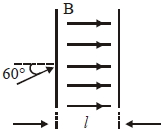
- The figure shows a region of length \('l'\) with a uniform magnetic field of \(0.3\, T\) in it and a proton entering the region with velocity \(4 \times 10^{5}\, ms ^{-1}\) making an angle \(60^{\circ}\) with the field. If the proton completes \(10\) revolution by the time it cross the region shown, \(l\) is close to....... \(m\) (mass of proton \(=1.67 \times 10^{-27} \,kg ,\) charge of the proton \(\left.=1.6 \times 10^{-19}\, C \right)\)
 JEE Mains 2020 Hard
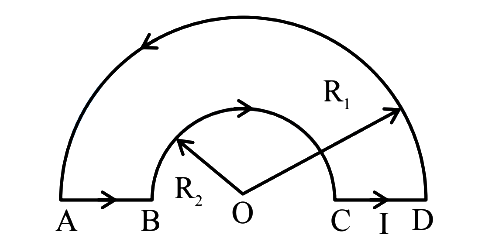
- A loop ABCDA , carrying current \(\mathrm{I}=12 \mathrm{~A}\), is placed in a plane, consists of two semi-circular segments of radius \(R_1=6 \pi \mathrm{~m}\) and \(\mathrm{R}_2=4 \pi \mathrm{~m}\). The magnitude of the resultant magnetic field at center O is \(\mathrm{k} \times 10^{-7} \mathrm{~T}\). The value of k is ______ (Given \(\mu_0=4 \pi \times 10^{-7} \mathrm{Tm} \mathrm{A}^{-1}\))
 JEE Mains 2025 Medium
- For the two cells having same EMF E and internal resistance r, the current passing through the external resistor 6 \(\Omega\) is same when both the cells are connected either in parallel or in series. The value of internal resistance r is ___________ \(\Omega\).JEE Mains 2026 Hard