


JEE Mains · Physics · STD 11 - 3.2 motion in plane
A particle moving in a circle of radius \(R\) with uniform speed takes time \(\mathrm{T}\) to complete one revolution. If this particle is projected with the same speed at an angle \(\theta\) to the horizontal, the maximum height attained by it is equal to \(4 R\). The angle of projection \(\theta\) is then given by _______.
- A \(\sin ^{-1}\left[\frac{2 g T^2}{\pi^2 R}\right]^{\frac{1}{2}}\)
- B \(\sin ^{-1}\left[\frac{\pi^2 R}{2 \mathrm{gT}^2}\right]^{\frac{1}{2}}\)
- C \(\cos ^{-1}\left[\frac{2 \mathrm{gT}^2}{\pi^2 \mathrm{R}}\right]^{\frac{1}{2}}\)
- D \(\cos ^{-1}\left[\frac{\pi R}{2 g T^2}\right]^{\frac{1}{2}}\)
Answer & Solution
Correct Answer
(A) \(\sin ^{-1}\left[\frac{2 g T^2}{\pi^2 R}\right]^{\frac{1}{2}}\)
Step-by-step Solution
Detailed explanation
\(\frac{2 \pi R}{T}=V\) \(\text { Maximum height } H=\frac{v^2 \sin ^2 \theta}{2 g}\) \(4 R=\frac{4 \pi^2 R^2}{T^2 2 g} \sin ^2 \theta\) \(\sin \theta=\sqrt{\frac{2 g T^2}{\pi^2 R}}\) \(\theta=\sin ^{-1}\left(\frac{2 g T^2}{\pi^2 R}\right)^{\frac{1}{2}}\)
See the Complete Solution
Get step-by-step explanations for this and 2.5 Lakh+ more JEE, NEET & CET questions.
- Unlock all solutions
- Practice the full chapter
- Track accuracy across PYQs
4.8 rated on Google Play · 14,000+ reviews
More questions from Physics
- An object is placed at a distance of \(12 \,{cm}\) from a convex lens. A convex mirror of focal length \(15 \,{cm}\) is placed on other side of lens at \(8 \,{cm}\) as shown in the figure. Image of object coincides with the object.When the convex mirror is removed, a real and inverted image is formed at a position. The distance of the image from the object will be ..... \((cm)\)
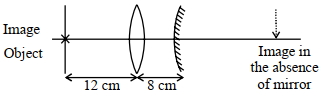 JEE Mains 2021 Hard
 - Two planets have masses \(M\) and \(16\, M\) and their radii are \(a\) and \(2\, a\) respectively. The separation between the centres of the planets is \(10\, a.\) A body of mass \(m\) is fired from the surface of the larger planet towards the smaller planet along the line joining their centres. For the body to be able to reach at the surface of smaller planet, the minimum firing speed needed isJEE Mains 2020 Hard
- An EM wave from air enters a medium. The electric fields are \(\overrightarrow {{E_1}} = {E_{01}}\hat x\;cos\left[ {2\pi v\left( {\frac{z}{c} - t} \right)} \right]\) in air and \(\overrightarrow {{E_2}} = {E_{02}}\hat x\;cos\left[ {k\left( {2z - ct} \right)} \right]\) in medium, where the wave number \(k\) and frequency \(v\) refer to their values in air. The medium is nonmagnetic. If \(\varepsilon {_{{r_1}}}\) and \(\varepsilon {_{{r_2}}}\) refer to relative permittivities of air and medium respectively, which of the following options is correct?JEE Mains 2018 Medium
- Width of one of the two slits in a Young's double slit interference experiment is half of the other slit. The ratio of the maximum to the minimum intensity in the interference pattern is _______.JEE Mains 2025 Easy
- A simple pendulum of length \(L\) is placed between the plates of a parallel plate capacitor having electric field \(E,\) as shown in figure. Its bob has mass \(m\) and charge \(q.\) the time period of the pendulum is given by
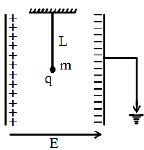 JEE Mains 2019 Hard
 - In \(LC\) circuit the inductance \(\mathrm{L}=40\; \mathrm{mH}\) and capacitance \(\mathrm{C}=100\; \mu \mathrm{F} .\) If a voltage \(\mathrm{V}(\mathrm{t})=10 \sin (314 \mathrm{t})\) is applied to the circuit, the current in the circuit is given asJEE Mains 2020 Hard
More PYQs from JEE Mains
- The distance of the point \((1, 0, 2)\) from the point of intersection of the line \(\frac{{x - 2}}{3} = \frac{{y + 1}}{4} = \frac{{z - 2}}{{12}}\) and the plane \(x - y + z = 16\) isJEE Mains 2015 Medium
- Two small spherical balls of mass 10 g each with charges \(-2 \mu \mathrm{C}\) and \(2 \mu \mathrm{C}\), are attached to two ends of very light rigid rod of length 20 cm. The arrangement is now placed near an infinite nonconducting charge sheet with uniform charge density of \(100 \mu \mathrm{C} / \mathrm{m}^2\) such that length of rod makes an angle of \(30^{\circ}\) with electric field generated by charge sheet. Net torque acting on the rod is:
(Take \(\varepsilon_0: 8.85 \times 10^{-12} \mathrm{C}^2 / \mathrm{Nm}^2\))JEE Mains 2025 Easy - A block of mass 1 kg , moving along x with speed \(\mathrm{v}_{\mathrm{i}}=10 \mathrm{~m} / \mathrm{s}\) enters a rough region ranging from \(\mathrm{x}=0.1 \mathrm{~m}\) to \(\mathrm{x}=1.9 \mathrm{~m}\). The retarding force acting on the block in this range is \(\mathrm{F}_{\mathrm{r}}=-\mathrm{kx} \mathrm{N}\), with \(\mathrm{k}=10 \mathrm{~N} / \mathrm{m}\). Then the final speed of the block as it crosses rough region isJEE Mains 2025 Medium
- Let \(H: \frac{-x^2}{a^2}+\frac{y^2}{b^2}=1\) be the hyperbola, whose eccentricity is \(\sqrt{3}\) and the length of the latus rectum is \(4 \sqrt{3}\). Suppose the point \((\alpha, 6), \alpha>0\) lies on \(H\). If \(\beta\) is the product of the focal distances of the point \((\alpha, 6)\), then \(\alpha^2+\beta\) is equal to :JEE Mains 2024 Hard
- Given below are two statements: one is labelled as Assertion \(A\) and the other is labelled as Reason \(R\). Assertion \(A :\) The escape velocities of planet \(A\) and \(B\) are same. But \(A\) and \(B\) are of unequal mass. Reason \(R :\) The product of their mass and radius must be same, \(M _{1} R _{1}= M _{2} R _{2}\) In the light of the above statements, choose the most appropriate answer from the options given belowJEE Mains 2021 Medium
- The threshold frequency of metal is \(f_0\). When the light of frequency \(2 f_0\) is incident on the metal plate, the maximum velocity of photoelectron is \(v_1\). When the frequency of incident radiation is increased to \(5 f _0\). the maximum velocity of photoelectrons emitted is \(v_2\). The ratio of \(v_1\) to \(v_2\) is:JEE Mains 2023 Medium