


JEE Mains · Physics · STD 11 - Motion in straight line
- JEE Mains 2024
- Hard
- Numerical
A particle is moving in one dimension (along the x-axis) under the action of a variable force. Its position \( x \) (in meters) varies with time \( t \) (in seconds) according to the equation \( x = -3t^3 + 18t^2 + 16t + 16 \). The velocity of the particle when its acceleration becomes zero is _________ \( \text{m/s} \).
Pick an option to check your answer.
Answer & Solution
Correct Answer
(B) \(52\)
Step-by-step Solution
Detailed explanation
Explanation:
1. Finding Velocity: Velocity \( v \) is the first derivative of position with respect to time (\( v = \frac{dx}{dt} \)):
\( v = \frac{d}{dt}(-3t^3 + 18t^2 + 16t + 16) \)
\( v = -9t^2 + 36t + 16 \)
2. Finding Acceleration: Acceleration \( a \) is the first derivative of velocity with respect to time (\( a = \frac{dv}{dt} \)):
\( a = \frac{d}{dt}(-9t^2 + 36t + 16) \)
\( a = -18t + 36 \)
3. Condition for Zero Acceleration: Setting the acceleration equation to zero allows us to determine the specific time \( t \):
\( -18t + 36 = 0 \)
\( 18t = 36 \implies t = 2\text{ s} \)
4. Calculating Velocity at \( t = 2\text{ s} \):
Substituting \( t = 2 \) back into the velocity equation yields:
\( v(2) = -9(2)^2 + 36(2) + 16 \)
\( v(2) = -9(4) + 72 + 16 \)
\( v(2) = -36 + 72 + 16 = 52\text{ m/s} \)
Hence, Option B is the correct choice.
More questions from Physics
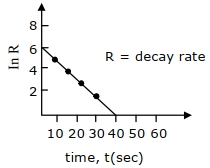
- For a certain radioactive process the graph between \(In\, {R}\) and \({t}\,({sec})\) is obtained as shown in the figure. Then the value of half life for the unknown radioactive material is approximately \(....\,{sec}.\)
 JEE Mains 2021 Medium
- A water spray gun is attached to a hose of cross sectional area \(30\) cm\(^2\). The gun comprises of \(10\) perforations each of cross sectional area \(15\) mm\(^2\). If the water flows in the hose with the speed of \(50\) cm/s, calculate the speed at which the water flows out from each perforation. (Neglect any edge effects)JEE Mains 2026 Medium
- A solid cylinder of mass \(m\) is wrapped with an inextensible light string and, is placed on a rough inclined plane as shown in the figure. The frictional force acting between the cylinder and the inclined plane is: [The coefficient of static friction, \(\mu_{ s },\) is \(\left.0.4\right]\)
 JEE Mains 2021 Hard
- An engine takes in \(5\) moles of air at \(20\,^{\circ} C\) and \(1\) \(atm,\) and compresses it adiabaticaly to \(1 / 10^{\text {th }}\) of the original volume. Assuming air to be a diatomic ideal gas made up of rigid molecules, the change in its internal energy during this process comes out to be \(X\, kJ\). The value of \(X\) to the nearest integer isJEE Mains 2020 Hard
- A mass of \(1\text{ kg}\) is kept on an inclined plane with \(30°\) inclination with respect to horizontal plane and it is at rest initially. Then the whole assembly is moved up with constant velocity of \(4\text{ m/s}\). The work done by the frictional force in time \(2\text{ s}\) is _______ J. (Take \(g = 10\text{ m/s}^2\))JEE Mains 2026 Medium
- Two metallic wires \(P\) and \(Q\) have same volume and are made up of same material. If their area of cross sections are in the ratio \(4: 1\) and force \(F_1\) is applied to \(\mathrm{P}\), an extension of \(\Delta l\) is produced. The force which is required to produce same extension in \(Q\) is \(\mathrm{F}_2\).The value of \(\frac{\mathrm{F}_1}{\mathrm{~F}_2}\) is _______.JEE Mains 2024 Hard
More PYQs from JEE Mains
- A long solenoid with \(1000\, turns/m\) has a core material with relative permeability \(500\) and volume \(10^{3}\, {cm}^{3} .\) If the core material is replaced by another material having relative permeability of \(750\) with same volume maintaining same current of \(0.75\, {A}\) in the solenoid, the fractional change in the magnetic moment of the core would be approximately \(\left(\frac{{x}}{499}\right) .\) Find the value of \({x}\).JEE Mains 2021 Hard
- Distance between object and its image \(\left( \text{magnified by } -\frac{1}{3}\right)\) is 30 cm. The focal length of the mirror used is \(\left(\frac{x}{4}\right) \mathrm{cm}\),
where magnitude of value of \(x\) is _________.JEE Mains 2025 Medium - Two wires \(A\) and \(B\) are made up of the same material and have the same mass. Wire A has radius of \(2.0 \mathrm{~mm}\) and wire \(B\) has radius of \(4.0 \mathrm{~mm}\). The resistance of wire B is \(2 \Omega\). The resistance of wire \(\mathrm{A}\) is _______ \(\Omega\).JEE Mains 2024 Hard
- A uniform string oflength \(20\ m\) is suspended from a rigid support. A short wave pulse is introduced at its lowest end. It starts moving up the string. The time taken to reach the supports is (take \(g= 10 \) \(ms^{-2}\) )JEE Mains 2016 Easy
- A small block of mass m slides down from the top of a frictionless inclined surface, while the inclined plane is moving towards left with constant acceleration \(a_{0}.\) The angle between the inclined plane and ground is \(\theta\) and its base length is L. Assuming that initially the small block is at the top of the inclined plane, the time it takes to reach the lowest point of the inclined plane is ___________.
 JEE Mains 2026 Easy