


JEE Mains · Physics · STD 11 - 7. gravitation
The masses and radii of the earth and moon are \(\left({M}_{1}, {R}_{1}\right)\) and \(\left({M}_{2}, {R}_{2}\right)\) respectively. Their centres are at a distance ' \({r}\) ' apart. Find the minimum escape velocity for a particle of mass ' \({m}\) ' to be projected from the middle of these two masses:
- A \({V}=\frac{1}{2} \sqrt{\frac{4 {G}\left({M}_{1}+{M}_{2}\right)}{{r}}}\)
- B \({V}=\sqrt{\frac{4 {G}\left({M}_{1}+{M}_{2}\right)}{{r}}}\)
- C \({V}=\frac{1}{2} \sqrt{\frac{2 {G}\left({M}_{1}+{M}_{2}\right)}{{r}}}\)
- D \({V}=\frac{\sqrt{2 {G}}\left({M}_{1}+{M}_{2}\right)}{{r}}\)
Answer & Solution
Correct Answer
(B) \({V}=\sqrt{\frac{4 {G}\left({M}_{1}+{M}_{2}\right)}{{r}}}\)
Step-by-step Solution
Detailed explanation
\(\frac{1}{2} {mV}^{2}-\frac{{GM}_{1} {m}}{{r} / 2}-\frac{{GM}_{2} {m}}{{r} / 2}=0\) \(\frac{1}{2} {mV}^{2}=\frac{2 {Gm}}{{r}}\left({M}_{1}+{M}_{2}\right)\) \({V}=\sqrt{\frac{4 {G}\left({M}_{1}+{M}_{2}\right)}{{r}}}\)
See the Complete Solution
Get step-by-step explanations for this and 2.5 Lakh+ more JEE, NEET & CET questions.
- Unlock all solutions
- Practice the full chapter
- Track accuracy across PYQs
4.8 rated on Google Play · 14,000+ reviews
More questions from Physics
-
Choose the correct answer from the options given belowList-\(I\) List-\(II\) \((a)\) \(MI\) of the rod (length \({L}\), Mass \({M}\), about an axis \(\perp\) to the rod passing through the midpoint) \((i)\;\frac {8 {ML}^{2}}{3}\) \((b)\) MI of the rod (length \(L\), Mass \(2 M\), about an axis \(\perp\) to the rod Passing through one its end) \((ii)\;\frac {{ML}^{2}}{3}\) \((c)\) MI of the rod (length \(2 {L}\), Mass \({M}\), about an axis \(\perp\) to the rod Passing through its midpoint) \((iii)\;\frac {{ML}^{2}}{12}\) \((d)\) MI of the rod (length \(2 {L}\), Mass \(2 {M}\), about an axis \(\perp\) to the rod passing through one of its end) \((iv)\;\frac {2 {ML}^{2}}{3}\) JEE Mains 2021 Medium - Statement\(-I :\) To get a steady de output from the pulsating voltage received from a full wave rectifier we can connect a capacitor across the output parallel to the load \({R}_{{L}}\) Statement\(-II :\) To get a steady de output from the pulsating voltage received from a full wave rectifier we can connect an inductor in series with \({R}_{{L}}\). In the light of the above statements, choose the most appropriate answer from the options given below:JEE Mains 2021 Medium
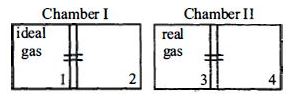
- There are two identical chambers, completely thermally insulated from surroundings. Both chambers have a partition wall dividing the chambers in two compartments. Compartment \(1\) is filled with an ideal gas and Compartment \(3\) is filled with a real gas. Compartments \(2\) and \(4\) are vacuum . A small hole (orifice) is made in the partition walls and the gases are allowed to expand in vacuum Statement \(-1\) : No change in the temperature of the gas takes place when ideal gas expands in vacuum. However, the temperature of real gas goes down (cooling) when it expands in vacuum Statement \(-2\) : The internal energy of an ideal gas is only kinetic. The internal energy of a real gas is kinetic as well as potential
 JEE Mains 2013 Medium
 - Two ideal Carnot engines operate in cascade (all heat given up by one engine is used by the other engine to produce work) between temperatures, \(\mathrm{T}_{1}\) and \(\mathrm{T}_{2} .\) The temperature of the hot reservoir of the first engine is \(\mathrm{T}_{1}\) and the temperature of the cold reservoir of the second engine is \(\mathrm{T}_{2} . T\) is temperature of the sink of first engine which is also the source for the second engine. How is \(T\) related to \(\mathrm{T}_{1}\) and \(\mathrm{T}_{2}\), if both the engines perform equal amount of work?JEE Mains 2020 Medium
- Consider a spherical shell of radius \(R\) at temperature \(T\). The black body radiation inside it can be considered as an ideal gas of photons with internal energy per unit volume\(E=\) \(\frac{U}{V} \propto {T^4}\) and pressure \(P = \frac{1}{3}\left( {\frac{U}{V}} \right)\) If the shell now undergoes an adiabatic expansion the relation between \(T\) and \(R\) isJEE Mains 2015 Hard
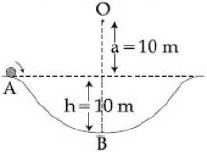
- A particle of mass \(20\,g\) is released with an initial velocity \(5\,m/s\) along the curve from the point \(A,\) as shown in the figure. The point \(A\) is at height \(h\) from point \(B.\) The particle slides along the frictionless surface. When the particle reaches point \(B,\) its angular momentum about \(O\) will be ......... \(kg - m^2/s\). [Take \(g = 10\,m/s^2\) ]
 JEE Mains 2019 Medium
More PYQs from JEE Mains
- The sum of an infinite geometric series with positive terms is \(3\) and the sum of the cubes of its terms is \(\frac {27}{19}\). Then the common ratio of this series isJEE Mains 2019 Hard
- The mean of the data set comprising of \(16\) observations is \(16.\) If one of the observation valued \(16\) is deleted and three new observations valued \(3, 4\) and \(5\) are added to the data, then the mean of the resultant data, is:JEE Mains 2015 Medium
- If the coefficients of \(x^{-2}\) and \(x^{-4}\) in the expansion of \({\left( {{x^{\frac{1}{3}}} + \frac{1}{{2{x^{\frac{1}{3}}}}}} \right)^{18}}\,,\,\left( {x > 0} \right),\) are \(m\) and \(n\) respectively, then \(\frac{m}{n}\) is equal toJEE Mains 2016 Hard
- Let \(d\) be the distance between the foot of perpendiculars of the points \(P (1,2-1)\) and \(Q (2,-\) 1,3 ) on the plane \(- x + y + z =1\). Then \(d ^{2}\) is equal toJEE Mains 2022 Hard
- A square loop of side \(10 \mathrm{~cm}\) and resistance \(0.7\ \Omega\) is placed vertically in east-west plane. A uniform magnetic field of \(0.20 \mathrm{~T}\) is set up across the plane in north east direction. The magnetic field is decreased to zero in \(1 \mathrm{~s}\) at a steady rate. Then, magnitude of induced emf is \(\sqrt{\mathrm{x}} \times 10^{-3} \mathrm{~V}\). The value of \(x\) is _______.JEE Mains 2024 Hard
- The percentage decrease in the weight of a rocket, when taken to a height of \(32 km\) above the surface of earth will, be\(.....\%\) (Radius of earth \(=6400\,km\) )JEE Mains 2022 Medium