


JEE Mains · Physics · STD 12 - Electromagnetic waves
- JEE Mains 2026
- Medium
- MCQ
For an electromagnetic wave propagating through vacuum, \(\vec{k}\), \(\vec{E}\) and \(\omega\) represent propagation vector, electric field and angular frequency, respectively. The magnetic field associated with this wave is represented by :
Pick an option to check your answer.
Answer & Solution
Correct Answer
(B) \(\dfrac{\vec{k} \times \vec{E}}{\omega}\)
Step-by-step Solution
Detailed explanation
For an electromagnetic wave, the direction of wave propagation \(\hat{k}\) is along the direction of \(\vec{E} \times \vec{B}\).
Since \(\vec{E}\), \(\vec{B}\), and \(\vec{k}\) form a mutually perpendicular right-handed system, the direction of the magnetic field is given by \(\hat{B} = \hat{k} \times \hat{E}\).
The magnitudes of the electric and magnetic fields are related by \(B = \dfrac{E}{c}\).
Using the relation for the speed of light \(c = \dfrac{\omega}{k}\), we get \(B = \dfrac{kE}{\omega}\).
Combining the magnitude and direction gives:
\(\vec{B} = B\hat{B} = \dfrac{kE}{\omega} (\hat{k} \times \hat{E})\)
Since \(\vec{k} = k\hat{k}\) and \(\vec{E} = E\hat{E}\), this simplifies to:
\(\vec{B} = \dfrac{\vec{k} \times \vec{E}}{\omega}\)
Answer: \(\dfrac{\vec{k} \times \vec{E}}{\omega}\)
More questions from Physics
- The metallic bob of simple pendulum has the relative density \(5\). The time period of this pendulum is \(10\,s\). If the metallic bob is immersed in water, then the new time period becomes \(5 \sqrt{ x } s\). The value of \(x\) will be.JEE Mains 2022 Medium
- An ac current is represented as
\(\mathrm{i}=5 \sqrt{2}+10 \cos \left(650 \pi \mathrm{t}+\frac{\pi}{6}\right) \mathrm{Amp}\)
The r.m.s value of the current isJEE Mains 2025 Easy - The time dependence of the position of a particle of mass \(m = 2\) is given by \(\vec r\,(t)\, = \,2t\,\hat i\, - 3{t^2}\hat j\) Its angular momentum with respect to the origin at time \(t = 2\) isJEE Mains 2019 Hard
- A gas can be taken from \(A\) to \(B\) via two different processes \(ACB\) and \(ADB\). When path \(ACB\) is used \(60\, J\) of heat flows into the system and \(30\, J\) of work is done by the system. If path \(ADB\) is used work down by the system is \(10\, J\). the heat flow into the system in path \(ADB\) is ..... \(J\)
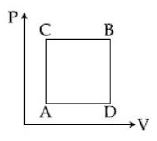 JEE Mains 2019 Medium
- An air bubble of diameter \(6\,mm\) rises steadily through a solution of density \(1750\,kg / m ^3\) at the rate of \(0.35\,cm / s\). The co-efficient of viscosity of the solution (neglect density of air) is \(..........\,Pas\) (given, \(g =10\,ms ^{-2}\))JEE Mains 2023 Medium
- A fly wheel is accelerated uniformly from rest and rotates through \(5 \,rad\) in the first second. The angle rotated by the fly wheel in the next second, will be.........\(rad\)JEE Mains 2022 Easy
More PYQs from JEE Mains
- When a resistance of \(5\,\Omega\) is shunted with a moving coil galvanometer, it shows a full scale deflection for a current of \(250\,mA\), however when \(1050\,\Omega\) resistance is connected with it in series, it gives full scale deflection for \(25\) volt. The resistance of galvanometer is \(......\,\Omega\).JEE Mains 2023 Hard
- Imagine that a reactor converts all given mass into energy and that it operates at a power level of \(10^9\, watt\). The mass of the fuel consumed per hour in the reactor will be : (velocity of light, \(c\) is \(3\times10^8\, m/s\))JEE Mains 2017 Medium
- For the given circuit, the power across zener diode is ..... \({mW}.\)
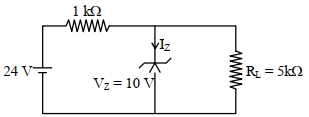 JEE Mains 2021 Hard
- In photoelectric effect an em-wave is incident on a metal surface and electrons are ejected from the surface. If the work function of the metal is 2.14 eV and stopping potential is 2 V , what is the wavelength of the em-wave ?
(Given hc \(=1242 \mathrm{eVnm}\) where h is the Planck's constant and c is the speed of light in vaccum.)JEE Mains 2025 Easy