


JEE Mains · Physics · STD 12 - 11. Dual nature of radiation and matter
The de Broglie wavelength associated with an electron accelerated through a potential difference V is \(\lambda_e\) and the de Broglie wavelength associated with a proton accelerated through the same potential difference is \(\lambda_p\). If their corresponding masses are \(m_e\) and \(m_p\), respectively, then the ratio of their de Broglie wavelengths \(\left(\dfrac{\lambda_e}{\lambda_p}\right)\) is ______.
- A \(\sqrt{\dfrac{m_p}{m_e}}\)
- B \(\sqrt{\dfrac{m_e}{m_p}}\)
- C \(\dfrac{m_p}{m_e}\)
- D \(\left(\dfrac{m_p}{m_e}\right)^2\)
Answer & Solution
Correct Answer
(A) \(\sqrt{\dfrac{m_p}{m_e}}\)
Step-by-step Solution
Detailed explanation
The de Broglie wavelength of a particle accelerated through a potential difference \(V\) is given by \(\lambda = \dfrac{h}{\sqrt{2mqV}}\). For an electron, the charge is \(e\) and mass is \(m_e\). Its de Broglie wavelength is \(\lambda_e = \dfrac{h}{\sqrt{2m_e eV}}\). For a…
See the Complete Solution
Get step-by-step explanations for this and 2.5 Lakh+ more JEE, NEET & CET questions.
- Unlock all solutions
- Practice the full chapter
- Track accuracy across PYQs
4.8 rated on Google Play · 14,000+ reviews
More questions from Physics
- A square loop of side \(2\, a ,\) and carrying current I, is kept in \(XZ\) plane with its centre at origin. A long wire carrying the same current \(I\) is placed parallel to the \(z-\)axis and passing through the point \((0, b, 0),(b>>a)\). The magnitude of the torque on the loop about \(z-\)axis is given by:JEE Mains 2020 Hard
- A capacitor of capacitance \(100\ \mu \mathrm{F}\) is charged to a potential of \(12 \mathrm{~V}\) and connected to a \(6.4 \ \mathrm{mH}\) inductor to produce oscillations. The maximum current in the circuit would be :JEE Mains 2024 Hard
- In an experiment to find out the diameter of wire using screw gauge, the following observation were noted. \((a)\) Screw moves \(0.5\,mm\) on main scale in one complete rotation \((b)\) Total divisions on circular scale \(=50\) \((c)\) Main scale reading is \(2.5\,mm\) \((d)\) \(45^{\text {th }}\) division of circular scale is in the pitch line \((e)\) Instrument has \(0.03 \;mm\) negative error Then the diameter of wire is \(...........\,mm\)
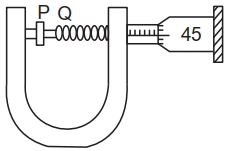 JEE Mains 2022 Medium
 - A ball is thrown up vertically with a certain velocity so that, it reaches a maximum height \(h\). Find the ratio of the times in which it is at height \(\frac{ h }{3}\) while going up and coming down respectively.JEE Mains 2022 Hard
- The number of molecules in one litre of an ideal gas at \(300 \,{K}\) and \(2\) atmospheric pressure with mean kinetic energy \(2 \times 10^{-9}\, {J}\) per molecules is \(....\, \times 10^{11}\)JEE Mains 2021 Medium
- In the circuit shown, the resistance \(r\) is a variable resistance. If for \(r = fR,\) the heat generation in \(r\) is maximum then the value of \(f\) is
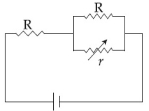 JEE Mains 2016 Hard
More PYQs from JEE Mains
- An experiment takes \(10\, minutes\) to raise the temperature of water in a container from \(0\,^oC\) to \(100\,^oC\) and another \(55\, minutes\) to convert it totally into steam by a heater supplying heat at a uniform rate . Neglecting the specific heat of the container and taking specific heat of water to be \(1\, cal / g\,^oC\), the heat of vapourization according to this experiment will come out to be ........ \(cal/g\)JEE Mains 2015 Medium
- Calculate the amount of charge on capacitor of \(4\, \mu\, {F}\). The internal resistance of battery is \(1\, \Omega\) : (in \(\mu {C}\))
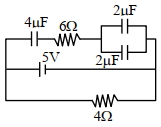 JEE Mains 2021 Hard
 - The energy released per fission of nucleus of \({ }^{240} X\) is \(200 MeV\). The energy released if all the atoms in \(120 g\) of pure \({ }^{240} X\) undergo fission is \(........\times 10^{25}\,MeV\).\(\left(\right.\) Given \(\left.N_A=6 \times 10^{23}\right)\)JEE Mains 2023 Medium
- An object of mass \(0.2 \mathrm{~kg}\) executes simple harmonic motion along \(\mathrm{x}\) axis with frequency of \(\left(\frac{25}{\pi}\right) \mathrm{Hz}\). At the position \(\mathrm{x}=0.04 \mathrm{~m}\) the object has kinetic energy \(0.5 \mathrm{~J}\) and potential energy \(0.4 \mathrm{~J}\) The amplitude of oscillation is _______ cm.JEE Mains 2024 Hard
- The magnitude of vectors \(\overrightarrow{ OA }, \overrightarrow{ OB }\) and \(\overrightarrow{ OC }\) in the given figure are equal. The direction of \(\overrightarrow{ OA }+\overrightarrow{ OB }-\overrightarrow{ OC }\) with \(x\)-axis will be
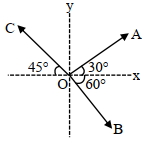 JEE Mains 2021 Hard
 - A time varying potential difference is applied between the plates of a parallel plate capacitor of capacitance \(2.5 \mu \mathrm{~F}\). The dielectric constant of the medium between the capacitor plates is 1 . It produces an instantaneous displacement current of 0.25 mA in the intervening space between the capacitor plates, the magnitude of the rate of change of the potential difference will be _____ \(\mathrm{Vs}^{-1}\).JEE Mains 2025 Hard