


JEE Mains · Physics · STD 12 - Dual nature of radiation and matter
- JEE Mains 2026
- Medium
- MCQ
The graph shows variation of stopping potential \(V_o\) with the frequency \(\nu\) of the incident radiation for three photosensitive metals \(X_1\), \(X_2\) and \(X_3\). Which metal will give out electrons with greater kinetic energy, for the same wavelength of incident radiation?

Pick an option to check your answer.
Answer & Solution
Correct Answer
(A) \(X_1\)
Step-by-step Solution
Detailed explanation
From Einstein's photoelectric equation, the maximum kinetic energy of emitted photoelectrons is given by:
\(K_{\text{max}} = \dfrac{hc}{\lambda} - \Phi\)
where \(\lambda\) is the wavelength of incident radiation and \(\Phi\) is the work function of the metal.
The work function is related to the threshold frequency \(\nu_0\) by \(\Phi = h\nu_0\). From the given graph, the x-intercept represents the threshold frequency. We can observe that:
\(\nu_0(X_1) < \nu_0(X_2) < \nu_0(X_3)\)
Therefore, the work functions of the metals follow the order:
\(\Phi(X_1) < \Phi(X_2) < \Phi(X_3)\)
For the same wavelength \(\lambda\) of incident radiation, the term \(\dfrac{hc}{\lambda}\) is constant. Thus, the kinetic energy \(K_{\text{max}}\) will be greatest for the metal with the smallest work function.
Since metal \(X_1\) has the minimum work function, it will emit electrons with the greatest kinetic energy.
Answer: \(X_1\)
More questions from Physics
- A mixture of hydrogen and oxygen has volume \(500\, {cm}^{3}\), temperature \(300\, {K}\), pressure \(400\, {kPa}\) and mass \(0.76\, {g}\). The ratio of masses of oxygen to hydrogen will be :-JEE Mains 2021 Hard
- A rod of length \(L\) has non-uniform linear mass density given by \(\rho(\mathrm{x})=\mathrm{a}+\mathrm{b}\left(\frac{\mathrm{x}}{\mathrm{L}}\right)^{2},\) where \(a\) and \(\mathrm{b}\) are constants and \(0 \leq \mathrm{x} \leq \mathrm{L}\). The value of \(\mathrm{x}\) for the centre of mass of the rod is atJEE Mains 2020 Hard
- Which of the following equations is dimensionally incorrect? Where \(t=\) time, \(h=\) height, \(s=\) surface tension, \(\theta=\) angle, \(\rho=\) density, \(a, r=\) radius, \(g=\) acceleration due to gravity, \({v}=\) volume, \({p}=\) pressure, \({W}=\) work done, \(\Gamma=\) torque, \(\varepsilon=\) permittivity, \({E}=\) electric field, \({J}=\) current density, \({L}=\) length.JEE Mains 2021 Hard
- A uniform cylinder of mass \(M\) and radius \(R\) is to be pulled over a step of height \(a (a < R\)) by applying a force \(F\) at its centre \('O'\) perpendicular to the plane through the axes of the cylinder on the edge of the step ( see figure). The minimum value of \(F\) required is
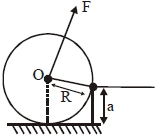 JEE Mains 2020 Hard
- A block of mass \(m = 10\,kg\) rests on a horizontal table. The coefficient of friction between the block and the table is \(0.05.\) When hit by a bullet of mass \(50\,g\) moving with speed \(v,\) that gets embedded in it, the block moves and comes to stop after moving a distance of \(2\,m\) on the table. If a freely falling object were to acquire speed \(\frac {v}{10}\) after being dropped from height \(H,\) then neglecting energy losses and taking \(g = 10\,ms^{-2},\) the value of \(H\) is close to ................. \(\mathrm{km}\)JEE Mains 2015 Hard
- At time \(\mathrm{t}=0\) magnetic field of \(1000\) Gauss is passing perpendicularly through the area defined by the closed loop shown in the figure. If the magnetic field reduces linearly to \(500\) Gauss, in the next \(5 \;\mathrm{s}\), then induced \(EMF\) in the loop is ........\( \mu \mathrm{V}\)
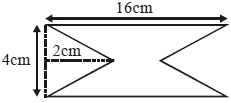 JEE Mains 2020 Medium
More PYQs from JEE Mains
- A piece of wood of mass \(0.03\, kg\) is dropped from the top of a \(100\, m\) height building. At the same time, a bullet of mass \(0.02\, kg\) is fired vertically upward, with a velocity \(100\, ms^{- 1}\), from the ground. The bullet gets embedded in the wood. Then the maximum height to which the combined system reaches above the top of the building before falling below is ........ \(m\). \((g = 10\, ms^{-2})\)JEE Mains 2019 Hard
- If mass is written as \(\mathrm{m}=\mathrm{kc}^{\mathrm{p}} \mathrm{G}^{-1 / 2} \mathrm{~h}^{1 / 2}\) then the value of \(P\) will be _______. (Constants have their usual meaning with \(\mathrm{k}\) a dimensionless constant)JEE Mains 2024 Hard
- The motion of a mass on a spring, with spring constant \({K}\) is as shown in figure. The equation of motion is given by \(x(t)= A sin \omega t+ Bcos\omega t\) with \(\omega=\sqrt{\frac{K}{m}}\) Suppose that at time \(t=0\), the position of mass is \(x(0)\) and velocity \(v(0)\), then its displacement can also be represented as \(x(t)=C \cos (\omega t-\phi)\), where \(C\) and \(\phi\) are
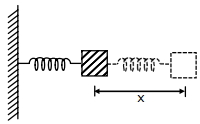 JEE Mains 2021 Hard
- If a wave gets refracted into a denser medium, then which of the following is true?JEE Mains 2022 Medium
- A calorimeter of water equivalent \(20\, g\) contains \(180\, g\) of water at \(25^{\circ} C\). '\(m\)' grams of steam at \(100^{\circ} C\) is mixed in it till the temperature of the mixure is \(31^{\circ} C\). The value of \('m'\) is close to (Latent heat of water \(=540\) cal \(g ^{-1}\), specific heat of water \(=1\) cal \(g^{-1}{ }^{\circ} C ^{-1}\) )JEE Mains 2020 Medium