


JEE Mains · Physics · STD 12 - Nuclei
- JEE Mains 2026
- Medium
- MCQ
Two nuclei of mass number \(3\) combine with another nucleus of mass number \(4\) to yield a nucleus of mass number \(10\). If the binding energy per nucleon for the mass numbers \(3\), \(4\) and \(10\) are \(5.6\) MeV, \(7.4\) MeV and \(6.1\) MeV, respectively, then in the process, \(\Delta Mc^2 = \) _____ MeV.
Pick an option to check your answer.
Answer & Solution
Correct Answer
(C) \(2.2\)
Step-by-step Solution
Detailed explanation
The nuclear reaction is given by:
\(2 X^{3} + Y^{4} \rightarrow Z^{10}\)
The total binding energy of the reactants is the sum of the binding energies of the two nuclei of mass number \(3\) and the nucleus of mass number \(4\).
Binding energy of reactants \(= 2 \times (3 \times 5.6) + (4 \times 7.4)\)
\(= 33.6 + 29.6 = 63.2\) MeV
The total binding energy of the product nucleus of mass number \(10\) is:
Binding energy of product \(= 10 \times 6.1 = 61.0\) MeV
The change in mass energy \(\Delta M c^2\) is equal to the difference in the total binding energies of the reactants and the product.
\(\Delta M c^2 = |63.2 - 61.0| = 2.2\) MeV
Answer: \(2.2\)
More questions from Physics
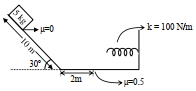
- A block is simply released from the top of an inclined plane as shown in the figure above. The maximum compression in the spring when the block hits the spring is _______.
 JEE Mains 2024 Hard
- Surface tension of two liquids (having same densities), \(T_1\) and \(T_2\), are measured using capillary rise method utilizing two tubes with inner radii of \(r_1\) and \(r_2\) where \(r_1>r_2\). The measured liquid heights in these tubes are \(h_1\) and \(h_2\) respectively. [Ignore the weight of the liquid about the lowest point of miniscus]. The heights \(h _1\) and \(h _2\) and surface tensions \(T _1\) and \(T _2\) satisfy the relation :JEE Mains 2026 Easy
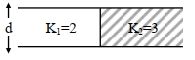
- A capacitor of \(10 \mu \mathrm{F}\) capacitance whose plates are separated by \(10 \mathrm{~mm}\) through air and each plate has area \(4 \mathrm{~cm}^2\) is now filled equally with two dielectric media of \(\mathrm{K}_1=2, \mathrm{~K}_2=3\) respectively as shown in figure. If new force between the plates is \(8 \mathrm{~N}\). The supply voltage is _______ \(\times 10^{-4}\)V.
 JEE Mains 2024 Hard
- A coil of self inductance \(10\,mH\) and resistance \(0.1\,\Omega \) is connected through a switch to a battery of internal resistance \(0.9\,\Omega \). After the switch is closed the time taken for the current to attain \(80\%\) of the saturation values is: [take \(ln\,5 = 1.6\) ]JEE Mains 2019 Hard
- Two parallel, long wires are kept \(0.20\,m\) apart in vacuum, each carrying current of \(x\) in the same direction. If the force of attraction per meter of each wire is \(2 \times 10^{-6}\,N\), then the value of \(x\) is approximatelyJEE Mains 2022 Medium
- A man (mass \(= 50\, kg\)) and his son (mass \(= 20\, kg\)) are standing on a frictionless surface facing each other. The man pushes his son so that he starts moving at a speed of \(0.70\, ms^{-1}\) with respect to the man. The speed of the man with respect to the surface is ........ \(ms^{-1}\)JEE Mains 2019 Medium
More PYQs from JEE Mains
- A small metallic sphere of diameter 2 mm and density \(10.5 g / cm ^3\) is dropped in glycerine having viscosity 10 Poise and density \(1.5 g / cm ^3\) respectively. The terminal velocity attained by the sphere is ___________ \(cm / s\).
\(\left(\pi=\frac{22}{7}\right.\) and \(\left.g=10 m / s ^2\right)\)JEE Mains 2026 Hard - The three charges \(q / 2, q\) and \(q / 2\) are placed at the corners \(A , B\) and \(C\) of a square of side ' \(a\) ' as shown in figure. The magnitude of electric field \((E)\) at the comer \(D\) of the square, is
 JEE Mains 2022 Medium
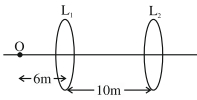
- A point object, \(O\) is placed in front of two thin symmetrical coaxial convex lenses \(L _1\) and \(L _2\) with focal length \(24\,cm\) and \(9\,cm\) respectively. The distance between two lenses is \(10\,cm\) and the object is placed \(6\,cm\) away from lens \(L _1\) as shown in the figure. The distance between the object and the image formed by the system of two lenses is .........\(cm\)
 JEE Mains 2023 Hard
- If \(\overrightarrow{ P }=3 \hat{ i }+\sqrt{3} \hat{ j }+2 \hat{ k }\) and \(\overrightarrow{ Q }=4 \hat{ i }+\sqrt{3} \hat{ j }+2.5 \hat{ k }\) then, The unit vector in the direction of \(\overrightarrow{ P } \times \overrightarrow{ Q }\) is \(\frac{1}{x}(\sqrt{3} \hat{i}+\hat{j}-2 \sqrt{3} \hat{k})\). The value of \(x\) isJEE Mains 2023 Medium
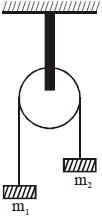
- A uniformly thick wheel with moment of inertia \(I\) and radius \(R\) is free to rotate about its centre of mass (see fig). A massless string is wrapped over its rim and two blocks of masses \(\mathrm{m}_{1}\) and \(\mathrm{m}_{2}\left(\mathrm{m}_{1}>\mathrm{m}_{2}\right)\) are attached to the ends of the string. The system is released from rest. The angular speed of the wheel when \(\mathrm{m}_{1}\) descents by a distance \(h\) is
 JEE Mains 2020 Hard