


JEE Mains · Physics · STD 11 - Oscillations
- JEE Mains 2025
- Hard
- MCQ
Two blocks of masses \(m\) and \(M,(M \gt m)\), are placed on a frictionless table as shown in figure. A massless spring with spring constant k is attached with the lower block. If the system is slightly displaced and released then
(\(\mu=\) coefficient of friction between the two blocks)

(A) The time period of small oscillation of the two blocks is \(\mathrm{T}=2 \pi \sqrt{\frac{(\mathrm{~m}+\mathrm{M})}{\mathrm{k}}}\)
(B) The acceleration of the blocks is \(\mathrm{a}=\frac{\mathrm{kx}}{\mathrm{M}+\mathrm{m}}\) (\(\mathrm{x}=\) displacement of the blocks from the mean position)
(C) The magnitude of the frictional force on the upper block is \(\frac{m \mu|x|}{M+m}\)
(D) The maximum amplitude of the upper block, if it does not slip, is \(\frac{\mu(M+m) g}{k}\)
(E) Maximum frictional force can be \(\mu(\mathrm{M}+\mathrm{m}) \mathrm{g}\).
Choose the correct answer from the options given below:
Pick an option to check your answer.
Answer & Solution
Correct Answer
(A) A, B, D Only
Step-by-step Solution
Detailed explanation
(A) As both blocks moving together so Time period \(=2 \pi \sqrt{\frac{\mathrm{~m}}{\mathrm{~K}}} ;\) where \(\mathrm{m}=\mathrm{M}+\mathrm{m}\)
\(\mathrm{T}=2 \pi \sqrt{\frac{\mathrm{M}+\mathrm{m}}{\mathrm{~K}}}\)
(B) Let block is displaced by x in \((+\mathrm{ve})\) direction so force on block will be in(-ve) direction
\(\begin{aligned}
& \mathrm{F}=-\mathrm{Kx} \\
& (\mathrm{M}+\mathrm{m}) \mathrm{a}=-\mathrm{Kx} \\
& \mathrm{a}=-\frac{\mathrm{Kx}}{(\mathrm{M}+\mathrm{m})}
\end{aligned}\)
(C) As upper block is moving due to friction thus
\(\mathrm{f}=\mathrm{ma}=\frac{\mathrm{mKx}}{(\mathrm{M}+\mathrm{m})}\)
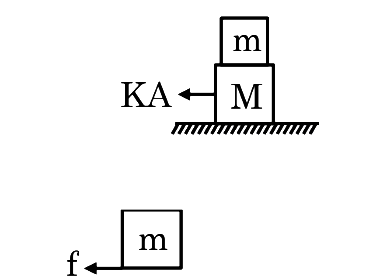
(D) This option is like two block problem in friction for maximum amplitude, force on block is also maximum, for which both blocks are moving together.
\(\begin{aligned}
& K A=(M+m) a \\
& a=\frac{K A}{(M+m)} \\
& f=m a=\frac{m K A}{(M+m)} \\
& f_{\max }=f_L=\mu \mathrm{mg} \\
& f=\mu m g \\
& \frac{m K A}{(M+m)}=\mu m g \\
& A=\frac{\mu(M+m) g}{K}
\end{aligned}\)
(E) Maximum friction can be \(\mu \mathrm{mg}\) as force is acting between blocks & normal force here is mg.
\(\mathrm{T}=2 \pi \sqrt{\frac{\mathrm{M}+\mathrm{m}}{\mathrm{~K}}}\)
(B) Let block is displaced by x in \((+\mathrm{ve})\) direction so force on block will be in(-ve) direction
\(\begin{aligned}
& \mathrm{F}=-\mathrm{Kx} \\
& (\mathrm{M}+\mathrm{m}) \mathrm{a}=-\mathrm{Kx} \\
& \mathrm{a}=-\frac{\mathrm{Kx}}{(\mathrm{M}+\mathrm{m})}
\end{aligned}\)
(C) As upper block is moving due to friction thus
\(\mathrm{f}=\mathrm{ma}=\frac{\mathrm{mKx}}{(\mathrm{M}+\mathrm{m})}\)
(D) This option is like two block problem in friction for maximum amplitude, force on block is also maximum, for which both blocks are moving together.
\(\begin{aligned}
& K A=(M+m) a \\
& a=\frac{K A}{(M+m)} \\
& f=m a=\frac{m K A}{(M+m)} \\
& f_{\max }=f_L=\mu \mathrm{mg} \\
& f=\mu m g \\
& \frac{m K A}{(M+m)}=\mu m g \\
& A=\frac{\mu(M+m) g}{K}
\end{aligned}\)
(E) Maximum friction can be \(\mu \mathrm{mg}\) as force is acting between blocks & normal force here is mg.
More questions from Physics
- In a Young's double slits experiment, the ratio of amplitude of light coming from slits is \(2: 1\). The ratio of the maximum to minimum intensity in the interference pattern is :JEE Mains 2023 Medium
- For a uniform rectangular sheet shown in the figure, the ratio of moments of inertia about the axes perpendicular to the sheet and passing through \(O\) (the centre of mass) and \(O ^{\prime}(\) corner point \()\) is
 JEE Mains 2020 Hard
- Given below are two statements. One is labelled as Assertion (A) and the other is labelled as Reason (R).
Assertion (A) : With the increase in the pressure of an ideal gas, the volume falls off more rapidly in an isothermal process in comparison to the adiabatic process.
Reason (R) : In isothermal process, \(\mathrm{PV}=\) constant, while in adiabatic process \(\mathrm{PV}^\gamma=\) constant. Here \(\gamma\) is the ratio of specific heats, P is the pressure and V is the volume of the ideal gas.
In the light of the above statements, choose the correct answer from the options given below :JEE Mains 2025 Medium - Which of the following equations is dimensionally incorrect? Where \(t=\) time, \(h=\) height, \(s=\) surface tension, \(\theta=\) angle, \(\rho=\) density, \(a, r=\) radius, \(g=\) acceleration due to gravity, \({v}=\) volume, \({p}=\) pressure, \({W}=\) work done, \(\Gamma=\) torque, \(\varepsilon=\) permittivity, \({E}=\) electric field, \({J}=\) current density, \({L}=\) length.JEE Mains 2021 Hard
- In the figure, given that \(V_{BB}\) supply can vary from \(0\) to \(5.0 \,V,\,\,V_{CC} = 5\,V,\) \(\beta _{dc} = 200,\,\,R_B = 100,\,k\Omega ,\) \(R_C = 1\,k\Omega \) an \(V_{BE} = 1.0\,V,\) The minimum base current and the input voltage at which the transistor will go to saturation, will be respectively
 JEE Mains 2019 Hard
- The \(X-Y\) plane be taken as the boundary between two transparent media \(M _{1}\) and \(M _{2} . M _{1}\) in \(Z \geq 0\) has a refractive index of \(\sqrt{2}\) and \(M _{2}\) with \(Z <0\) has a refractive index of \(\sqrt{3}\). A ray of light travelling in \(M_{1}\) along the direction given by the vector \(\overrightarrow{ A }=4 \sqrt{3 i }-3 \sqrt{3 \hat{j}}-5 \hat{ k }\), is incident on the plane of separation. The value of difference between the angle of incident in \(M _{1}\) and the angle of refraction in \(M _{2}\) will be \(....\) degree.JEE Mains 2022 Hard
More PYQs from JEE Mains
- A voltage regulating circuit consisting of Zener diode, having break-down voltage of 10 V and maximum power dissipation of 0.4 W , is operated at 15 V . The approximate value of protective resistance in this circuit is _________ \(\Omega\).JEE Mains 2026 Easy
- Charge is distributed within a sphere of radius \(R\) with a volume charge density \(\rho (r) = \frac{A}{{{r^2}}}{e^{ - 2r/a}}\) where \(A\) and \(a\) are constants. If \(Q\) is the total charge of this charge distribution, the radius \(R\) is.JEE Mains 2019 Hard
- Taking the wavelength of first Balmer line in hydrogen spectrum (\( n = 3\) to \(n = 2\) ) as \(660\,nm ,\) the wavelength of the \(2^{nd}\) Balmer line ( \(n =4\) to \(n = 2\) ) will be....\(nm\)JEE Mains 2019 Hard
- Given below are two statements : Statement \(I:\) If the Brewster's angle for the light propagating from air to glass is \(\theta_{ B }\), then Brewster's angle for the light propagating from glass to air is \(\frac{\pi}{2}-\theta_B\). Statement \(II:\) The Brewster's angle for the light propagating from glass to air is \(\tan ^{-1}\left(\mu_{ g }\right)\) where \(\mu_{ g }\) is the refractive index of glass. In the light of the above statements, choose the correct answer from the options given below :JEE Mains 2023 Medium
- A parallel plate capacitor is made of two plates of length \(l\), width \(w\) and separated by distance \(d\). A dielectric slab ( dielectric constant \(K\)) that fits exactly between the plates is held near the edge of the plates. It is pulled into the capacitor by a force \(F = -\frac{{\partial U}}{{\partial x}}\) where \(U\) is the energy of the capacitor when dielectric is inside the capacitor up to distance \(x\) (See figure). If the charge on the capacitor is \(Q\) then the force on the dielectric when it is near the edge is
 JEE Mains 2014 Hard