


JEE Mains · Physics · STD 11 - 13. oscillations
Given below are two statements. One is labelled as Assertion (A) and the other is labelled as Reason (R).
Assertion (A) : Knowing initial position \(x_0\) and initial momentum \(p_0\) is enough to determine the position and momentum at any time \(t\) for a simple harmonic motion with a given angular frequency \(\omega\).
Reason (R): The amplitude and phase can be expressed in terms of \(x_0\) and \(\mathrm{p}_0\).
In the light of the above statements, choose the correct answer from the options given below :
- A (A) is false but (R) is true
- B (A) is true but (R) is false
- C Both (A) and (R) are true but (R) is NOT the correct explanation of (A)
- D Both \((\mathbf{A})\) and \((\mathbf{R})\) are true and \((\mathbf{R})\) is the correct explanation of \((\mathbf{A})\)
Answer & Solution
Correct Answer
(D) Both \((\mathbf{A})\) and \((\mathbf{R})\) are true and \((\mathbf{R})\) is the correct explanation of \((\mathbf{A})\)
Step-by-step Solution
Detailed explanation
\(\begin{aligned} & \text { If we express position } x(t)=A \sin (\omega t+\phi) \\ & \text { then } x_0=A \sin \phi \\ & v_0=A \omega \cos \phi \\ & \Rightarrow \tan \phi=\frac{\omega x_0}{v_0} \\ & A=\sqrt{x_0^2+\frac{v_0^2}{\omega^2}}\end{aligned}\) Hence both position and…
See the Complete Solution
Get step-by-step explanations for this and 2.5 Lakh+ more JEE, NEET & CET questions.
- Unlock all solutions
- Practice the full chapter
- Track accuracy across PYQs
4.8 rated on Google Play · 14,000+ reviews
More questions from Physics
- A galvanometer of resistance \(100 \Omega\) when connected in series with \(400 \Omega\) measures a voltage of upto \(10 \mathrm{~V}\). The value of resistance required to convert the galvanometer into ammeter to read upto \(10 \mathrm{~A}\) is \(\mathrm{x} \times 10^{-2} \Omega\). The value of \(\mathrm{x}\) is _______.JEE Mains 2024 Hard
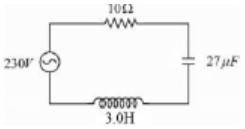
- In the circuit shown in the figure, the ratio of the quality factor and the band width is \(.............\) s.
 JEE Mains 2023 Medium
 - Consider a binary star system of star \(A\) and star \(B\) with masses \(m_{A}\) and \(m_{B}\) revolving in a circular orbit of radii \(r_{A}\) and \(r_{B}\), respectively. If \(T_{A}\) and \(T_{B}\) are the time period of star \(A\) and star \(B\), respectively, then -JEE Mains 2021 Medium
- If a semiconductor photodiode can detect a photon with a maximum wavelength of \(400\, nm ,\) then its band gap energy is Planck's constant \(h=6.63 \times 10^{-34}\, J . s\) Speed of ligh \(c =3 \times 10^{8}\, m / s\)JEE Mains 2020 Easy
- Given below are two statements :
Statement I : In a vernier callipers, one vernier scale division is always smaller than one main scale division.
Statement II : The vernier constant is given by one main scale division multiplied by the number of vernier scale divisions.
In the light of the above statements, choose the correct answer from the options given below.JEE Mains 2025 Easy - An object of mass \(0.2 \mathrm{~kg}\) executes simple harmonic motion along \(\mathrm{x}\) axis with frequency of \(\left(\frac{25}{\pi}\right) \mathrm{Hz}\). At the position \(\mathrm{x}=0.04 \mathrm{~m}\) the object has kinetic energy \(0.5 \mathrm{~J}\) and potential energy \(0.4 \mathrm{~J}\) The amplitude of oscillation is _______ cm.JEE Mains 2024 Hard
More PYQs from JEE Mains
- Two objects are projected with same velocity ' \(u\) ' however at different angles \(\alpha\) and \(\beta\) with the horizontal. If \(\alpha+\beta=90^{\circ}\), the ratio of horizontal range of the first object to the \(2^{\text {nd }}\) object will be :JEE Mains 2023 Medium
- The escape velocity from a spherical planet A is 10 km/s. The escape velocity from another planet B whose density and radius are 10% of those of planet A, is __________ m/s.JEE Mains 2026 Medium
- Let \( \bar x , M\) and \(\sigma^2\) be respectively the mean, mode and variance of \(n\) observations \(x_1 , x_2,...,x_n\) and \(d_i\, = - x_i - a, i\, = 1, 2, .... , n\), where \(a\) is any number.
Statement \(I\): Variance of \(d_1, d_2,.....d_n\) is \(\sigma^2\).
Statement \(II\) : Mean and mode of \(d_1 , d_2, .... d_n\) are \(-\bar x -a\) and \(- M - a\), respectivelyJEE Mains 2014 Hard - Which of the following pair of nuclei are isobars of the element?JEE Mains 2026 Easy
- The area of the region \(A\,\{ \,(x,y)\,\,:\,\,0\,\, \le \,y\, \le \,x\,\left| x \right|\, + \,1\) and \( - \,1\, \le \,x\, \le \,1\,\} \) in sq. units, isJEE Mains 2019 Hard
- The relationship between the magnetic susceptibility \((\chi)\) and the magnetic permeability \((\mu)\) is given by :
(\(\mu_0\) is the permeability of free space and \(\mu_{\mathrm{r}}\) is relative permeability)JEE Mains 2025 Easy