


JEE Mains · Physics · STD 11 - 14. waves and sound
The amplitude and phase of a wave that is formed by the superposition of two harmonic travelling waves, \(\mathrm{y}_1(\mathrm{x}, \mathrm{t})=4 \sin (\mathrm{kx}-\omega \mathrm{t})\) and \(\mathrm{y}_2(\mathrm{x}, \mathrm{t})=2 \sin \left(\mathrm{kx}-\omega \mathrm{t}+\frac{2 \pi}{3}\right)\), are \(:\)
(Take the angular frequency of initial waves same as \(\omega\))
- A \(\left[6, \frac{2 \pi}{3}\right]\)
- B \(\left[6, \frac{\pi}{3}\right]\)
- C \(\left[\sqrt{3}, \frac{\pi}{6}\right]\)
- D \(\left[2 \sqrt{3}, \frac{\pi}{6}\right]\)
Answer & Solution
Correct Answer
(D) \(\left[2 \sqrt{3}, \frac{\pi}{6}\right]\)
Step-by-step Solution
Detailed explanation
\begin{aligned} & \begin{array}{l}\mathrm{A}=\sqrt{2^2+4^2+2 \times 2 \times 4 \times \cos 120^{\circ}} \\ \quad=\sqrt{12}=2 \sqrt{3} \\ \tan \phi=\frac{2 \sin 120^{\circ}}{4+2 \cos 120^{\circ}}=\frac{\sqrt{3}}{3}=\frac{1}{\sqrt{3}} \\ \phi=\frac{\pi}{6}\end{array}\end{aligned}
See the Complete Solution
Get step-by-step explanations for this and 2.5 Lakh+ more JEE, NEET & CET questions.
- Unlock all solutions
- Practice the full chapter
- Track accuracy across PYQs
4.8 rated on Google Play · 14,000+ reviews
More questions from Physics
- Two identical electric point dipoles have dipole moments \(\overrightarrow{p}_{1}= p\hat i\) and \(\overrightarrow{p}_{2}=- p\hat i\) and are held on the \(x-\)axis at distance \('a'\) from each other. When released, they move along the \(x-\)axis with the direction of their dipole moments remaining unchanged. If the mass of each dipole is \('m',\) their speed when they arc infinitely far apart isJEE Mains 2020 Medium
- In a spring gun having spring constant \(100\, {N} / {m}\) a small ball \('B'\) of mass \(100\, {g}\) is put in its barrel (as shown in figure) by compressing the spring through \(0.05\, {m}\). There should be a box placed at a distance \('d'\) on the ground so that the ball falls in it. If the ball leaves the gun horizontally at a height of \(2\, {m}\) above the ground. The value of \(d\) is \(....{m} .\) \(\left(g=10\, {m} / {s}^{2}\right)\)
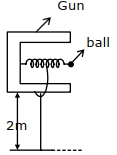 JEE Mains 2021 Hard
 - A heat engine is involved with exchange of heat of \(1915\, J,\) \(-40\, J ,+125\, J\) and \(-Q\,J\), during one cycle achieving an efficiency of \(50.0 \%\). The value of \(Q\) is.......\(J\)JEE Mains 2020 Medium
- The equivalent capacitance of the combination shown is
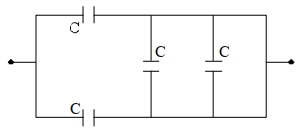 JEE Mains 2023 Medium
 - If electronic charge \(e\), electron mass \(m\), speed of light in vacuum \(c\) and Planck 's constant \(h\) are taken as fundamental quantities, the permeability of vacuum \(\mu _0\) can be expressed in units ofJEE Mains 2015 Hard
- An electric field \(\vec E\, = (25 \hat i + 30 \hat j)\,NC^{-1}\) exists in a region of space. If the potential at the origin is taken to be zero then the potential at \(x\, = 2\, m, y\, = 2\, m\) is......\(volt\)JEE Mains 2015 Medium
More PYQs from JEE Mains
- A dipole with two electric charges of \(2 \mu \mathrm{C}\) magnitude each, with separation distance \(0.5 \mu \mathrm{~m}\), is placed between the plates of a capacitor such that its axis is parallel to an electric field established between the plates when a potential difference of 5 V is applied. Separation between the plates is 0.5 mm. If the dipole is rotated by \(30^{\circ}\) from the axis, it tends to realign in the direction due to a torque. The value of torque is :JEE Mains 2025 Medium
- If one were to apply Bohr model to a particle of mass \('m'\) and charge \('q'\) moving in a plane under the influence of a magnetic field \('B',\) the energy of the charged particle in the \(n^{th}\) level will beJEE Mains 2015 Hard
- A square loop of side \(2\, a ,\) and carrying current I, is kept in \(XZ\) plane with its centre at origin. A long wire carrying the same current \(I\) is placed parallel to the \(z-\)axis and passing through the point \((0, b, 0),(b>>a)\). The magnitude of the torque on the loop about \(z-\)axis is given by:JEE Mains 2020 Hard
- A \(2 \,{kg}\) steel rod of length \(0.6\, {m}\) is clamped on a table vertically at its lower end and is free to rotate in vertical plane. The upper end is pushed so that the rod falls under gravity, Ignoring the friction due to clamping at its lower end, the speed of the free end of rod when it passes through its lowest position is \(\ldots \ldots \ldots \ldots \,{ms}^{-1}\). (Take \(g = 10\, {ms}^{-2}\) )JEE Mains 2021 Hard
- A multiple choice examination has \(5\) questions. Each question has three alternative answers of which exactly one is correct. The probability that a student will get \(4\) or more correct answers just by guessing is :JEE Mains 2013 Medium
- Let \(\mathrm{A}(x, y, z)\) be a point in \(x y\)-plane, which is equidistant from three points \((0,3,2),(2,0,3)\) and ( \(0,0,1\) ).
Let \(\mathrm{B}=(1,4,-1)\) and \(\mathrm{C}=(2,0,-2)\). Then among the statements
(S1) : \(\triangle \mathrm{ABC}\) is an isosceles right angled triangle, and
(S2) : the area of \(\triangle \mathrm{ABC}\) is \(\frac{9 \sqrt{2}}{2}\),JEE Mains 2025 Hard