


JEE Mains · Physics · STD 12 - Dual nature of radiation and matter
- JEE Mains 2025
- Hard
- Numerical
An electron is released from rest near an infinite non-conducting sheet of uniform charge density ' \(-\sigma\) '. The rate of change of de-Broglie wave length associated with the electron varies inversely as \(\mathrm{n}^{\text {th }}\) power of time. The numerical value of \(n\) is ________.
Pick an option to check your answer.
Answer & Solution
Correct Answer
(A) 2
Step-by-step Solution
Detailed explanation
Let the momentum of \(\mathrm{e}^{-}\)at any time t is p and its de-broglie wavelength is \(\lambda\).
Then, \(\mathrm{p}=\frac{\mathrm{h}}{\lambda}\)
\(\begin{aligned}
& \frac{\mathrm{dp}}{\mathrm{dt}}=\frac{-\mathrm{h}}{\lambda^2} \frac{\mathrm{~d} \lambda}{\mathrm{dt}} \\
& \mathrm{ma}=\mathrm{F}=-\frac{\mathrm{h}}{\lambda} \frac{\mathrm{~d} \lambda}{\mathrm{dt}} \quad[\mathrm{~m}=\text { mass of } \mathrm{e}]
\end{aligned}\)
Where, -ve sign represents decrease in \(\lambda\) with time
\(\mathrm{ma}=\frac{-\mathrm{h}}{(\mathrm{~h} / \mathrm{p})^2} \frac{\mathrm{~d} \lambda}{\mathrm{dt}}\)
\(\begin{aligned}
& \mathrm{a}=-\frac{\mathrm{p}^2}{\mathrm{mh}} \frac{\mathrm{~d} \lambda}{\mathrm{dt}} \\
& \mathrm{a}=-\frac{\mathrm{mv}^2}{\mathrm{~h}} \frac{\mathrm{~d} \lambda}{\mathrm{dt}} \\
& \frac{\mathrm{~d} \lambda}{\mathrm{dt}}=-\frac{\mathrm{ah}}{\mathrm{mv}^2}...(1)
\end{aligned}\)
here, \(\mathrm{a}=\frac{\mathrm{qE}}{\mathrm{m}}=\frac{\mathrm{e}}{\mathrm{m}} \frac{\sigma}{2 \varepsilon_0}\)
\(\mathrm{a}=\frac{\sigma \mathrm{e}}{2 \mathrm{~m} \varepsilon_0}\)
and \(\mathrm{v}=\mathrm{u}+\mathrm{at}\)
\(\mathrm{v}=\mathrm{at}\)
Substituting values of a \& v in equation (1)
\(\begin{aligned}
& \frac{\mathrm{d} \lambda}{\mathrm{dt}}=-\frac{2 \mathrm{~h} \varepsilon_0}{\sigma \mathrm{et}^2} \\
& \Rightarrow \frac{\mathrm{~d} \lambda}{\mathrm{dt}} \propto \frac{1}{\mathrm{t}^2} \\
& \Rightarrow \mathrm{n}=2
\end{aligned}\)
More questions from Physics
- Find the truth table for the function \(Y\) and \(A\) and \(B\) represented in the following figure.
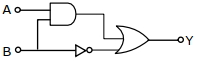 JEE Mains 2021 Medium
- A galvanometer having coil resistance \(10 \ \Omega\) shows a full scale deflection for a current of \(3 \mathrm{~mA}\). For it to measure a current of \(8 \mathrm{~A}\), the value of the shunt should be:JEE Mains 2024 Hard
- Statement \(I :\)Two forces \((\overrightarrow{{P}}+\overrightarrow{{Q}})\) and \((\overrightarrow{{P}}-\overrightarrow{{Q}})\) where \(\overrightarrow{{P}} \perp \overrightarrow{{Q}}\), when act at an angle \(\theta_{1}\) to each other, the magnitude of their resultant is \(\sqrt{3\left({P}^{2}+{Q}^{2}\right)}\), when they act at an angle \(\theta_{2}\), the magnitude of their resultant becomes \(\sqrt{2\left({P}^{2}+{Q}^{2}\right)}\). This is possible only when \(\theta_{1}<\theta_{2}\). Statement \(II :\) In the situation given above. \(\theta_{1}=60^{\circ} \text { and } \theta_{2}=90^{\circ}\) In the light of the above statements, choose the most appropriate answer from the options given belowJEE Mains 2021 Hard
- A closed and an open organ pipe have same lengths. If the ratio of frequencies of their seventh overtones is \(\left(\frac{a-1}{a}\right)\) then the value of \(a\) is _______.JEE Mains 2024 Medium
- A thin rod of mass \(0.9\, kg\) and length \(1 \,m\) is suspended, at rest, from one end so that it can freely oscillate in the vertical plane. A particle of move \(0.1\, kg\) moving in a straight line with velocity \(80\,m / s\) hits the rod at its bottom most point and sticks to it (see figure). The angular speed (in \(rad/s\)) of the rod immediately after the collision will be
 JEE Mains 2020 Hard
- A particle performs simple harmonic motion with a period of \(2\) second. The time taken by the particle to cover a displacement equal to half of its amplitude from the mean position is \(\frac{1}{ a } s .\) The value of \('a'\) to the nearest integer is.........JEE Mains 2021 Medium
More PYQs from JEE Mains
- A ball is released from a height \(h\). If \(t_{1}\) and \(t_{2}\) be the time required to complete first half and second half of the distance respectively. Then, choose the correct relation between \(t_{1}\) and \(t_{2}\).JEE Mains 2022 Hard
- In a conductor, if the number of conduction electrons per unit volume is \(8.5 \times 10^{28}\, m^{-3}\) and mean free time is \(25\,fs\) (femto second), its approximate resistivity is \(\left( {{m_e} = 9.1 \times {{10}^{ - 31}}\,kg} \right)\)JEE Mains 2019 Medium
- A stone of mass \(20\, {g}\) is projected from a rubber catapult of length \(0.1\, {m}\) and area of cross section \(10^{-6} \,{m}^{2}\) stretched by an amount \(0.04\, {m}\). The velocity of the projected stone is \(....\,m\,/s.\) (Young's modulus of rubber \(=0.5 \times 10^{9}\, {N} / {m}^{2}\) )JEE Mains 2021 Hard
- Potential energy (V) versus distance (x) is given by the graph, Rank various regions as per the magnitudes of the force (F) acting on a particle from high to low.
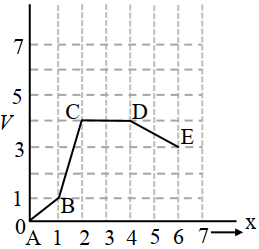 JEE Mains 2026 Hard
- When UV light of wavelength \(300 \mathrm{~nm}\) is incident on the metal surface having work function \(2.13 \mathrm{eV}\), electron emission takes place. The stopping potential is _______. (Given hc \(=1240 \mathrm{eV} \mathrm{nm}\) )JEE Mains 2024 Hard
- An object moves with speed \(v_1, v_2\), and \(v_3\) along a line segment \(A B, B C\) and \(C D\) respectively as shown in figure. Where \(AB = BC\) and \(AD =3 AB\), then average speed of the object will be :
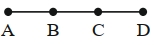 JEE Mains 2023 Medium