


JEE Mains · Physics · STD 12 - 11. Dual nature of radiation and matter
An electron with mass ' \(m\) ' with an initial velocity \((\mathrm{t}=0) \overrightarrow{\mathrm{v}}=\mathrm{v}_0 \hat{\mathrm{i}} \quad\left(\mathrm{v}_0 \gt 0\right)\) enters a magnetic field \(\vec{B}=B_0 \hat{j}\). If the initial de-Broglie wavelength at \(\mathrm{t}=0\) is \(\lambda_0\) then its value after time ' t ' would be :
- A \(\frac{\lambda_0}{\sqrt{1-\frac{\mathrm{e}^2 \mathrm{~B}_0^2 \mathrm{t}^2}{\mathrm{~m}^2}}}\)
- B \(\frac{\lambda_0}{\sqrt{1+\frac{\mathrm{e}^2 \mathrm{~B}_0^2 \mathrm{t}^2}{\mathrm{~m}^2}}}\)
- C \(\lambda_0 \sqrt{1+\frac{\mathrm{e}^2 \mathrm{~B}_0^2 \mathrm{t}^2}{\mathrm{~m}^2}}\)
- D \(\lambda_0\)
Answer & Solution
Correct Answer
(D) \(\lambda_0\)
Step-by-step Solution
Detailed explanation
Magnetic field does not work \(\therefore\) Speed will not charge, so De-Broglie wavelength remains same.
See the Complete Solution
Get step-by-step explanations for this and 2.5 Lakh+ more JEE, NEET & CET questions.
- Unlock all solutions
- Practice the full chapter
- Track accuracy across PYQs
4.8 rated on Google Play · 14,000+ reviews
More questions from Physics
- In an alpha particle scattering experiment distance of closest approach for the \(\alpha\) particle is \(4.5 \times 10^{-14} \mathrm{~m}\). If target nucleus has atomic number \(80\) , then maximum velocity of \(\alpha\)-particle is _______ \(\times 10^5\) \(\mathrm{m} / \mathrm{s}\) approximately. \(\left(\frac{1}{4 \pi \epsilon_0}=9 \times 10^9 \mathrm{SI}\right.\) unit, mass of \(\alpha\) particle \(=\) \(\left.6.72 \times 10^{-27} \mathrm{~kg}\right)\)JEE Mains 2024 Hard
- An electric field of \(1000\,V/m\) is applied to an electric dipole at angle of \(45^o\). The value of electric dipole moment is \(10^{-29}\, C.m.\) What is the potential energy of the electric dipole?JEE Mains 2019 Medium
- Let \(K_{1}\) and \(K_{2}\) be the maximum kinetic energies of photo-electrons emitted when two monochromatic beams of wavelength \(\lambda_{1}\) and \(\lambda_{2}\), respectively are incident on a metallic surface. If \(\lambda_{1}=3 \lambda_{2}\) thenJEE Mains 2022 Medium
- Seven identical circular planar disks, each of mass \(M\) and radius \(R\) are welded symmetrically as shown. The moment of inertia of the arrangement about the axis normal to the plane and passing through the point \(P\) is:
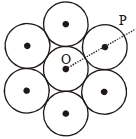 JEE Mains 2018 Hard
 - A transmitting station releases waves of wavelength \(960\, m\). A capacitor of \(2.56\, \mu F\) is used in the resonant circuit. The self inductance of coil necessary for resonance is ............. \(-\times 10^{-8} H\)JEE Mains 2021 Medium
- 10 kg of ice at \(-10^{\circ}C\) is added to 100 kg of water to lower its temperature from \(25^{\circ}C.\) Consider no heat exchange to surroundings. The decrement to the temperature of water is ___________ \(^{\circ}C.\)
(specific heat of ice \(= 2100\ J/Kg.^{\circ}C\), specific heat of water \(= 4200\ J/Kg.^{\circ}C\), latent heat of fusion of ice \(= 3.36 \times 10^{5}\ J/Kg\))JEE Mains 2026 Hard
More PYQs from JEE Mains
- Let \(\mathrm{a}>0\) be a root of the equation \(2 \mathrm{x}^2+\mathrm{x}-2=0\). If \(\lim _{x \rightarrow \frac{1}{a}} \frac{16\left(1-\cos \left(2+x-2 x^2\right)\right)}{\left(1-a x^2\right)}=\alpha+\beta \sqrt{17}\), where \(\alpha, \beta \in Z\) then \(\alpha+\beta\) is equal to ...........JEE Mains 2024 Hard
- If \(\mathrm{a}_{\mathrm{r}}=\cos \frac{2 \mathrm{r} \pi}{9}+i \sin \frac{2 \mathrm{r} \pi}{9}, \mathrm{r}=1,2,3, \ldots, i=\sqrt{-1}\) then the determinant \(\left|\begin{array}{lll}a_{1} & a_{2} & a_{3} \\ a_{4} & a_{5} & a_{6} \\ a_{7} & a_{8} & a_{9}\end{array}\right|\) is equal to :JEE Mains 2021 Medium
- The term independent of \(x\) in the expression of \(\left(1-x^{2}+3 x^{3}\right)\left(\frac{5}{2} x^{3}-\frac{1}{5 x^{2}}\right)^{11}, x \neq 0\) isJEE Mains 2022 Hard
- Let \(\mathrm{f}\) be any continuous function on \([0,2]\) and twice differentiable on \((0,2)\). If \(\mathrm{f}(0)=0, \mathrm{f}(1)=1\) and \(f(2)=2\), thenJEE Mains 2021 Hard
- For \(x > 0,\) if \(f(x)=\int_{1}^{x} \frac{\log _{e} t}{(1+t)} d t,\) then \(f(e)+f\left(\frac{1}{e}\right)\) is equal to ...... .JEE Mains 2021 Hard
- The circumcentre of a triangle lies at the origin and its centroid is the mid point of the line segment joining the points \((a^2 + 1 , a^2 + 1 )\) and \((2a, - 2a)\), \(a \ne 0\). Then for any \(a\) , the orthocentre of this triangle lies on the lineJEE Mains 2014 Hard