


JEE Mains · Physics · STD 11 - Waves and sound
- JEE Mains 2020
- Easy
- MCQ
For a transverse wave travelling along a straight line, the distance between two peaks (crests) is \(5 \,m ,\) while the distance between one crest and one trough is \(1.5 \,m\) The possible wavelengths (in \(m\) ) of the waves are
Pick an option to check your answer.
Answer & Solution
Correct Answer
(D) \(\frac{1}{1}, \frac{1}{3}, \frac{1}{5}, \ldots\)
Step-by-step Solution
Detailed explanation
Given \(T\) to \(C\,\, 1.5 m\)
\(C\) to \(C\, 5 m\)
\(T\) to \(C =\left(2 n _{1}+1\right) \frac{\lambda}{2}\)
\(C\) to \(C = n _{2} \lambda\)
\(\frac{1.5}{5}=\frac{\left(2 n _{1}+1\right)}{2 n _{2}} \Rightarrow 3 n _{2}=10 n _{1}+5\)
\(n _{1}=1, n _{2}=5 \rightarrow \lambda=1\)
\(n _{1}=4, n _{2}=15 \rightarrow \lambda=1 / 3\)
\(n _{1}=7, n _{2}=25 \rightarrow \lambda=1 / 5\)
More questions from Physics
- A thin bar of length \(L\) has a mass per unit length \(\lambda \), that increases linearly with distance from one end. If its total mass is \(M\) and its mass per unit length at the lighter end is \(\lambda_0\), then the distance of the centre of mass from the lighter end isJEE Mains 2014 Hard
- A body takes \(4\, {min}\). to cool from \(61^{\circ} {C}\) to \(59^{\circ} {C}\). If the temperature of the surroundings is \(30^{\circ} {C}\), the time taken by the body to cool from \(51^{\circ} {C}\) to \(49^{\circ} {C}\) is \(....\,min\)JEE Mains 2021 Medium
- Initially a gas of diatomic molecules is contained in a cylinder of volume \(V _{1}\) at a pressure \(P_{1}\) and temperature \(250\, K\). Assuming that \(25 \%\) of the molecules get dissociated causing a change in number of moles. The pressure of the resulting gas at temperature \(2000\, K ,\) when contained in a volume \(2 V _{1}\) is given by \(P _{2}\). The ratio \(\frac{P _{2}}{ P _{1}}\) is.JEE Mains 2020 Medium
- In a coil of resistance \(100\ \Omega\) , a current is induced by changing the magnetic flux through it as shown in the figure. The magnitude of change in flux through the coil is......\(Wb\)
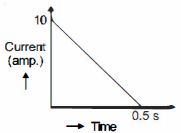 JEE Mains 2017 Medium
- Given below are two statements: one is labelled as Assertion \(A\) and the other is labelled as Reason \(R\) Assertion \(A\) : A spherical body of radius \((5 \pm 0.1)\) \(mm\) having a particular density is falling through a liquid of constant density. The percentage error in the calculation of its terminal velocity is \(4\,\%\). Reason \(R\) : The terminal velocity of the spherical body falling through the liquid is inversely proportional to its radius. In the light of the above statements, choose the correct answer from the options given below on :JEE Mains 2023 Medium
- Seawater at a frequency \(f =9 \times 10^{2} \,Hz ,\) has permittivity \(\varepsilon=80\, \varepsilon_{0}\) and resistivity \(\rho=0.25\, \Omega m.\) Imagine a parallel plate capacitor is immersed in seawater and is driven by an alternating voltage source \(V ( t )= V _{0} \sin (2 \pi ft ) .\) Then the conduction current density becomes \(10^{x}\) times the displacement current density after time \(t =\frac{1}{800} \,s\). The value of \(x\) is ......... .
\(\left(\frac{1}{4 \pi \varepsilon_{0}}=9 \times 10^{9} Nm ^{2} C ^{-2}\right)\)JEE Mains 2021 Hard
More PYQs from JEE Mains
- A thermometer graduated according to a linear scale reads a value \(x_0\) when in contact with boiling water, and \(x_0/3\) when in contact with ice. What is the temperature of an object in \({}^oC\), if this thermometer in the contact with the object reads \(x_0/2\) ?JEE Mains 2019 Hard
- Match List-I with List-II.
Choose the correct answer from the options given below :List-I (Relation) List-II (Law) A. \(\oint \overrightarrow{ E } \cdot \overrightarrow{ d } l =-\frac{ d }{ dt } \oint \overrightarrow{ B } \cdot \overrightarrow{ d a}\) I. Ampere's circuital law. B. \(\oint\) B. \(\vec{d} l=\mu_0\left(1+\epsilon_0 \frac{d \phi_E}{d t}\right)\) II. Faraday's laws of electromagnetic induction. C. \(\oint \overrightarrow{ E } . \overrightarrow{ d a}=\frac{1}{\epsilon_0} \int \rho dv\) III. Ampere-Maxwell law D. \(\oint \overrightarrow{ B } \cdot \overrightarrow{ d } l =\mu_0 I\) IV. Gauss's law of electrostatics JEE Mains 2026 Easy - In a collinear collision, a particle with an initial speed \(v_0\) strikes a stationary particle of the same mass. If the final total kinetic energy is \(50\%\) greater than the original kinetic energy, the magnitude of the relative velocity between the two particles, after collision, is:JEE Mains 2018 Medium