


JEE Mains · Physics · STD 11 - Waves and sound
- JEE Mains 2020
- Medium
- MCQ
Three harmonic waves having equal frequency \(\mathrm{v}\) and same intensity \(\mathrm{I}_{0}\), have phase angles \(0 , \frac{\pi}{4}\) and \(-\frac{\pi}{4}\) respectively. When they are superimposed the intensity of the resultant wave is close to
Pick an option to check your answer.
Answer & Solution
Correct Answer
(A) \(5.8 \mathrm{I}_{0}\)
Step-by-step Solution
Detailed explanation
Let amplitude of each wave is \(A.\)
Resultant wave equation
\(=A \sin \omega t+A \sin \left(\omega t-\frac{\pi}{4}\right)+A \sin \left(\omega t+\frac{\pi}{4}\right)\)
\(=\mathrm{A} \sin \omega \mathrm{t}+\sqrt{2} \mathrm{A} \sin \omega \mathrm{t}\)
\(=(\sqrt{2}+1) \mathrm{A} \sin \omega \mathrm{t}\)
Resultant wave amplitude \(=(\sqrt{2}+1) \mathrm{A}\)
as \(I \propto A ^{2}\)
so \(\frac{\mathrm{I}}{\mathrm{I}_{0}}=(\sqrt{2}+1)^{2}\)
\(I=5.8 \mathrm{I}_{0}\)
More questions from Physics
- A block of mass 5 kg is moving on an inclined plane which makes an angle of \(30^{\circ}\) with the horizontal. Friction coefficient between the block and inclined plane surface is \(\frac{\sqrt{3}}{2}\). The force to be applied on the block so that the block will move down without acceleration is ___________ N.JEE Mains 2026 Medium
- A heavy ball of mass \(M\) is suspended from the ceiling of car by a light string of mass \(m (m << M)\). When the car is at rest, the speed of transverse waves in the string is \(60\, ms^{-1}\). When the car has acceleration \(a\) , the wave-speed increases to \(60.5\, ms^{-1}\). The value of \(a\) , in terms of gravitational acceleration \(g\) is closest toJEE Mains 2019 Hard
- A particle starts moving from time \(t=0\) and its coordinate is given as \(x(t)=4t^{3}-3t.\)
A. The particle returns to its original position (origin) 0.866 units later
B. The particle is 1 unit away from origin at its turning point.
C. Acceleration of the particle is non-negative.
D. The particle is 0.5 units away from origin at its turning point.
E. Particle never turns back as acceleration is non-negative.
Choose the correct answer from the options given below :JEE Mains 2026 Hard - A block of mass \(2\,kg\) moving on a horizontal surface with speed of \(4\,ms ^{-1}\) enters a rough surface ranging from \(x =0.5\,m\) to \(x =1.5\,m\). The retarding force in this range of rough surface is related to distance by \(F =- kx\) where \(k =12\,Nm ^{-1}\). The speed of the block as it just crosses the rough surface will be ........... \(\,ms ^{-1}\)JEE Mains 2022 Hard
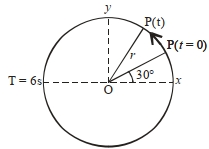
- For particle \(P\) revolving round the centre \(O\) with radius of circular path \(r\) and angular velocity \(\omega\), as shown in below figure, the projection of \(OP\) on the \(x\)-axis at time \(t\) is \(.................\).
 JEE Mains 2023 Easy
- In a Young’s double slit experiment with slit separation \(0.1\, mm\), one observes a bright fringe at angle \(\frac{1}{{40}}\, rad\) by using light of wavelength \({\lambda _1}\). When the light of wavelength \(\lambda _2\) is used a bright fringe is seen at the same angle in the same set up. Given that \({\lambda _1}\) and \({\lambda _2}\) are in visible range (\(380\, nm\) to \(740\, nm\)), their values areJEE Mains 2019 Medium
More PYQs from JEE Mains
- \(27\) similar drops of mercury are maintained at \(10 \,V\) each. All these spherical drops combine into a single big drop. The potential energy of the bigger drop is ....... times that of a smaller drop.JEE Mains 2021 Hard
- The current density in a cylindrical wire of radius \(4 \; mm\) is \(4 \times 10^{6} \; Am ^{-2}\). The current through the outer portion of the wire between radial distance \(\frac{R}{2}\) and \(R\) is \(\dots \; \pi A .\)JEE Mains 2022 Medium