


- JEE Mains 2020
- Hard
- MCQ
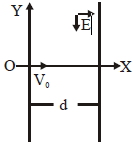
A charged particle (mass \(m\) and charge \(q\) ) moves along \(X\) axis with velocity \(V _{0}\). When it passes through the origin it enters a region having uniform electric field \(\overrightarrow{ E }=- E \hat{ j }\) which extends upto \(x = d\). Equation of path of electron in the region \(x > d\) is
Answer & Solution
(A) \(y=\frac{q E d}{m V_{0}^{2}}\left(\frac{d}{2}-x\right)\)
Step-by-step Solution
Detailed explanation
Solve for \((q,m)\) mathematically
\(F _{ x }=0, a _{ x }=0,( v )_{ x }=\) constant
time taken to reach at \(P ^{\prime}=\frac{ d }{ V _{0}}= t _{0}( let )\)\(\ldots(1)\)
(Along \(-y), y_{0}=0+\frac{1}{2} \cdot \frac{q E}{m} \cdot t_{0}^{2}....(2)\)
\(v_{x}=v_{0}\)
\(v=u+a t\) (along -ve \('y'\))
speed \(v _{ y 0}=\frac{ q E }{ m } \cdot t _{0}\)
\(\tan \theta=\frac{ v _{ y }}{ v _{ x }}=\frac{ qEt _{0}}{ m \cdot v _{ o }},\left( t _{ o }=\frac{ d }{ v _{ o }}\right)\)
\(\tan \theta=\frac{q Ed }{ m \cdot v _{0}^{2}}\)
\(\operatorname{slope}=\frac{-q \operatorname{Ed}}{m v_{0}^{2}}\)
Now we have to find eq \(^{n}\) of straight line whose slope is \(\frac{-q Ed }{ mv _{0}^{2}}\) and it pass through
point \(\rightarrow\left( d ,- y _{0}\right)\)
Because after \(x > d\)
No electric field \(\Rightarrow F _{\text {net }}=0, \overrightarrow{ v }=\) const.
\(y=m x+c,\left\{\begin{array}{l}m=\frac{q E d}{m v_{0}^{2}} \\ \left(d,-y_{0}\right)\end{array}\right\}\)
\(-y_{0}=\frac{-q E d}{m v_{0}^{2}} \cdot d+c \Rightarrow c=-y_{0}+\frac{q E d^{2}}{m v_{0}^{2}}\)
Put the value
\(y=\frac{-q E d}{m v_{0}^{2}} x-y_{0}+\frac{q E d^{2}}{m v_{0}^{2}}\)
\(y _{0}=\frac{1}{2} \cdot \frac{ qE }{ m }\left(\frac{ d }{ v _{0}}\right)^{2}=\frac{1}{2} \frac{ q Ed ^{2}}{ mv _{0}^{2}}\)
\(y =\frac{- qEdx }{ mv _{0}^{2}}-\frac{1}{2} \frac{ qEd ^{2}}{ mv _{0}^{2}}+\frac{ qEd ^{2}}{ mv _{0}^{2}}\)
\(y=\frac{-q E d}{m v_{0}^{2}} x+\frac{1}{2} \frac{q E d^{2}}{m v_{0}^{2}}\)
\(y=\frac{q E d}{m v_{0}^{2}}\left(\frac{d}{2}-x\right)\)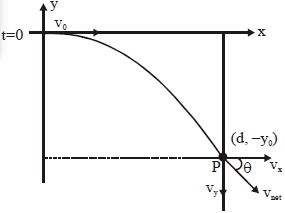
More questions from Physics
- A solid sphere and a hollow sphere of the same mass and of same radius are rolled on an inclined plane. Let the time taken to reach the bottom by the solid sphere and the hollow sphere be \(t_1\) and \(t_2\), respectively, then...JEE Mains 2025 Easy
- A cylindrical tube AB of length \(l\), closed at both ends contains an ideal gas of 1 mol having molecular weight M. The tube is rotated in a horizontal plane with constant angular velocity \( \omega \) about an axis perpendicular to AB and passing through the edge at end A. If \( P_{A} \) and \( P_{B} \) are the pressures at A and B respectively, then (Consider the temperature is same at all points in the tube)
 JEE Mains 2026 Hard
- Diameter of a plano-convex lens is \(6 \,cm\) and thickness at the centre is \(3\, mm\). If the speed of light in the material of the lens is \(2 \times 10^8 m/sec\), the focal length of the lens is.......\(cm\)JEE Mains 2021 Hard
- Two massless springs with spring constants \(2\,k\) and \(9\,k\), carry \(50\, g\) and \(100 \,g\) masses at their free ends. These two masses oscillate vertically such that their maximum velocities are equal. Then, the ratio of their respective amplitudes will beJEE Mains 2022 Easy
- The de-Broglie wavelength associated with a particle of mass \(m\) and energy \(E\) is \(\mathrm{h} / \sqrt{2 m E}\) The dimensional formula for Planck's constant is _______.JEE Mains 2024 Hard
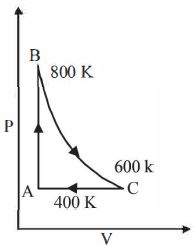
- One mole of a diatomic ideal gas undergoes a cyclic process \(ABC\) as shown in figure. The process \(BC\) is adiabatic. The temperatures at \(A, B\) and \(C\) are \(400\ K, 800\ K \) and \(600\ K\) respectively. Choose the correct statement
 JEE Mains 2014 Easy
More PYQs from JEE Mains
- Concentric metallic hollow spheres of radii \(R\) and \(4 R\) hold charges \(Q _{1}\) and \(Q _{2}\) respectively. Given that surface charge densities of the concentric spheres are equal, the potential difference \(V ( R )- V (4 R )\) isJEE Mains 2020 Medium
- Sun light falls normally on a surface of area \(36\,cm ^{2}\) and exerts an average force of \(7.2 \times 10^{-9}\,N\) within a time period of \(20\) minutes. Considering a case of complete absorption, the energy flux of incident light is.JEE Mains 2022 Medium