


JEE Mains · Physics · STD 11 - 13. oscillations
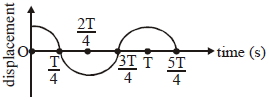
The displacement time graph of a particle executing \(S.H.M.\) is given in figure: (sketch is schematic and not to scale) Which of the following statements is are true for this motion? \((A)\) The force is zero \(t=\frac{3 T}{4}\) \((B)\) The acceleration is maximum at \(t=T\) \((C)\) The speed is maximum at \(t =\frac{ T }{4}\) \((D)\) The \(P.E.\) is equal to \(K.E.\) of the oscillation at \(t=\frac{T}{2}\)
- A \(( A ),( B )\) and \(( D )\)
- B \(( B ),( C )\) and \(( D )\)
- C \((A)\) and \((D)\)
- D \(( A ),( B )\) and \(( C )\)
Answer & Solution
Correct Answer
(D) \(( A ),( B )\) and \(( C )\)
Step-by-step Solution
Detailed explanation
Sol. \((A)\) \(F =\) ma \(\quad a =-\omega^{2} x\) at \(\frac{3 T }{4}\) displacement zero \(( x =0),\) so \(a =0\) \(F=0\) \((B)\) at \(t=T \quad\) displacement \((x)=A\) \(x\) maximum, So acceleration is maximum. \((C)\) \(V =\omega \sqrt{ A ^{2}- x ^{2}}\) \(V _{\max }\) at…
See the Complete Solution
Get step-by-step explanations for this and 2.5 Lakh+ more JEE, NEET & CET questions.
- Unlock all solutions
- Practice the full chapter
- Track accuracy across PYQs
4.8 rated on Google Play · 14,000+ reviews
More questions from Physics
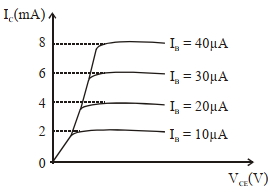
- The typical output characteristics curve for a transistor working in the common-emitter configuration is shown in the figure. The estimated current gain from the figure is
 JEE Mains 2021 Medium
 - A uniformly charged solid sphere of radius \(R\) has potential \(V_0\) (measured with respect to \(\infty\)) on its surface. For this sphere the equipotential surfaces with potentials \(\frac{{3{V_0}}}{2},\;\frac{{5{V_0}}}{4},\;\frac{{3{V_0}}}{4}\) and \(\frac{{{V_0}}}{4}\) have rasius \(R_1,R_2,R_3\) and \(R_4\) respectively. ThenJEE Mains 2015 Medium
- One mole of an ideal gas passes through a process where pressure and volume obey the relation \(P\, = {P_0}\,\left[ {1 - \frac{1}{2}{{\left( {\frac{{{V_0}}}{V}} \right)}^2}} \right]\). Here \(P_0\) and \(V_0\) are constants. Calculate the change in the temperature of the gas if its volume change from \(V_0\) to \(2V_0\)JEE Mains 2019 Hard
- Match the LIST-I with LIST-II:
Choose the correct answer from the options given below:List-I List-II A. Spring constant I. \(ML ^2 T^{-2} K^{-1}\) B. Thermal conductivity II. \(ML ^0 T^{-2}\) C. Boltzmann constant III. \(ML ^2 T^{-3} A^{-2}\) D. Inductive reactance IV. \(MLT ^{-3} K^{-1}\) JEE Mains 2026 Easy - A square loop of side \(2\, a ,\) and carrying current I, is kept in \(XZ\) plane with its centre at origin. A long wire carrying the same current \(I\) is placed parallel to the \(z-\)axis and passing through the point \((0, b, 0),(b>>a)\). The magnitude of the torque on the loop about \(z-\)axis is given by:JEE Mains 2020 Hard
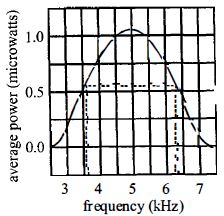
- The plot given below is of the average power delivered to an \(LRC\) circuit versus frequency. The quality factor of the circuit is
 JEE Mains 2013 Medium
More PYQs from JEE Mains
- The initial pressure and volume of an ideal gas are \(P_0\) and \(V_0\). The final pressure of the gas when the gas is suddenly compressed to volume \(\frac{ V _0}{4}\) will be (Given \(\gamma=\) ratio of specific heats at constant pressure and at constant volume)JEE Mains 2023 Medium
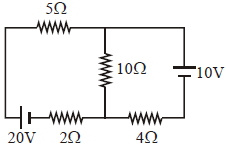
- In the figure shown, the current in the \(10\, V\) battery is close to
 JEE Mains 2020 Medium
 - Let the function \(f(x)=\frac{x}{3}+\frac{3}{x}+3, x \neq 0\) be strictly increasing in \(\left(-\infty, \alpha_1\right) \mathrm{U}\left(\alpha_2, \infty\right)\) and strictly decreasing in \(\left(\alpha_3, \alpha_4\right) \mathrm{U}\left(\alpha_4, \alpha_5\right)\). Then \(\sum_{\mathrm{i}=1}^5 \alpha_{\mathrm{i}}^2\) is equal to :-JEE Mains 2025 Easy
- A body of mass \(M\) and charge \(q\) is connected to a spring of spring constant \(k\). It is oscillating along \(x-\) direction about its equilibrium position, taken to be at \(x = 0\), with an amplitude \(A\). An electric field \(E\) is applied along the \(x-\) direction. Which of the following statements is correct?JEE Mains 2018 Hard
- A solid sphere of mass \(M\) and radius \(R\) is divided into two unequal parts. The first part has a mass of \(\frac {7M}{8}\) and is converted into a uniform disc of radius \(2R.\) The second part is converted into a uniform solid sphere. Let \(I_1\) be the moment of inertia of the disc about its axis and \(I_2\) be the moment of inertia of the new sphere about its axis. The ratio of \(I_1/I_2\) is given byJEE Mains 2019 Hard
- Using a battery, a 100 pF capacitor is charged to 60 V and then the battery is removed. After that, a second uncharged capacitor is connected to the first capacitor in parallel. If the final voltage across the second capacitor is 20 V, its capacitance is : (in pF)JEE Mains 2025 Medium