


JEE Mains · Physics · STD 12 - 1. Electric charges and fields
An electric dipole of moment \(\overrightarrow{\mathrm{p}}=(-\hat{\mathrm{i}}-3 \hat{\mathrm{j}}+2 \hat{\mathrm{k}}) \times 10^{-29}\; \mathrm{C} \cdot \mathrm{m}\) is at the origin \((0,0,0) .\) The electric field due to this dipole at \(\overrightarrow{\mathrm{r}}=+\hat{\mathrm{i}}+3 \hat{\mathrm{j}}+5 \hat{\mathrm{k}}\) (note that \(\overrightarrow{\mathrm{r}} \cdot \overrightarrow{\mathrm{p}}=0)\) is parallel to
- A \((-\hat{i}+3 \hat{j}-2 \hat{k})\)
- B \((+\hat{i}-3 \hat{j}-2 \hat{k})\)
- C \((+\hat{i}+3 \hat{j}-2 \hat{k})\)
- D \((-\hat{i}-3 \hat{j}+2 \hat{k})\)
Answer & Solution
Correct Answer
(C) \((+\hat{i}+3 \hat{j}-2 \hat{k})\)
Step-by-step Solution
Detailed explanation
since \(\overrightarrow{\mathrm{r}}\) and \(\overrightarrow{\mathrm{p}}\) are perpendicular to each other therefore point lies on the equitorial plane. Therefore electric field at the point will be antiparallel to the dipole moment. i.e.…
See the Complete Solution
Get step-by-step explanations for this and 2.5 Lakh+ more JEE, NEET & CET questions.
- Unlock all solutions
- Practice the full chapter
- Track accuracy across PYQs
4.8 rated on Google Play · 14,000+ reviews
More questions from Physics
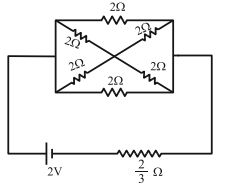
- In the following circuit, the battery has an emf of \(2\mathrm{V}\) and an internal resistance of \(\frac{2}{3}\ \Omega\). The power consumption in the entire circuit is _______ \(W\).
 JEE Mains 2024 Hard
 - A galvanometer has a resistance of \(50 \Omega\) and allows a maximum current of \(5 \mathrm{~mA}\) to pass. What is the necessary series resistance to connect to convert it to a voltmeter that can measure \(100 \mathrm{~V}\)?JEE Mains 2024 Hard
- A toy-car, blowing its horn, is moving with a steady speed of \(5\, m/s\) , away from a wall. An observer, towards whom the toy car is moving, is able to hear \(5\, beats\) per second. If the velocity of sound in air is \(340\, m/s\), the frequency of the horn of the toy car is close to ... \(Hz\)JEE Mains 2016 Medium
- A pendulum of length \(2 \; m\) consists of a wooden bob of mass \(50 \; g\). A bullet of mass \(75 \; g\) is fired towards the stationary bob with a speed \(v\). The bullet emerges out of the bob with a speed \(\frac{v}{3}\) and the bob just completes the vertical circle. The value of \(v\) is \(\dots \; ms ^{-1}\). (if \(g =10 \; m / s ^{2}\) )JEE Mains 2022 Hard
- A radioactive sample has an average life of \(30\, {ms}\) and is decaying. A capacitor of capacitance \(200\, \mu\, {F}\) is first charged and later connected with resistor \(^{\prime}{R}^{\prime}\). If the ratio of charge on capacitor to the activity of radioactive sample is fixed with respect to time then the value of \(^{\prime}R^{\prime}\) should be \(....\,\Omega\)JEE Mains 2021 Hard
- Given below are two statements: \(Statement\) \(I\) : If a capillary tube is immersed first in cold water and then in hot water, the height of capillary rise will be smaller in hot water. \(Statement\) \(II\) : If a capillary tube is immersed first in cold water and then in hot water, the height of capillary rise will be smaller in cold water. In the light of the above statements, choose the most appropriate from the options given belowJEE Mains 2024 Hard
More PYQs from JEE Mains
- Which of the following phenomena can not be explained by wave theory of light ?JEE Mains 2025 Medium
- The distance of the point \((1,-5, 9)\) from the plane \(x - y + z = 5\) measured along the line \(x = y = z\) isJEE Mains 2016 Hard
- If the equation, \(x^{2}+b x+45=0(b \in R)\) has conjugate complex roots and they satisfy \(|z+1|=2 \sqrt{10},\) thenJEE Mains 2020 Hard
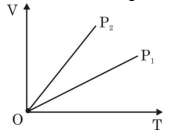
- The given figure represents two isobaric processes for the same mass of an ideal gas, then ....
 JEE Mains 2024 Hard
 - A series \(LR\) circuit connected with an ac source \(E=(25 \sin 1000 t)\ V\) has a power factor of \(\frac{1}{\sqrt{2}}\). If the source of emf is changed to \(E=(20 \sin 2000 t)\ V,\) the new power factor of the circuit will be _______.JEE Mains 2024 Hard
- Let \(A=\left[a_{i j}\right], a_{i j} \in Z \cap[0,4], 1 \leq i, j \leq 2\). The number of matrices \(A\) such that the sum of all entries is a prime number \(p \in(2,13)\) is \(........\).JEE Mains 2023 Hard