


enEnglishguગુજરાતી
JEE Mains · Physics · STD 11 - 13. oscillations
A simple pendulum of length \(1\, m\) is oscillating with an angular frequency \(10\, rad/s\). The support of the pendulum starts oscillating up and down with a small angular frequency of \(1\, rad/s\) and an amplitude of \(10^{-2}\, m\). The relative change in the angular frequency of the pendulum is best given by
- A \(10^{-3} rad/s\)
- B \(1\,rad/s\)
- C \(10^{-1} rad/s\)
- D \(10^{-5} rad/s\)
Answer & Solution
Correct Answer
(A) \(10^{-3} rad/s\)
Step-by-step Solution
Detailed explanation
Angular frequency of pendulum \(\omega \propto \sqrt{\frac{g_{e f f}}{\ell}}\) \(\therefore \quad \frac{\Delta \omega}{\omega}=\frac{1}{2} \frac{\Delta g_{e f f}}{g_{e f f}}\) \(\Delta \omega=\frac{1}{2} \frac{\Delta g}{g} \times \omega\) \([ \omega_{s}=\) angular frequency of…
See the Complete Solution
Get step-by-step explanations for this and 2.5 Lakh+ more JEE, NEET & CET questions.
- Unlock all solutions
- Practice the full chapter
- Track accuracy across PYQs
4.8 rated on Google Play · 14,000+ reviews
More questions from Physics
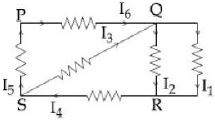
- In the given circuit diagram, the currents, \({I_1} = - \,0.3\,A,\,{I_4} = 0.8\,A\) and \({I_5} = 0.4\,A,\) are flowing as shown. The currents \(I_2,\,I_3\) and \(I_6,\) respectively are
 JEE Mains 2019 Medium
 - A parallel plate capacitor with area \(200\,cm^2\) and separation between the plates \(1.5\,cm\), is connected across a battery of \(emf\) \(V\). If the force of attraction between the plates is \(25\times10^{-6}\,N\), the value of \(V\) is approximately........\(V\) \(\left( {{\varepsilon _0} = 8.85 \times {{10}^{ - 12}}\,\frac{{{C^2}}}{{N{m^2}}}} \right)\)JEE Mains 2018 Hard
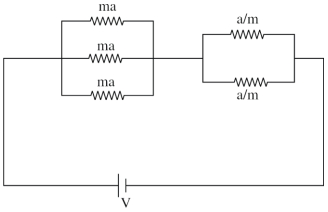
- In the given circuit ' \(a\) ' is an arbitrary constant. The value of \(m\) for which the equivalent circuit resistance is minimum, will be \(\sqrt{\frac{ x }{2}}\). The value of \(x\) is ...........
 JEE Mains 2022 Hard
 - Given below are two statements: Statement \(I\) : In hydrogen atom, the frequency of radiation emitted when an electron jumps from lower energy orbit \(\left( E _{1}\right)\) to higher energy orbit \(\left( E _{2}\right)\), is given as \(hf = E _{1}- E _{2}\). Statement \(II\) : The jumping of electron from higher energy orbit \(\left(E_{2}\right)\) to lower energy orbit \(\left(E_{1}\right)\) is associated with frequency of radiation given as \(f\) \(=\left( E _{2}- E _{1}\right) / h\) This condition is Bohr's frequency condition. In the light of the above statements, choose the correct answer from the options given belowJEE Mains 2022 Medium
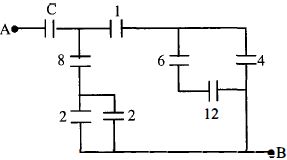
- Figure shows a network of capacitors where the numbers indicates capacitances in micro Farad. The value of capacitance \(C\) if the equivalent capacitance between point \(A\) and \(B\) is to be \(1\,\mu F\) is
 JEE Mains 2016 Hard
 - A Carnot engine operates between two reservoirs of temperatures \(900\; \mathrm{K}\) and \(300 \;\mathrm{K}\) The engine performs \(1200\; \mathrm{J}\) of work per cycle. The heat energy (in \(\mathrm{J}\) ) delivered by the engine to the low temperature reservoir, in a cycle. isJEE Mains 2020 Medium
More PYQs from JEE Mains
- The value of \(\frac{e^{-\frac{\pi}{4}}+\int \limits_0^{\frac{\pi}{4}} e^{-x} \tan ^{50} x d x}{\int \limits_0^{\frac{\pi}{4}} e^{-x}\left(\tan ^{49} x+\tan ^{51} x\right) d x}\) isJEE Mains 2023 Hard
- Consider two ideal diatomic gases \(\mathrm{A}\) and \(\mathrm{B}\) at some temperature \(T\). Molecules of the gas \(A\) are rigid, and have a mass \(m\). Molecules of the gas \(\mathrm{B}\) have an additional vibrational mode, and have a mass \(\frac{\mathrm{m}}{4} .\) The ratio of the specific heats \((\mathrm{C}_{\mathrm{v}}^{\mathrm{A}}\) and \(\mathrm{C}_{\mathrm{v}}^{\mathrm{B}})\) of gas \(\mathrm{A}\) and \(\mathrm{B}\), respectively isJEE Mains 2020 Medium
- Light from a point source in air falls on a convex curved surface of radius \(20 \mathrm{~cm}\) and refractive index \(1.5.\) If the source is located at \(100 \mathrm{~cm}\) from the convex surface, the image will be formed at _______ \(\mathrm{cm}\) from the object.JEE Mains 2024 Hard
- Let \(A=\{-4,-3,-2,0,1,3,4\}\) and \(R =\{( a , b ) \in A\) \(\times A : b =| a |\) or \(\left.b ^2= a +1\right\}\) be a relation on \(A\). Then the minimum number of elements, that must be added to the relation \(R\) so that it becomes reflexive and symmetric, is \(........\).JEE Mains 2023 Medium
- Let \(s _1, s _2, s _3, \ldots \ldots, s _{10}\) respectively be the sum to 12 terms of 10 A.P.s whose first terms are \(1,2,3, \ldots, 10\) and the common differences are \(1,3,5, \ldots, 19\) respectively. Then \(\sum \limits_{i=1}^{10} s _{ i }\) is equal toJEE Mains 2023 Hard
- If the sum and product of the first three term in an \(A.P\). are \(33\) and \(1155\), respectively, then a value of its \(11^{th}\) tern isJEE Mains 2019 Hard