


Questions
4 questionsShowing 1–4 of 4 questions
-
- (A) carbanion
- (B) carbene
- (C) carbocation
- (D) free radical
Show answer and solution
Correct Answer: (C)
\(\begin{matrix}
Cl-CH-C{{H}_{3}} \\
|\,\,\,\,\,\,\,\,\, \\
\underset{(-)\,\,\,\,\,\,\,\,\,\,\,\,\,\,}{\mathop{Ph\,\,\,\,\,\,\,}}\, \\
\end{matrix}\xrightarrow[Toluene]{SbC{{l}_{5}}}\underset{\begin{smallmatrix}
(Carbocation) \\
(planar)
\end{smallmatrix}}{\mathop{Ph-\overset{\oplus }{\mathop{C}}\,H-C{{H}_{3}}}}\,+SbCl_{6}^{-}\) \(\to \underset{\begin{smallmatrix}
(d\,and\,l)\,mixture \\
+SbC{{l}_{5}}
\end{smallmatrix}}{\mathop{\begin{matrix}
Ph-CH-C{{H}_{3}} \\
\,|\,\,\,\,\,\,\,\,\, \\
Cl\,\,\,\,\,\,\,\,\, \\
\end{matrix}}}\,\) - 2. Arrange in the correct order of stability (decreasing order) for the following molecules
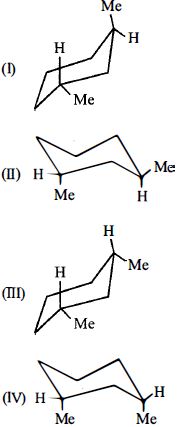 2013 Hard
- (A) \((I) > (II) > (III) >(IV)\)
- (B) \((IV) > (III) > (II) \approx (I)\)
- (C) \((I) > (II) \approx (III) > (IV)\)
- (D) \((III) > (I) \approx (II) > (IV)\)
Show answer and solution
Correct Answer: (C)
Disequatorial cis \(-1,\,3-\) Dimethylcyclohexane is more stable as both methyl groups are equatorial and are away from each other. (Refer to Image \(I\))It is followed by trans \(-1,\,3-\) Dimethylcyclohexane where one \(-C H_{3}\) group is equatorial and other is axial (Refer to Image \(II\))
Diaxial cis \(-1,\,3-\) Dimethylcyclohexane is less stable due to large amount of steric strain due to the interaction of axial - \(\mathrm{CH}_{3}\) groups. (Refer to Image \(III\) )
\((I) > (II) \approx (III) > (IV)\)
- 3. In the above compounds correct order of reactivity in electrophilic substitution reactions will be
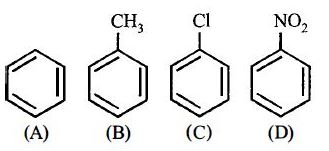 2013 Hard
- (A) \(B >A> C > D\)
- (B) \(D > C > B > A\)
- (C) \(A > B > C > D\)
- (D) \(B > C > A > D\)
Show answer and solution
Correct Answer: (A)
\(- Cl\) and \(-CH_3\) groups are \(o\) and \(p\) directing. They are electron releasing due to \(+ E\) and \(+ M\) effects. Further since such groups increase electron density in the nucleus, they facilitate further electrophilic substitution and hence known as activating group. The activating effect of these groups is in order of \(- CH_3 > -X\) but chlorine exceptionally deactive the ring due to strong \(- I\) effect. Hence, it is difticult to carry out substitution in chlorobenzene than in benzene . Further \(- NO_2\) is a deactivating group hence deactivates the benzene nucleus, i.e. hinder the further substitution. Thus nitrobenzene undergo electrophilic substitution with a great difficulty hence the correct order will be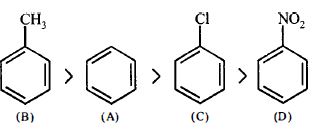
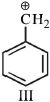
-
- (A) \(III > II > I\)
- (B) \(I > II > III\)
- (C) \(II > III > I\)
- (D) \(III > I > II\)
Show answer and solution
Correct Answer: (D)
Stability due to resonance - More the no of resonating structure more is the stability.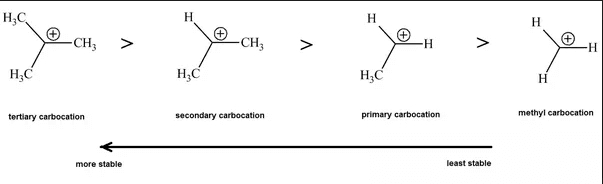
No questions on this page match these filters.