


Questions
11 questionsShowing 1–11 of 11 questions
-
- (A) \(61\)
- (B) \(38\)
- (C) \(35.5\)
- (D) \(41.5\)
Show answer and solution
Correct Answer: (D)
Given \(e = 1.60 \times 10^{-19}\,C\)\(d = 9.17 \times 10^{-11}\,m\)
From \(\mu = e \times d\)
\(\mu = 1.60 \times 10^{-19} \times 9.17 \times 10^{-11}\)
\(= 14.672 \times 10^{-30}\)
\(\%\) ionic character \( = \frac{{Observed\,dipole\,moment}}{{Dipole\,moment\,for\,100\% \,ionic\,bond}}\)
\( = \frac{{6.104 \times {{10}^{ - 30}}}}{{14.672 \times {{10}^{ - 30}}}} \times 100\)
\( = 41.5\% \)
-
- (A) \({H_2} > {B_2} > L{i_2}\)
- (B) \(L{i_2} > {H_2} > {B_2}\)
- (C) \(L{i_2} > {B_2} > {H_2}\)
- (D) None of these
Show answer and solution
Correct Answer: (D)
None of the given option is correct.The molecular orbital configuration of the given molecules is
\(H_2 = \sigma 1s^2\) (no electron anti-bonding)
\(L{i_2} = \sigma 1{s^2}\,{\sigma ^*}1{s^2}\,\sigma 2{s^2}\,\) (two anti - bonding electrons)
\({B_2} = \sigma 1{s^2}\,{\sigma ^*}1{s^2}\,\sigma 2{s^2}\,{\sigma ^*}2{s^2}\)
\(\left\{ {\pi 2p_y^1 = \pi 2p_z^1} \right\}\)
(\(4\) anti-bonding electrons)
Though the bond order of all the specie are same \((B.O=1)\) but stability is different.
This is due to difference in the presence of no. of anti-bonding electron.
Higher the no. of anti-bonding electron lower is the stability hence the correct order is
\(H_2 > Li_2 >B_2\)
- 3. In which of the following pairs of molecules/ions, both the species are not likely to exist? 2013 Medium
- (A) \(H_{2}^+, He_2^{2-}\)
- (B) \(H_{2}^-, He_2^{2-}\)
- (C) \(H_{2}^{+2}, He_2\)
- (D) \(H_{2}^-, He_2^{2+}\)
Show answer and solution
Correct Answer: (C)
Species having zero or negative bond order do not exist.\(\mathrm{H}_{2}^{2+}(1+1-2=0)=\sigma 1 \mathrm{s}^{0}\)
Bond order \(=0\)
\(\mathrm{He}_{2}(2+2=4)=\sigma 1 \mathrm{s}^{2},{ }^{\star} \mathrm{fs}^{2}\)
Bond order \(=\frac{N_{0}-N_{a}}{2}=\frac{2-2}{2}=0\)
\(\mathrm{So}, \mathrm{both} \mathrm{H}_{2}^{2+}\) and \(\mathrm{He}_{2}\) do not exist.
-
- (A) \(CO_2, NO_2, ClO_2, SiO_2\)
- (B) \(PCl_3,Al Cl_3, BCl_3, SbCl_3\)
- (C) \(BF_3, NF_3, PF_3,Al F_3\)
- (D) \(BF_4^- , CCl_4 , NH_4^+ , PCl_4^+\)
Show answer and solution
Correct Answer: (D)
All have tetrahedral structure -
- (A) \(Li_2 < Li_2^+ < Li_2^-\)
- (B) \(Li_2^- < Li_2^+ < Li_2\)
- (C) \(Li_2 < Li_2^- < Li_2^+\)
- (D) \(Li_2^- < Li_2 < Li_2^+\)
Show answer and solution
Correct Answer: (B)
Correct option(b) \(\mathrm{Li}_{2}-<\mathrm{Li}_{2}^{+}<\mathrm{Li}_{2}\)
Explanation:
\(\mathrm{Li}_{2}(3+3=6)=\sigma 1 \mathrm{s}^{2}, \quad \hat{\sigma} 1 \mathrm{s}^{2}, \sigma 2 \mathrm{s}^{2}\)
Bond order \(=\frac{N_{b}-N_{a}}{2}=\frac{4-2}{2}=1\)
\(\mathrm{Li}_{2}^{+}(3+3-1=5)=\sigma 1 \mathrm{s}^{2}, \dot{\sigma}^{2} 1 s^{2}, \cdot \sigma 2 s^{1}\)
Bond order \(=\frac{3-2}{2}=\frac{1}{2}=0.5\)
Bond order \(=\frac{4-3}{2}=\frac{1}{2}=0.5\)
Stability order is \(\mathrm{Li}_{2}>\mathrm{Li}_{2}^{+}>\mathrm{Li}_{2}^{-}\) (because Li \(_{2}^{-}\) have more number of electrons in antibonding orbitals which destabilises the species).
- 6. The internuclear distances in \(O -O\) bonds for \(O_2^+ ; O_2 , O_2^-\) and \(O_2^{2-}\) respectively are 2013 Medium
- (A) \(1.30\mathop {\,A}\limits^o ,1.49\,\mathop A\limits^o ,1.12\,\mathop A\limits^o ,1.21\,\mathop A\limits^o \)
- (B) \(1.49\mathop {\,A}\limits^o ,1.21\,\mathop A\limits^o ,1.12\,\mathop A\limits^o ,1.30\,\mathop A\limits^o \)
- (C) \(1.21\mathop {\,A}\limits^o ,1.12\,\mathop A\limits^o ,1.49\,\mathop A\limits^o ,1.30\,\mathop A\limits^o \)
- (D) \(1.12\mathop {\,A}\limits^o ,1.21\,\mathop A\limits^o ,1.30\,\mathop A\limits^o ,1.49\,\mathop A\limits^o \)
Show answer and solution
Correct Answer: (D)
The bond length follows the order\(O_2^+ < O_2 < O_2^- < O_2^{2-}\)
According to this the possible values are
\(1.12\mathop {\,A}\limits^o ,1.21\,\mathop A\limits^o ,1.30\,\mathop A\limits^o ,1.49\,\mathop A\limits^o \)
- 7. The structure of which of the following chloro species can be explained on the basis of \(dsp^2\) hybridization ? 2013 Hard
- (A) \(PdCl_4^{2 - }\)
- (B) \(FeCl_4^{2 - }\)
- (C) \(CoCl_4^{2 - }\)
- (D) \(NiCl_4^{2 - }\)
Show answer and solution
Correct Answer: (A)
\([PdCl_4]^{2-}\) is \(dsp^2\) hybridized and square planar in shape. -
- (A) \(ONCl\) and \(ONO^-\) are isoelectronic.
- (B) \(O_3\) molecule is bent
- (C) Ozone is violet-black in solid state
- (D) Ozone is diamagnetic gas.
Show answer and solution
Correct Answer: (A)
(a) Number of electrons in\(\begin{array}{l}\mathrm{ONCl}=3.2 \mathrm{e}^{-} \\\mathrm{ONO}^{-}=24 \mathrm{e}^{-}\end{array}\)
Thus, ONCl and ONO- are not isoelectronic.
(b) \(\mathrm{O}_{3}\) has bent shape structure. Central atom O is \(s p^{2}\) hybridised with 1 lone pair of electrons.
(c) Ozone is violet-black in solid state.
(d) \(O_{3}\) has no unpaired electrons, thus it is diamagnetic.
-
- (A) \(C_2\)
- (B) \(F_2\)
- (C) \(O_2\)
- (D) \(S_2\)
Show answer and solution
Correct Answer: (A)
The molecules expected to exhibit diamagnetic behavior are
A) \(C_2\) and B) \(F_2\).
A molecule is diamagnetic if all its electrons are paired and paramagnetic if it contains one or more unpaired electrons. Based on Molecular Orbital (MO) theory:
A) \(C_2\) (12 electrons): Configuration is \((\sigma 1 s)^2( \left.\sigma^* 1 s\right)^2(\sigma 2 s)^2\left(\sigma^* 2 s\right)^2\left(\pi 2 p_x\right)^2\left(\pi 2 p_y\right)^2\). All electrons are paired. (Diamagnetic)
B) \(F_2\) (18 electrons): Configuration is \(\sigma 1 s^2 \sigma^* 1 s^2 \sigma 2 s^2 \sigma^* 2 s^2 \sigma 2 p_z^2 \pi 2 p_x^2 \pi 2 p_y^2 \pi^* 2 p_x^2 \pi^* 2 p_y^2\). All electrons are paired. (Diamagnetic)
C) \(O _{ 2 }\) (16 electrons): Has two unpaired electrons in the \(\pi^* 2 p_x\) and \(\pi^* 2 p_y\) orbitals. (Paramagnetic)
D) \(S_2\) (32 electrons): Like \(O_2\), it has two unpaired electrons in its highest occupied molecular orbitals ( \(\pi^* 3 p\) ). (Paramagnetic) -
- (A) \(XeF_4\)
- (B) \(IF_5\)
- (C) \(SbF_5\)
- (D) \(CF_4\)
Show answer and solution
Correct Answer: (B)
The geometry of \(IF_5\) is square pyramidal with an unsymmetric charge distribution therefore this molecule is polar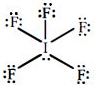
-
- (A) Two \(P\pi - d\pi \) bonds
- (B) One \(P\pi - d\pi \) bonds
- (C) Four \(P\pi - d\pi \) bonds
- (D) Three \(P\pi - d\pi \) bonds
Show answer and solution
Correct Answer: (C)
One \(s\) and three \(p\) orbital undergo \(s p^{3}\) hybridization. Four \(s p^{3}\) hybridorbitals form four \(\sigma\) bonds with oxygen atoms. They are \(\sigma s p^{3}-p .\) Four \(p \pi-d \pi\) bonds are also formed with oxygen atoms by the unpaired electrons.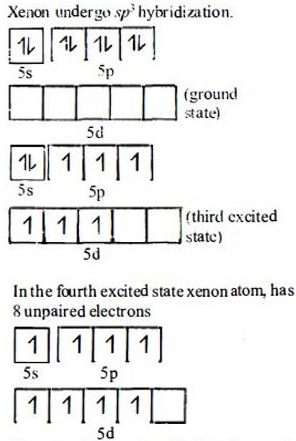
No questions on this page match these filters.