


JEE Mains · Chemistry · STD 12 - Amines
- JEE Mains 2013
- Hard
- MCQ
An organic compound \(A\) upon reacting with \(NH_3\) gives \(B.\) On heating \(B\) gives \(C.\) \(C\) in presence of \(KOH\) reacts with \(Br_2\) to given \(CH_3CH_2NH_2. A\) is :
Pick an option to check your answer.
Answer & Solution
Correct Answer
(D) \(CH_3CH_2COOH\)
Step-by-step Solution
Detailed explanation
\(\underset{(A)}{\mathop{\begin{matrix}
\,\,\,\,\,\,\,\,\,\,\,\,\,\,\,\,O \\
\,\,\,\,\,\,\,\,\,\,\,\,\,\,\,\,|| \\
C{{H}_{3}}C{{H}_{2}}-C-OH \\
\end{matrix}}}\,\) \(\xrightarrow{N{{H}_{3}}}\,\underset{(B)}{\mathop{C{{H}_{3}}C{{H}_{2}}COON{{H}_{4}}}}\,\xrightarrow{\Delta }\)
\,\,\,\,\,\,\,\,\,\,\,\,\,\,\,\,O \\
\,\,\,\,\,\,\,\,\,\,\,\,\,\,\,\,|| \\
C{{H}_{3}}C{{H}_{2}}-C-OH \\
\end{matrix}}}\,\) \(\xrightarrow{N{{H}_{3}}}\,\underset{(B)}{\mathop{C{{H}_{3}}C{{H}_{2}}COON{{H}_{4}}}}\,\xrightarrow{\Delta }\)
\(\underset{(C)}{\mathop{\begin{matrix}
\,\,\,\,\,\,\,\,\,\,\,\,\,\,\,\,\,\,\,\,O \\
\,\,\,\,\,\,\,\,\,\,\,\,\,\,\,\,\,\,\,\,|| \\
C{{H}_{3}}-C{{H}_{2}}-C-N{{H}_{2}} \\
\end{matrix}}}\,\) \(\xrightarrow[\begin{smallmatrix}
Hofmann's\,\,broamide \\
reaction
\end{smallmatrix}]{B{{r}_{2}}\,,\,KOH}\) \(C{{H}_{3}}-C{{H}_{2}}-N{{H}_{2}}\)
More questions from Chemistry
- The rate constant of a zero order reaction is \(2.0\times10^{-2}\, mol\, L^{-1}\, s^{-1}\) . If the concentration of the reactant after \(25\, seconds\) is \(0.5\, M\). ......... \(M\) is the initial concentration.JEE Mains 2013 Medium
- Among the following, the essential amino acid isJEE Mains 2017 Easy
- White Phosphorus on reaction with concentrated \(NaOH\) solution in an inert atmosphere of \(\mathrm{CO}_{2}\) gives phosphine and compound \((\mathrm{X}) .(\mathrm{X})\) on acidification with \(HCl\) gives compound \((Y)\). The basicity of compound \((Y)\) isJEE Mains 2020 Hard
- Given below are two statements: One is labelled as Assertion \(A\) and the other is labelled as Reason \(R\): Assertion \(A\): Alcohols react both as nucleophiles and electrophiles. Reason \(R\): Alcohols react with active metals such as sodium, potassium and aluminum to yield corresponding alkoxides and liberate hydrogen. In the light of the above statements, choose the correct answer from the options given below:JEE Mains 2024 Hard
- Iodine reacts with concentrated \(HNO_3\) to yield along with other products. The oxidation state of iodine in \(Y\) isJEE Mains 2019 Hard
- Which of the following happens when \(\mathrm{NH}_4 \mathrm{OH}\) is added gradually to the solution containing 1 M \(\mathrm{A}^{2+}\) and \(1 \mathrm{MB}^{3+}\) ions?
Given : \(\mathrm{K}_{\mathrm{sp}}\left[\mathrm{A}(\mathrm{OH})_2\right]=9 \times 10^{-10}\) and \(\mathrm{K}_{\mathrm{sp}}\left[\mathrm{B}(\mathrm{OH})_3\right]=27 \times 10^{-18}\) at 298 K .JEE Mains 2025 Medium
More PYQs from JEE Mains
- The correct order of metallic character is:JEE Mains 2023 Medium
- 0.1 M solution of KI reacts with excess of \(\mathrm{H}_2 \mathrm{SO}_4\) and \(\mathrm{KIO}_3\) solutions. According to equation
\(5 \mathrm{I}^{-}+\mathrm{IO}_3^{-}+6 \mathrm{H}^{+} \rightarrow 3 \mathrm{I}_2+3 \mathrm{H}_2 \mathrm{O}\)
Identify the correct statements :
(A) 200 mL of KI solution reacts with 0.004 mol of \(\mathrm{KIO}_3\)
(B) 200 mL of KI solution reacts with 0.006 mol of \(\mathrm{H}_2 \mathrm{SO}_4\)
(C) 0.5 L of KI solution produced 0.005 mol of \(\mathrm{I}_2\)
(D) Equivalent weight of \(\mathrm{KIO}_3\) is equal to ( \(\frac{\text { Molecular weight }}{5}\) )
Choose the correct answer from the options given below :JEE Mains 2025 Medium - The ratio of number of water molecules in Mohr's salt and potash alum is \(....\,\times 10^{-1}\)JEE Mains 2021 Hard
- The circuit shown below contains two ideal diodes, each with a forward resistance of \(50\,\Omega \). If the battery voltage is \(6\,V\), the current through the \(100\,\Omega \) resistance (in Amperes) is
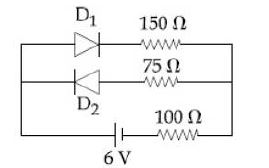 JEE Mains 2019 Medium
- Increasing order of electron withdrawing power of following functional groups is:
a. \(-CN\)
b. \(-COOH\)
c. \(-NO_2\)
d. \(-I\)JEE Mains 2026 Easy - \(A\). The drift velocity of electrons decreases with the increase in the temperature of conductor. \(B\). The drift velocity is inversely proportional to the area of cross-section of given conductor. \(C\). The drift velocity does not depend on the applied potential difference to the conductor. \(D\). The drift velocity of electron is inversely proportional to the length of the conductor. \(E\). The drift velocity increases with the increase in the temperature of conductor. Choose the correct answer from the options given below:JEE Mains 2022 Hard