


JEE Mains · Physics · STD 12 - 4. Moving charges and magnetism
A particle of charge \(q\) and mass \(m\) is projected from origin with an initial velocity \(\vec{v} = \left(\dfrac{v_0}{\sqrt{2}}\hat{x} + \dfrac{v_0}{\sqrt{2}}\hat{y}\right)\). There exists a uniform magnetic field \(\vec{B} = B_0 \hat{z}\) and a space varying electric field \(\vec{E} = E_0 e^{-\lambda x}\hat{x}\) within the region \(0 \leq x \leq L\). After travelling a distance such that \(x\)-coordinate has changed from \(x=0\) to \(x=L\), the change in the kinetic energy is _______.
- A \(\dfrac{qE_0}{\lambda}[1 - e^{-\lambda L}]\)
- B \(\left(\dfrac{v_0 q B_0}{2\lambda}\right)[2 - e^{-2\lambda L}]\)
- C \(\dfrac{qE_0}{\lambda}[1 + e^{-\lambda L}]\)
- D \(q\left(\dfrac{E_0 + v_0 B_0}{\lambda}\right)[1 - e^{-\lambda L/2}]\)
Answer & Solution
Correct Answer
(A) \(\dfrac{qE_0}{\lambda}[1 - e^{-\lambda L}]\)
Step-by-step Solution
Detailed explanation
According to the work-energy theorem, the change in kinetic energy of a particle is equal to the total work done by all the forces acting on it. The forces acting on the particle are the electric force and the magnetic force. The magnetic force is given by…
See the Complete Solution
Get step-by-step explanations for this and 2.5 Lakh+ more JEE, NEET & CET questions.
- Unlock all solutions
- Practice the full chapter
- Track accuracy across PYQs
4.8 rated on Google Play · 14,000+ reviews
More questions from Physics
- Let \(\sigma\) be the uniform surface charge density of two infinite thin plane sheets shown in figure. Then the electric fields in three different region \(E_{ I }, E_{ II }\) and \(E_{III}\) are
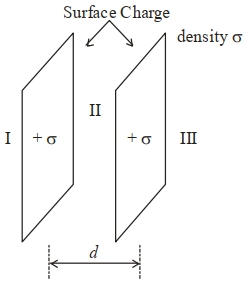 JEE Mains 2023 Medium
 - In the given circuit, the current \((I)\) through the battery will be \(..........\,A\)
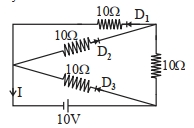 JEE Mains 2023 Medium
 - Match List - I with List - II.
List - I List - II (A) Magnetic induction (I) Ampere meter2 (B) Magnetic intensity (II) Weber (C) Magnetic flux (III) Gauss (D) Magnetic moment (IV) Ampere meter
Choose the correct answer from the options given below :JEE Mains 2025 Medium - In a Young's double slit experiment, the slits are separated by \(0.3\, {mm}\) and the screen is \(1.5\, {m}\) away from the plane of slits. Distance between fourth bright fringes on both sides of central bright is \(2.4\, {cm}\). The frequency of light used is \(..........\,\times 10^{14} {Hz}\)JEE Mains 2021 Hard
- A Carnot engine with efficiency \(50\,\%\) takes heat from a source at \(600\,K\). In order to increase the efficiency to \(70\,\%\), keeping the temperature of sink same, the new temperature of the source will be \(.........\,K\)JEE Mains 2023 Medium
- A green light is incident from the water to the air - water interface at the critical angle \((\theta)\). Select the correct statement .JEE Mains 2014 Easy
More PYQs from JEE Mains
- Let \(A\) be a \(3 \times 3\) matrix of non-negative real elements such that \(A\left[\begin{array}{l}1 \\ 1 \\ 1\end{array}\right]=3\left[\begin{array}{l}1 \\ 1 \\ 1\end{array}\right]\). Then the maximum value of \(\operatorname{det}(\mathrm{A})\) is ...........JEE Mains 2024 Hard
- Let \(a-2 b+c=1\) If \(f(x)=\left|\begin{array}{lll}{x+a} & {x+2} & {x+1} \\ {x+b} & {x+3} & {x+2} \\ {x+c} & {x+4} & {x+3}\end{array}\right|,\) thenJEE Mains 2020 Hard
- In a potentiometer arrangement, a cell gives a balancing point at \(75\, cm\) length of wire. This cell is now replaced by another cell of unknown emf. If the ratio of the emf's of two cells respectively is \(3: 2\), the difference in the balancing length of the potentiometer wire in above two cases will be.........\(cm .\)JEE Mains 2022 Medium
- Let \(p,q\in R.\) if \(2-\sqrt 3\) is a root of the quadratic equation, \(x^2 + px + q = 0,\) thenJEE Mains 2019 Hard
- When an external resistance of \(5\ \Omega\) is connected across terminals of a cell, a current of \(0.25\text{ A}\) flows through it. When the \(5\ \Omega\) resistor is replaced by a \(2\ \Omega\) resistor, a current of \(0.5\text{ A}\) flows through it. The internal resistance of the cell is _______ \(\Omega\).JEE Mains 2026 Easy
- An \(X-\)ray tube is operated at \(1.24\) million volt. The shortest wavelength of the produced photon will be ..... \(nm\)JEE Mains 2021 Medium